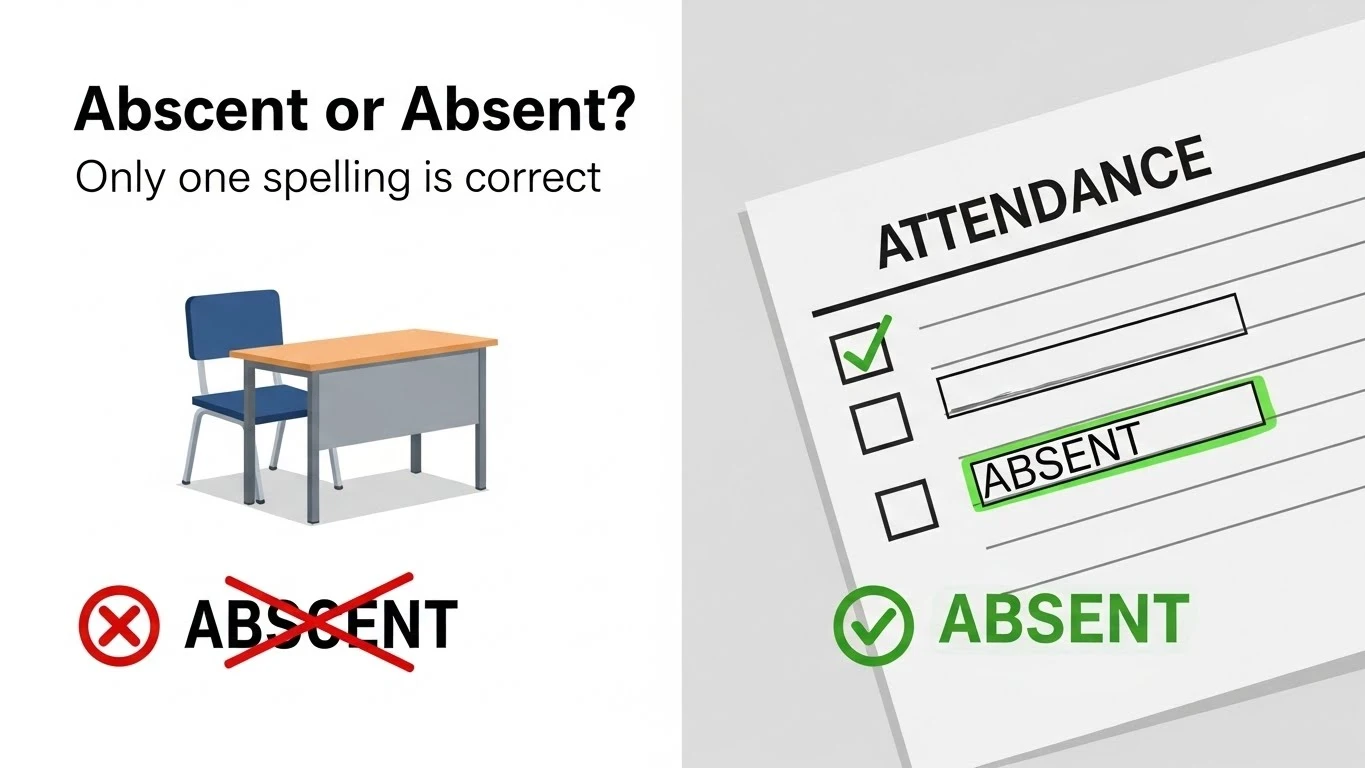
Absent is the correct spelling meaning ‘not present’; abscent is a spelling mistake and has no meaning in English
Many people search for “abscent or absent” because these two spellings look very similar, yet only one is correct in standard English. This confusion is extremely common in school attendance records, exams, office emails, applications, and formal reports.
A small spelling mistake in such a common word can make writing look careless or unprofessional.You may have seen sentences like “He was abscent from school today” or “She remained abscent during the meeting” and wondered whether abscent is an alternative spelling.
This article clears the confusion clearly and completely. You’ll get a quick answer, learn the word’s origin, understand why the mistake happens, see correct usage in everyday and professional contexts, and get clear advice on which spelling to use. By the end, you’ll confidently know why absent is correct and abscent is not.
Abscent or Absent : Quick Answer
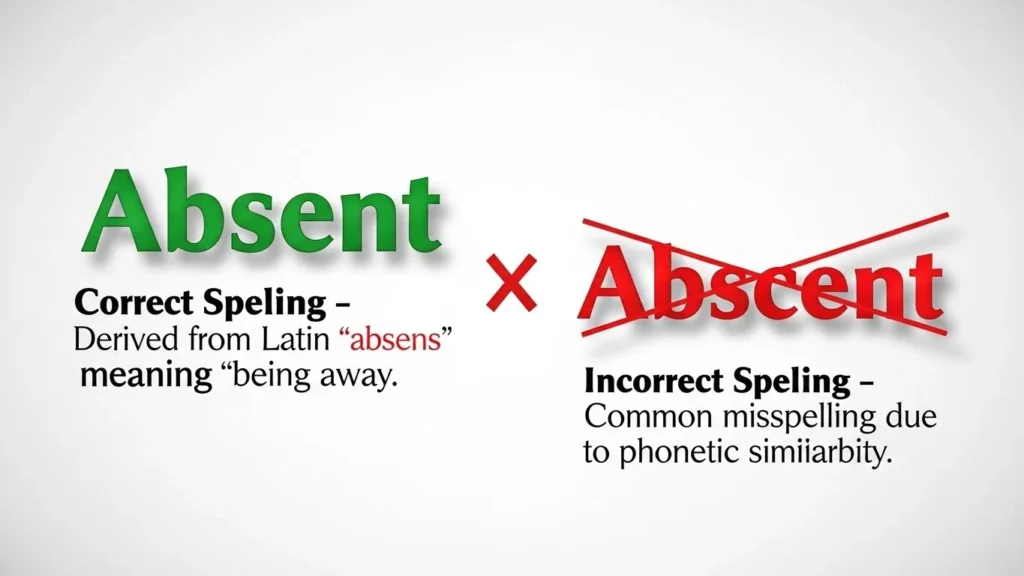
Absent is the correct spelling.
Abscent is incorrect in standard English.
Absent means not present or not attending.
Examples:
- ✅ He was absent from class today.
- ❌ He was abscent from class today.
- ✅ She is absent due to illness.
Discover More:Prepair or Prepare: Which Spelling Is Correct and Why It Matters
The Origin of Abscent or Absent
The word absent comes from the Latin word absentem, meaning being away. It entered English through French and has been used for centuries to describe someone who is not present at a place or event.
The structure of the word is simple:
- ab- = away
- sent = being
Together, absent means being away.
Abscent has no historical or linguistic origin in English. It appears because:
- The pronunciation can sound like “abs-sent”
- Learners insert an extra c by mistake
- Influence of spelling patterns from other words
Despite how common the mistake is, abscent has never been correct.
British English vs American English Spelling
This is not a British vs American spelling issue.
Both English varieties use:
- Absent → correct
- Abscent → incorrect
Comparison Table
| English Variety | Correct Spelling | Incorrect Spelling |
| American English | Absent | Abscent |
| British English | Absent | Abscent |
| Australian English | Absent | Abscent |
| Global English | Absent | Abscent |
There is no regional spelling difference.
Which Spelling Should You Use?
The rule is the same for all audiences.
- School and exams: Absent
- Office emails: Absent
- Legal or formal writing: Absent
- Casual writing: Absent
There is no context where abscent is acceptable.
If the sentence means not present, always use absent.
Common Mistakes with Abscent or Absent
These errors are very common:
- ❌ She was abscent yesterday.
✅ She was absent yesterday. - ❌ He remained abscent from duty.
✅ He remained absent from duty. - ❌ Many students were marked abscent.
✅ Many students were marked absent.
Helpful tip:
If you can replace the word with “not present”, then absent is correct.
Abscent or Absent in Everyday Examples
Emails
- “I will be absent from work tomorrow.”
News
- “Several members were absent during the vote.”
Social Media
- “Sorry I’ve been absent lately!”
Formal Writing
- “Attendance will be recorded for all absent students.”
School Context
- “He was absent due to fever.”
Abscent or Absent : Google Trends & Usage Data
Search trends show that “abscent or absent” is frequently searched in:
- South Asia
- Middle East
- ESL-learning regions
The confusion appears mostly in:
- School attendance writing
- Exam answers
- Office communication
Absent is widely used in textbooks, legal documents, news reports, and official records. Abscent appears almost entirely in spelling mistakes and learner searches. Search interest increases during exam seasons and school terms, showing strong user intent to avoid errors.
Comparison Table: Abscent vs Absent
| Word | Meaning | Correct Usage |
| Absent | Not present | ✅ Correct |
| Abscent | No meaning in standard English | ❌ Incorrect |
FAQs: Abscent or Absent
1. Is “abscent” ever correct?
No. It is not a recognized English spelling.
2. Is absent a noun or adjective?
It can be both, but it is most commonly an adjective.
3. Is absent spelled the same in British and American English?
Yes. The spelling is identical.
4. Why do people write abscent?
Because of pronunciation habits and spelling guesses.
5. What is the opposite of absent?
Present.
6. Can absent be used as a verb?
Yes. Example: “He absented himself from the meeting.”
7. Is absent formal or informal?
It is suitable for both.
Conclusion
The confusion between abscent or absent is very common, but the rule is simple. Absent is the only correct spelling in modern English. It is used across American, British, and global English to describe someone who is not present.
Abscent is a spelling mistake with no accepted meaning. Using it in exams, attendance records, emails, or professional writing can make your work look careless and reduce clarity. Since this word is frequently used in formal contexts, spelling it correctly is especially important.
To avoid mistakes, remember this rule:
If the meaning is not present, the correct word is always absent.
Mastering small spelling differences like this improves accuracy, confidence, and professionalism in your English writing.

I am Lynne Truss, a British writer and journalist who is best known for my work on English grammar. I have always been interested in language and punctuation, especially how small mistakes can change meaning. Through my books, I try to make grammar easy, interesting, and enjoyable for readers.