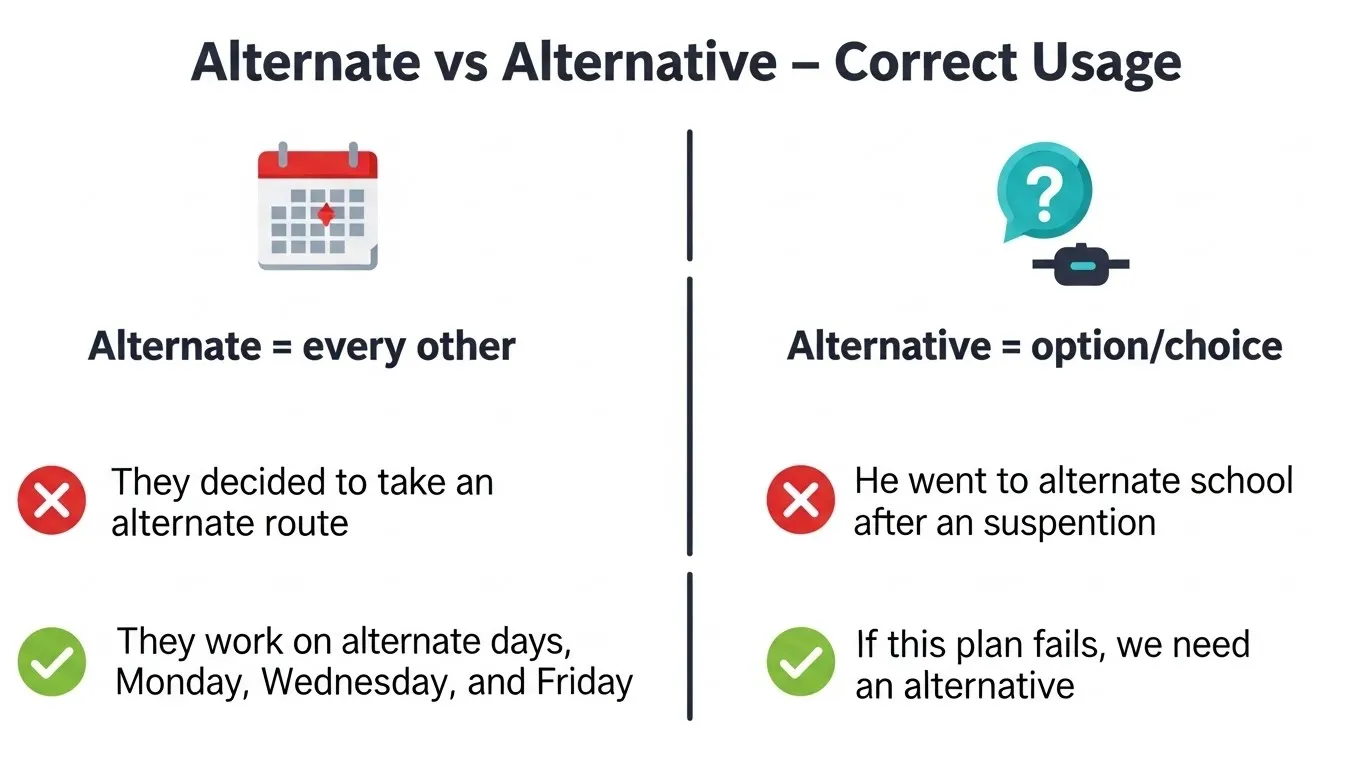
Alternate is used for things that happen every other time or take turns, while alternative means another option or choice
I remember pausing while writing and wondering whether alternate or alternative was the right choice. That moment helped me understand why so many people search for alternate or alternative online. I’d heard phrases like alternate plan and alternative route used interchangeably, which made the confusion worse.
Later, I realized that although alternate or alternative share the same root, English uses them differently depending on grammar and context. Using the wrong one can change meaning or sound unnatural in exams or professional writing.
In this article, I clear the confusion with simple explanations, real examples, and clear guidance so you can choose confidently every time.
Alternate or Alternative : Quick Answer
- Alternate → means every other, to take turns, or a substitute person or thing
- Alternative → means another option or choice
Examples:
- ✅ We meet on alternate days.
- ✅ This road is an alternative route.
The Origin of Alternate and Alternative
Both words come from the Latin alternare, meaning to do things by turns. Over time, English developed two related forms:
- Alternate focused on the idea of turning back and forth
- Alternative focused on the idea of choice between options
Although they share the same root, modern English uses them differently based on meaning and grammar.
Grammatical Differences
Alternate
- Can be a verb, adjective, or noun
Examples:
- Verb: They alternate shifts.
- Adjective: Classes are on alternate days.
- Noun: She is the alternate for the team.
Alternative
- Usually an adjective or noun
Examples:
- Adjective: We need an alternative plan.
- Noun: This is a good alternative to sugar.
Which One Should You Use?
Use alternate when you mean:
- Every second one
- Taking turns
- A replacement person
Use alternative when you mean:
- Another choice
- A different option
- A substitute idea or method
Common Mistakes with Alternate or Alternative
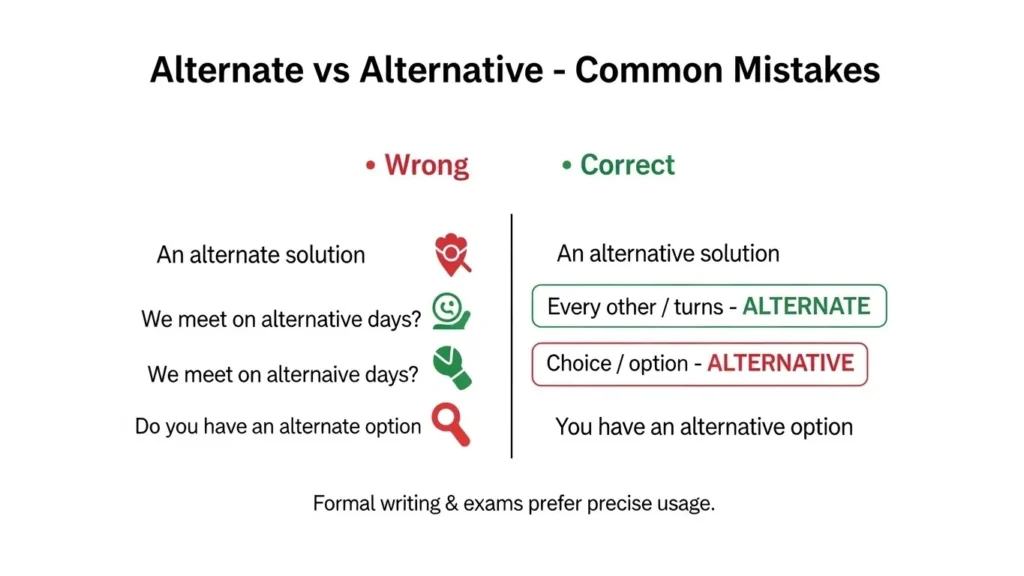
- ❌ An alternate solution
✅ An alternative solution - ❌ We meet on alternative days
✅ We meet on alternate days - ❌ Do you have an alternate option?
✅ Do you have an alternative option?
Tip:
If you can replace the word with choice or option, use alternative.
Another frequent mistake is overusing alternate because it sounds shorter or more formal.
❌ “We discussed several alternate ideas.”
✅ “We discussed several alternative ideas.”
Writers also misuse alternate with abstract nouns.
❌ “An alternate opinion was shared.”
✅ “An alternative opinion was shared.”
In exams, students often lose marks by ignoring context.
❌ “The school opens on alternative Saturdays.”
✅ “The school opens on alternate Saturdays.”
Finally, avoid assuming both words are interchangeable everywhere. While spoken English may blur the difference, formal writing expects precise usage.
Alternate or Alternative in Everyday Examples
Emails
- “Please suggest an alternative date.”
News
- “Flights operate on alternate days.”
Social Media
- “Looking for an alternative to fast food.”
Formal Writing
- “An alternative method was proposed.”
Work & Planning
- “An alternate member attended the meeting.”
Alternate or Alternative – Google Trends & Usage Data
Search data shows that:
- Alternative is searched more often worldwide
- Alternate is commonly searched with phrases like alternate days or alternate route
Both words are frequently confused in:
- Exams and assignments
- Office communication
- News headlines
Understanding the difference helps avoid common errors.
Comparison Table: Alternate vs Alternative
| Word | Meaning | Common Use |
| Alternate | Every other / taking turns | Alternate days |
| Alternative | Another option or choice | Alternative plan |
FAQs: Alternate or Alternative
1. Can alternate and alternative be used interchangeably?
Not always. Their meanings differ.
2. Is “alternate route” correct?
Yes, but alternative route is more common.
3. What does alternate days mean?
Every other day.
4. Is alternative always a choice?
Yes, it refers to an option.
5. Can alternate be a noun?
Yes, meaning a replacement person.
6. Which word is more common?
Alternative.
7. Which is safer in formal writing?
Alternative, unless you mean every other.
Conclusion
The difference between alternate or alternative is small but important. Alternate is used when something happens in turns or every other time, or when referring to a substitute person. Alternative is used when talking about another option or choice.
To avoid mistakes, remember this simple rule:
- Turns or every other → alternate
- Choice or option → alternative
Understanding alternative vs alternate helps you write with accuracy and confidence. Although the words are closely related, modern English assigns them distinct roles. Alternate focuses on sequence, turns, or replacement, while alternative emphasizes choice and options.Mixing them can confuse readers or weaken clarity, especially in exams, professional emails, and formal documents.
Using the correct word improves clarity, accuracy, and professionalism in your writing, especially in exams, formal communication, and professional settings.

I am Lynne Truss, a British writer and journalist who is best known for my work on English grammar. I have always been interested in language and punctuation, especially how small mistakes can change meaning. Through my books, I try to make grammar easy, interesting, and enjoyable for readers.