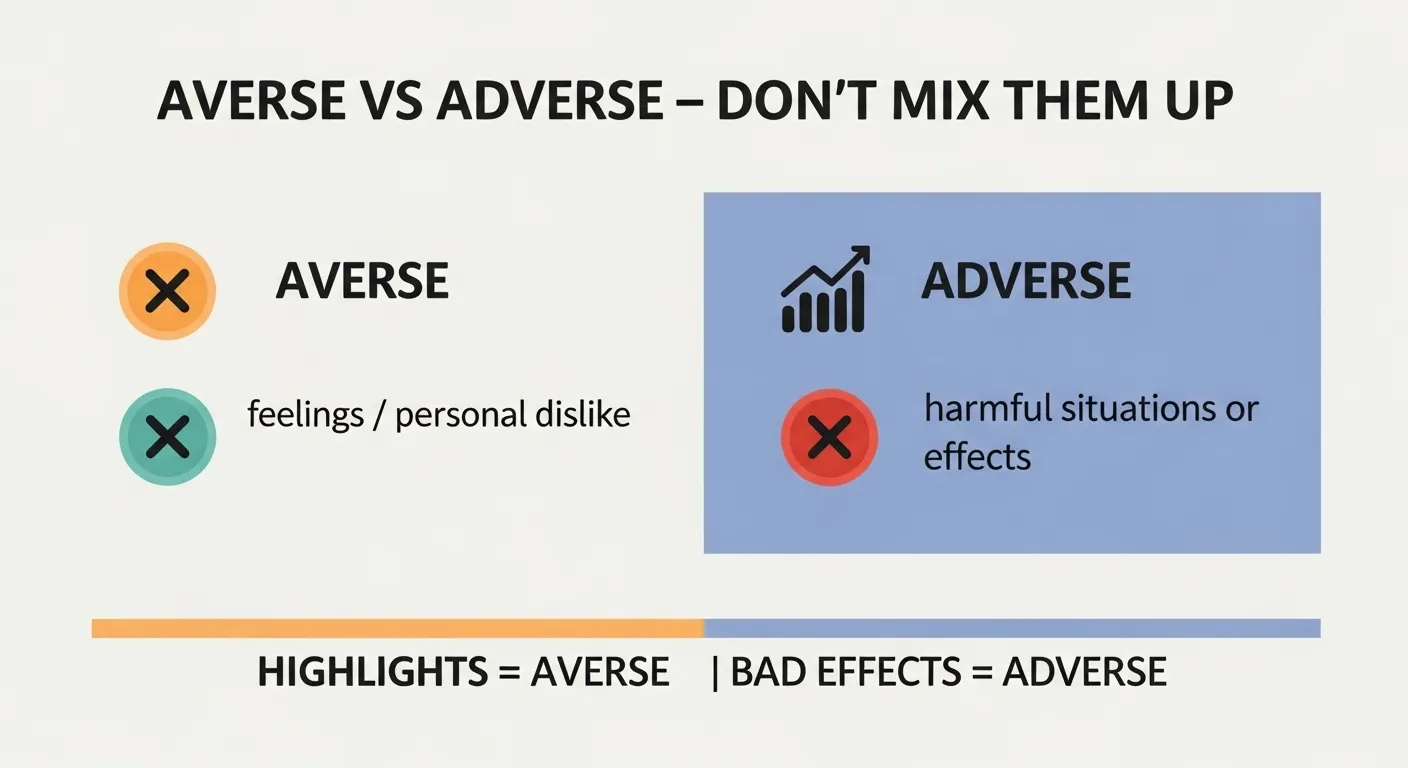
The short answer: averse describes a person’s feeling or attitude, while adverse describes a bad or harmful situation.
I still remember the first time I paused while writing an email and thought, “Is it averse or adverse?” I knew the sentence sounded right in my head, but the spelling felt wrong.
Like many people, I searched “averse or adverse” because both words look similar, sound related, and often appear in serious writing. That confusion made me curious. I realized the problem wasn’t spelling it was meaning.
Once I understood how each word works, the confusion disappeared. In this article, I’ll explain the difference simply, clearly, and practically, so you never hesitate again.
Averse or Adverse: Quick Answer
Averse means strongly disliking or avoiding something.
Adverse means harmful, unfavorable, or negative.
Simple examples
- I am averse to taking unnecessary risks.
- The company faced adverse market conditions.
Think of it this way:
- Averse = a person’s feeling
- Adverse = a bad effect or situation
The Origin of Averse or Adverse
Both words come from Latin, which is why they look so similar.
- Averse comes from the Latin word aversus, meaning “turned away.”
That’s why it describes a personal dislike or avoidance. - Adverse comes from adversus, meaning “turned against.”
This explains why it refers to opposition, harm, or negative conditions.
Over time, English kept both words but gave them different roles. The spelling difference exists because English borrowed them from related but separate Latin roots. Knowing this history helps explain why they are not interchangeable.
British English vs American English Spelling
Here’s the good news: averse and adverse are spelled the same in British and American English.
There is no spelling variation like colour/color or organise/organize.
What does vary is how often each word is used in certain contexts.
Usage comparison
| Aspect | British English | American English |
| Averse | Common in formal writing | Common in academic and professional writing |
| Adverse | Used in news and legal texts | Very common in business, law, and medicine |
| Spelling | Same | Same |
So if you’re worried about region-based spelling, you can relax these words don’t change.
Which Spelling Should You Use?
The choice depends on meaning, not audience.
- For US audiences:
Use averse for feelings, adverse for negative effects. - For UK and Commonwealth audiences:
The same rule applies. - For global or SEO content:
Accuracy matters more than region. Search engines reward correct usage.
If your sentence talks about emotions, preferences, or attitudes → averse
If your sentence talks about damage, risk, or bad conditions → adverse
Common Mistakes with Averse or Adverse
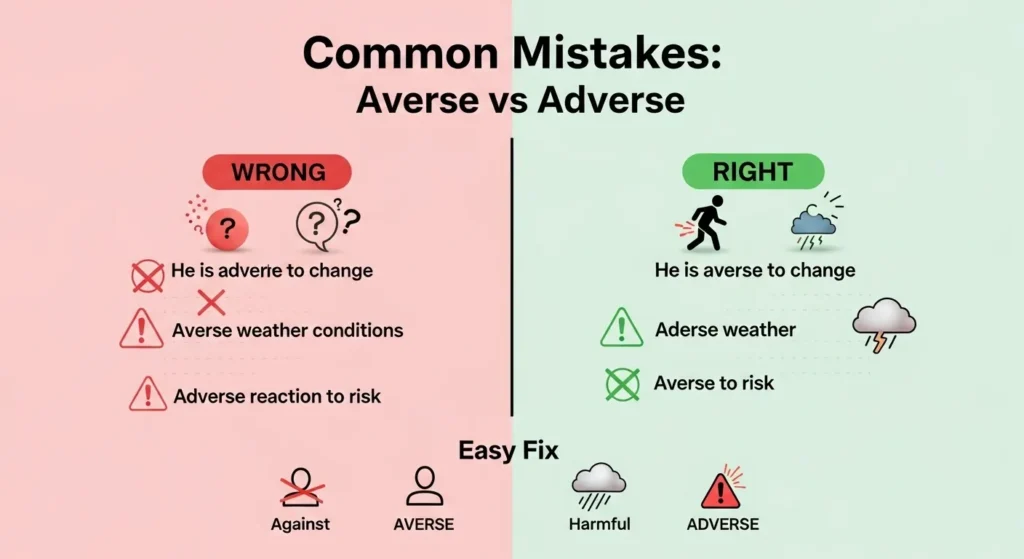
Many people mix these words because they sound academic and similar. Here are the most common mistakes I see.
❌ He is adverse to change.
✅ He is averse to change.
❌ They suffered averse weather conditions.
✅ They suffered adverse weather conditions.
❌ She has an adverse reaction to risk.
✅ She is averse to risk.
Easy fix
If you can replace the word with “against” → use averse
If you can replace it with “harmful” → use adverse
Averse or Adverse in Everyday Examples
Emails
- I am averse to unnecessary delays in this project.
- The policy change may have adverse effects on staff morale.
News
- Farmers are struggling due to adverse weather conditions.
- Investors remain averse to high-risk assets.
Social media
- I’m not lazy, I’m just averse to chaos 😅
- Traffic today had an adverse impact on my mood.
Formal writing
- Patients with adverse reactions should stop the medication.
- The committee is averse to sudden policy changes.
Averse or Adverse: Google Trends & Usage Data
Search data shows that “averse or adverse” is a very common query worldwide. People often search it when:
- Writing academic assignments
- Drafting professional emails
- Preparing legal or medical documents
Adverse appears more frequently in:
- News articles
- Health reports
- Legal and financial writing
Averse appears more often in:
- Opinion pieces
- Psychology and behavior studies
- Business strategy discussions
This tells us one thing clearly: people don’t struggle with spelling they struggle with choosing the right meaning.
Comparison Table: Averse vs Adverse
| Feature | Averse | Adverse |
| Part of speech | Adjective | Adjective |
| Refers to | Personal feeling | Situation or effect |
| Meaning | Strong dislike | Harmful or negative |
| Used for people | Yes | No |
| Used for conditions | No | Yes |
| Example | Averse to risk | Adverse effects |
Frequently Asked Questions (FAQs)
1. Is averse or adverse more correct?
Both are correct. It depends on the meaning you want.
2. Can adverse describe a person?
No. Adverse describes situations or effects, not feelings.
3. Is “risk-averse” correct?
Yes. Risk-averse is a very common and correct phrase.
4. Can I say “adverse to change”?
No. The correct phrase is averse to change.
5. Are averse and adverse interchangeable?
No. They have different meanings and cannot replace each other.
6. Which one is used in medicine?
Adverse, as in adverse reactions or adverse effects.
7. Do British and American English use them differently?
The meaning and spelling are the same in both.
Conclusion
When I finally understood the difference between averse or adverse, my writing became faster and more confident. The confusion disappears once you remember one simple rule: averse is about feelings, adverse is about harm. These words may look alike, but they play very different roles in English.
If you are writing an email, a blog post, a report, or a social media caption, choosing the correct word makes your writing clearer and more professional. Many people search this keyword because they fear making a mistake in formal writing.
Now you don’t have to. By focusing on meaning instead of spelling, you can use both words naturally and correctly. Mastering small distinctions like this is what separates basic English from polished, confident communication.

I am Mignon Fogarty, an American author and language expert also known as “Grammar Girl.”
I focus on explaining grammar rules, spelling mistakes, and confusing words in a simple and friendly way.
My goal is to make correct English easy and approachable for everyday readers.