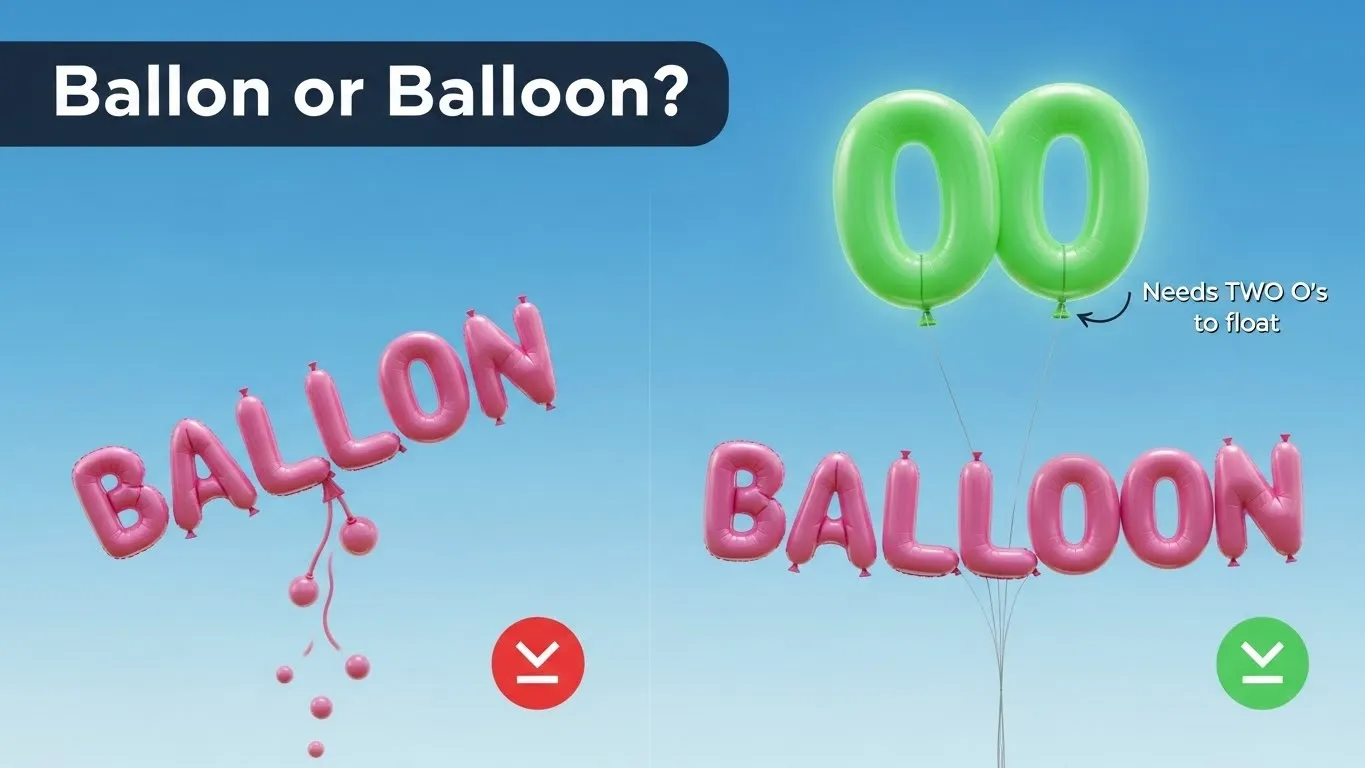
Balloon is the correct spelling for an inflatable object or something that expands; ballon is incorrect in standard English.
Many people search for “ballon or balloon” because both spellings look almost the same, yet only one is correct in standard English.
This confusion often appears in school writing, party invitations, advertisements, social media posts, product descriptions, and exam answers. Since the word is common and easy to pronounce, people often assume the shorter spelling might also be correct.
The mistake usually happens because English spelling does not always match pronunciation, and many learners drop one “o” while typing quickly.
This article clears up the confusion clearly and completely. You’ll get a quick answer, learn the word’s origin, understand why people make this mistake, see correct usage in everyday examples, and get clear guidance on which spelling to use in all types of writing.
Ballon or Balloon : Quick Answer
Balloon is the correct spelling.
Ballon is incorrect in standard English.
Balloon means a light rubber object filled with air or gas or to expand or swell.
Examples:
- ✅ The balloon floated into the air.
- ❌ The ballon floated into the air.
- ✅ She blew up a red balloon.
The Origin of Ballon or Balloon
The word balloon comes from the French word ballon, meaning a large ball. When the word entered English in the 18th century, English added an extra “o” to form balloon, which became the standard spelling.
Over time, balloon developed multiple meanings:
- A rubber object filled with air or gas
- A hot-air aircraft (hot-air balloon)
- A verb meaning to swell or increase suddenly
Ballon, however, did not remain as a correct English spelling. It exists mainly in French, not in modern English writing.
Discover More:Cheak or Cheek: Which Spelling Is Correct and Why It Matters
British English vs American English Spelling
This is not a British vs American English difference.
Both varieties use:
- Balloon → correct
- Ballon → incorrect
Comparison Table
| English Variety | Correct Spelling | Incorrect Spelling |
| American English | Balloon | Ballon |
| British English | Balloon | Ballon |
| Australian English | Balloon | Ballon |
| Global English | Balloon | Ballon |
There is no regional variation for this word.
Which Spelling Should You Use?
No matter your audience, the rule is simple.
- Academic writing: Balloon
- Business or ads: Balloon
- Casual writing: Balloon
- Technical or travel writing: Balloon
There is no situation where ballon is correct in English.
If the word refers to something that floats, inflates, or expands, always use balloon.
Common Mistakes with Ballon or Balloon
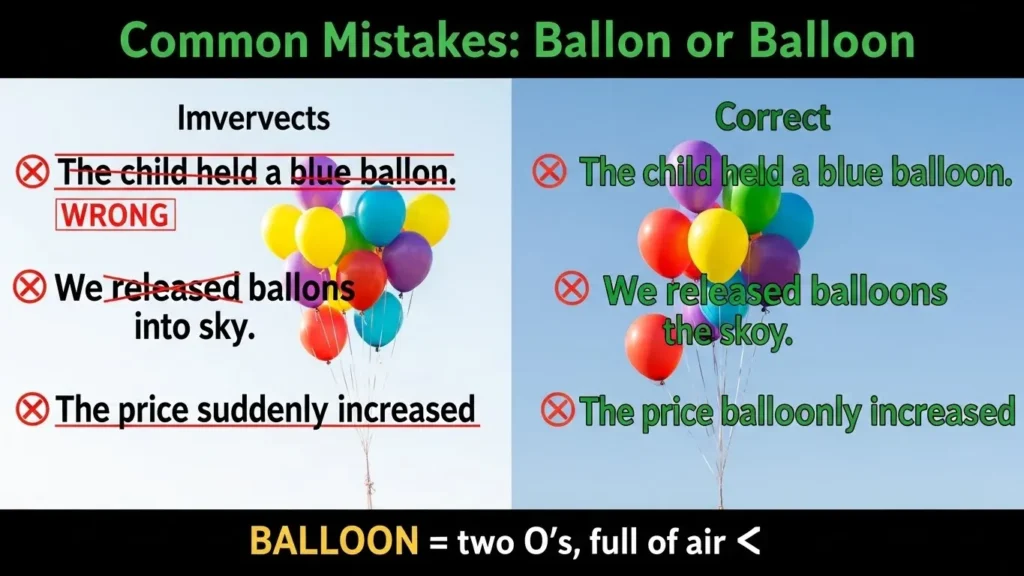
These errors are very common:
- ❌ The child held a blue ballon.
✅ The child held a blue balloon. - ❌ We released ballons into the sky.
✅ We released balloons into the sky. - ❌ The price ballon suddenly increased.
✅ The price ballooned suddenly increased.
Helpful tip:
If you are unsure, remember that balloon has two “o”s, just like it is full of air.
Ballon or Balloon in Everyday Examples
Emails
- “We will decorate the room with balloons.”
News
- “A weather balloon was launched for research.”
Social Media
- “Birthday vibes with lots of balloons 🎈”
Formal Writing
- “Hot-air balloons are used for tourism.”
Business
- “Costs may balloon if planning is poor.”
Ballon or Balloon : Google Trends & Usage Data
Search trend data shows that “ballon or balloon” is commonly searched in:
- South Asia
- Middle East
- ESL-learning regions
The confusion appears mainly in:
- School assignments
- Event planning content
- Online product listings
Balloon is widely used in books, news articles, advertisements, and everyday English. Ballon appears mostly in spelling mistakes and learner searches. Interest increases during festival seasons, birthdays, and exam periods.
Comparison Table: Ballon vs Balloon
| Word | Meaning | Correct Usage |
| Balloon | Inflated object; to expand | ✅ Correct |
| Ballon | Not correct in English | ❌ Incorrect |
FAQs: Ballon or Balloon
1. Is “ballon” ever correct in English?
No. It is not accepted in standard English.
2. Why does balloon have two “o”s?
Because English adapted it from French and standardized the spelling.
3. Is balloon a noun or a verb?
It can be both.
4. Is balloon spelled the same in British and American English?
Yes. The spelling is identical.
5. What is the plural of balloon?
Balloons.
6. What does “ballooning costs” mean?
It means costs are increasing rapidly.
7. Is balloon a formal word?
It works in both formal and informal contexts.
Conclusion
The confusion between ballon or balloon is very common, but the rule is simple. Balloon is the only correct spelling in modern English. It is used for inflatable objects, hot-air aircraft, and even figurative expressions about rapid growth.
Ballon is not an accepted English spelling and should be avoided in all forms of writing. Using it in exams, professional content, or everyday communication can make your writing look careless or incorrect.
To remember the correct form, think of a balloon filled with air it needs two “o”s. If you keep this simple trick in mind, you’ll never make this mistake again.
Mastering small spelling differences like this improves clarity, accuracy, and confidence in your English writing.

I am Mignon Fogarty, an American author and language expert also known as “Grammar Girl.”
I focus on explaining grammar rules, spelling mistakes, and confusing words in a simple and friendly way.
My goal is to make correct English easy and approachable for everyday readers.