Baptized or baptised? The quick answer is simple: both are correct, but baptized is American English, while baptised is British English.
I once helped edit a church newsletter. The writer used “baptised,” but the church website used “baptized.” At first, I thought one of them was wrong. But after checking, I learned both spellings are correct. The difference depends on the country.
Many people search “baptized or baptised” because they see both forms in religious books, news articles, and online posts.
This guide will explain the difference clearly and help you choose the right spelling for your audience.
Baptized or Baptised : Quick Answer
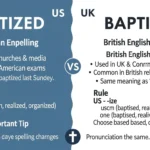
Baptized and baptised mean the same thing. Both are the past tense of baptize, which means to perform a Christian religious ceremony using water.The difference is regional spelling.
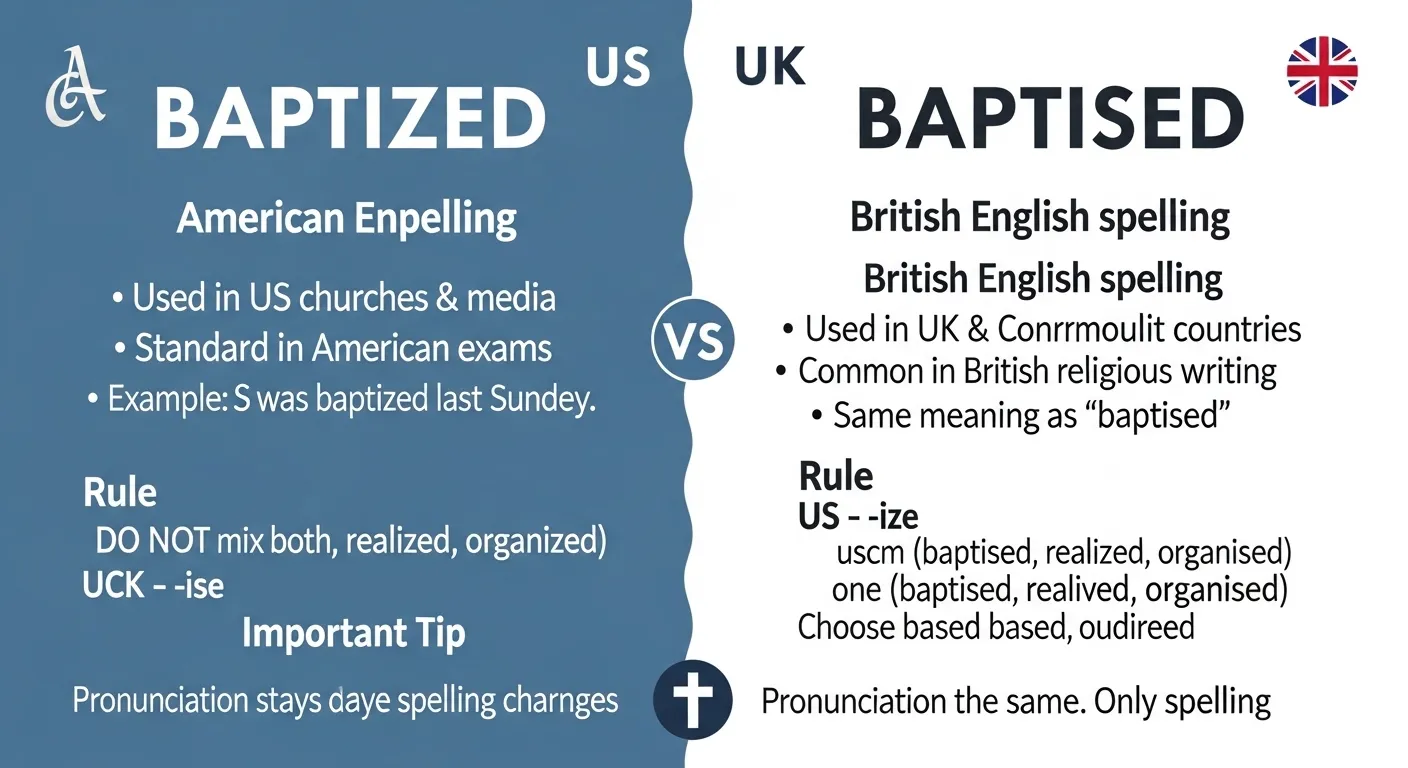
- Baptized → American English
- Baptised → British English
Examples:
🇺🇸 American English
✔ She was baptized last Sunday.
🇬🇧 British English
✔ She was baptised last Sunday.
If you write for the US, use baptized.
If you write for the UK, use baptised.
The Origin of Baptized and Baptised
The word “baptize” comes from the Greek word baptizein, meaning to dip or immerse in water. It entered English through Latin and Old French.
The spelling difference follows a common pattern:
- American English often uses -ize
- British English often uses -ise
Other examples include:
- Realize / Realise
- Organize / Organise
- Recognize / Recognise
In American English, -ize is standard.
In British English, both -ize and -ise can be correct, but -ise is more common in everyday writing.
British English vs American English Spelling
This is a classic spelling difference between the two forms of English.
🇺🇸 American English Rule
- Use -ize
- Preferred spelling: baptized
🇬🇧 British English Rule
- Often use -ise
- Common spelling: baptised
Comparison Table
| Version | Correct Spelling | Example |
| American English | Baptized | He was baptized as a child. |
| British English | Baptised | He was baptised as a child. |
| International (Neutral) | Baptized | The baby was baptized in church. |
Globally, “baptized” appears more often online due to American influence.
Which Spelling Should You Use?
Here is simple advice:
🇺🇸 Writing for an American Audience
Use baptized. It matches US dictionaries and style guides.
🇬🇧 Writing for a British or Commonwealth Audience
Use baptised. It follows common British spelling practice.
🌍 Writing for an International Audience
“Baptized” is more widely recognized online, but either form is correct if used consistently.
The key rule:
Do not mix both spellings in the same document.
Common Mistakes with Baptized or Baptised
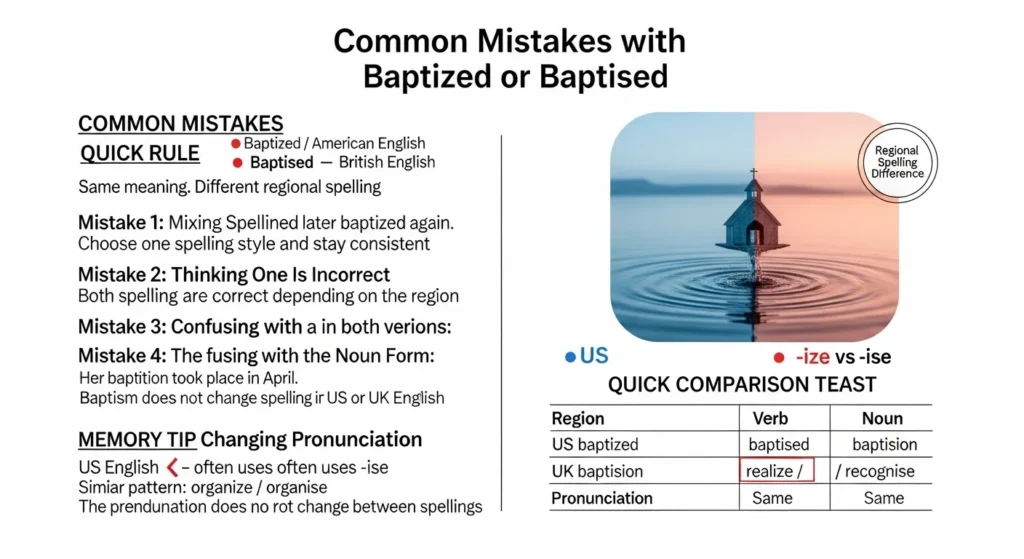
❌ Mistake 1: Mixing spellings
Wrong: She was baptised and later baptized again.
Correct: Choose one spelling style.
❌ Mistake 2: Thinking one is incorrect
Both are correct depending on region.
❌ Mistake 3: Confusing with noun form
The noun “baptism” stays the same in both US and UK English.
✔ Her baptism took place in April.
❌ Mistake 4: Changing pronunciation
The pronunciation does not change between spellings.
Baptised or Baptized in Everyday Examples
📧 In Emails
- My son was baptized last weekend. (US)
- My son was baptised last weekend. (UK)
📰 In News
- The child was baptized at the cathedral.
- The infant was baptised in a private ceremony.
📱 On Social Media
- Feeling blessed. I was baptized today!
- Grateful to be baptised this morning.
📄 In Religious Writing
- Jesus was baptized in the Jordan River.
- Jesus was baptised in the River Jordan.
The meaning remains exactly the same.
Baptized or Baptised : Usage Trends
In the United States, “baptized” is standard in churches, schools, and official documents.
In the United Kingdom, Australia, and other Commonwealth countries, “baptised” appears more often in church publications and news reports.
People search this keyword because:
- They prepare religious documents.
- They see both spellings in books.
- Spell check suggests different forms.
- They are unsure which version is correct for exams or formal writing.
Globally, “baptized” appears more often online, but “baptised” remains standard in British contexts.
Comparison Table: Baptized vs Baptised
| Word | Region | Meaning | Correct? |
| Baptized | US | To perform baptism | Yes |
| Baptised | UK | To perform baptism | Yes |
| Baptism | US/UK | Noun form | Yes |
| Baptizing / Baptising | US/UK | Present tense form | Yes |
The meaning never changes—only the spelling does.
FAQs
1.Baptised wrong in American English?
Yes, it is not the standard US spelling.
2. Baptized wrong in British English?
No. accepted, but less common.
3. Do both spellings mean the same thing?
Yes. There is no meaning difference.
4. Why does American English use “-ize”?
American English prefers “-ize” endings for many verbs.
5. Can British English use “-ize”?
Yes. Some British publications accept “-ize,” but “-ise” is more common.
6. Which spelling is more common worldwide?
“Baptized” appears more often globally.
7. Should I stay consistent?
Yes. Always use one spelling style in the same document.
Conclusion
The difference between baptized and baptised is simple. Both words mean the same thing. The only difference is regional spelling. American English uses “baptized” with “-ize,” while British English commonly uses “baptised” with “-ise.”
This pattern appears in many other verbs, such as realize/realise and organize/organise. The pronunciation does not change, and the meaning stays exactly the same. The choice depends entirely on your audience.
If you are writing for an American reader, use “baptized.” If your audience is British or from a Commonwealth country, “baptised” is the natural choice. For international writing, “baptized” is often more common, but consistency is more important than preference.
Once you understand that this is only a regional spelling difference, the confusion disappears. Choose the correct version for your readers and your writing will remain clear and professional.

I am Emily Carter, a British writer and linguistics enthusiast from London.
I specialize in studying the differences between British and American English.
I enjoy exploring how language changes across cultures and regions.
Through my writing, I aim to make English learning simple and interesting for students.