Benefiting or benefitting? The quick answer is this: both are correct, but benefiting is preferred in American English, while benefitting is more common in British English.
I once wrote “Our company is benefitting from the new policy” in a report. Then I checked a US style guide, and it corrected it to “benefiting.” That small double “t” created confusion. Many writers search “benefiting or benefitting” because they are unsure about spelling rules, especially with words ending in “-it.”
This guide will explain the difference clearly, show when to use each form, and help you write with confidence.
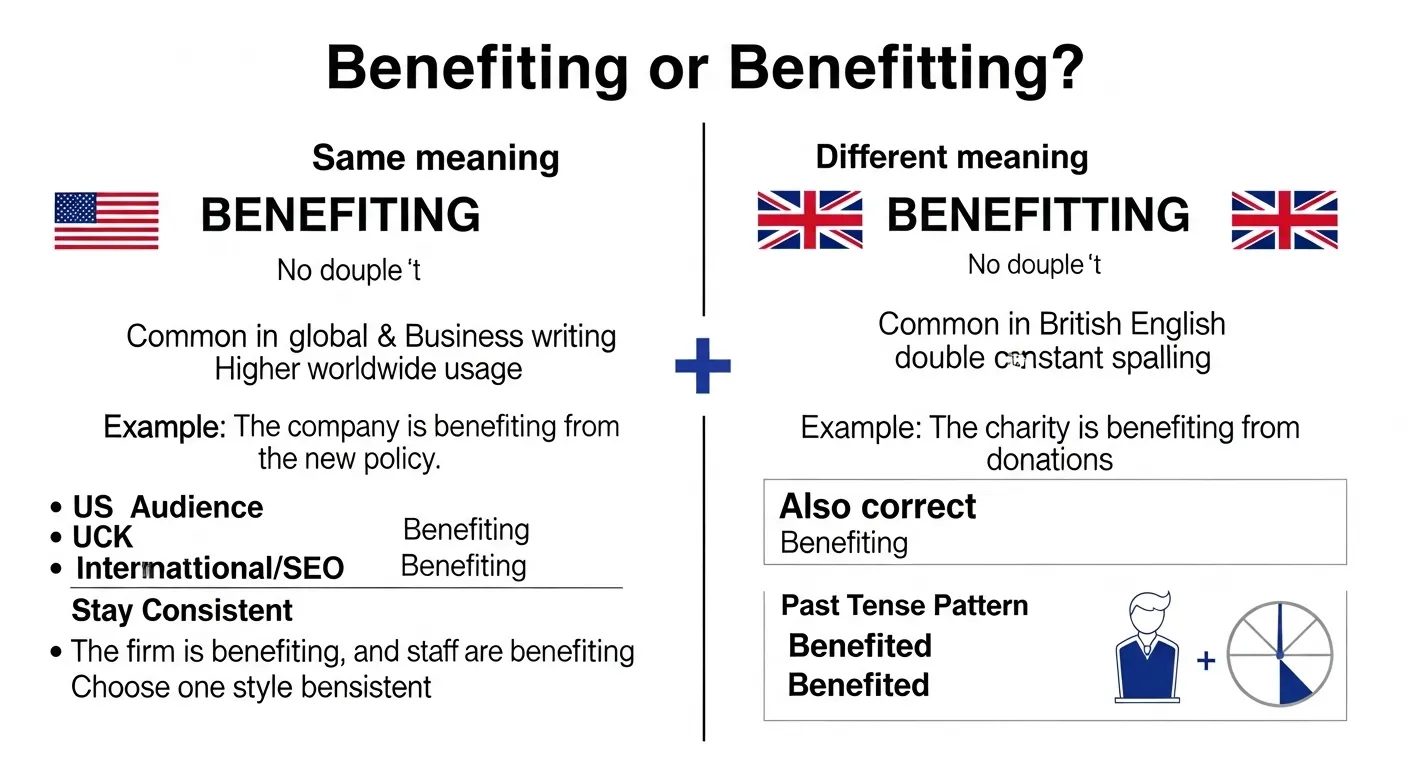
Benefiting or Benefitting Quick Answer
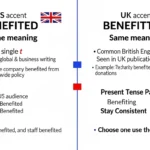
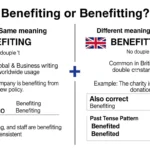
Both spellings are correct, but usage depends on region:
- Benefiting → American English (preferred)
- Benefitting → British English (common)
Examples:
🇺🇸 American English:
✔ The company is benefiting from the new law.
🇬🇧 British English:
✔ The charity is benefitting from donations.
If you write for a US audience, use benefiting.
If you write for a UK audience, benefitting is acceptable.
The Origin of Benefiting and Benefitting
The word “benefit” comes from the Latin word beneficium, meaning kindness or good deed. It entered English through Old French.
The confusion comes from a spelling rule in English:
When adding -ing to a verb:
- If the word ends in one vowel + one consonant, and the stress is on the last syllable, we often double the consonant.
Example:- Admit → Admitting
- Permit → Permitting
But “benefit” has stress on the first syllable:
BEN-e-fit
Because the stress is not on the last syllable, American English usually does not double the “t.”
So:
- US: benefit → benefiting
- UK: benefit → benefitting (double “t” more accepted)
British English vs American English Spelling
This is mainly a regional spelling difference.
🇺🇸 American English Rule
- Do not double the “t”
- Preferred form: benefiting
🇬🇧 British English Rule
- Often doubles the “t”
- Common form: benefitting
Comparison Table
| Version | Preferred Spelling | Example Sentence |
| American English | Benefiting | She is benefiting from the training. |
| British English | Benefitting | He is benefitting from the scheme. |
| Global/Neutral | Benefiting | The team is benefiting from support. |
In global business or online writing, benefiting is more widely accepted.
Which Spelling Should You Use?
Here is simple advice:
🇺🇸 Writing for US Audience
Use benefiting. It matches American dictionaries and style guides.
🇬🇧 Writing for UK or Commonwealth Audience
You can use benefitting. It follows British spelling patterns.
🌍 Writing for International or SEO Content
Use benefiting. It is more common worldwide and avoids confusion.
The most important rule:
✔ Be consistent.
Do not mix both spellings in the same document.
Common Mistakes with Benefiting or Benefitting
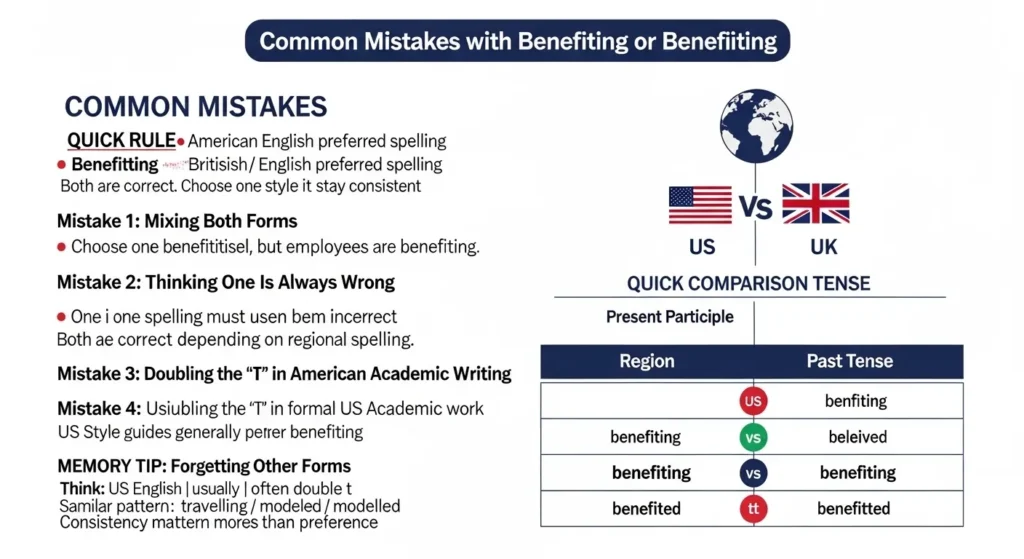
❌ Mistake 1: Mixing both forms
Wrong: The company is benefiting, but employees are benefitting.
Correct: Choose one style and stay consistent.
❌ Mistake 2: Thinking one is always wrong
Both are correct depending on region.
❌ Mistake 3: Doubling the “t” in American academic writing
US style guides prefer benefiting.
❌ Mistake 4: Forgetting other forms
Past tense is usually:
- US: benefited
- UK: benefitted
Same pattern applies.
Benefitting or Benefiting in Everyday Examples
📧 In Emails
- We are benefiting from your support. (US)
- Our team is benefitting from the new tools. (UK)
📰 In News Articles
- Small businesses are benefiting from tax cuts.
- Local schools are benefitting from government funding.
📱 On Social Media
- I’m really benefiting from this course!
- Students are benefitting from free workshops.
📄 In Formal Reports
- The organization is benefiting financially.
- Communities are benefitting socially.
In most international companies, benefiting is more common.
Benefiting or Benefitting Google Trends & Usage Data
Search data shows that “benefiting” is more common globally, especially in the United States.
In the UK, Australia, and some Commonwealth countries, “benefitting” appears more often in local publications.
Why do people search this keyword?
- They are unsure about double consonant rules.
- Spell check shows different suggestions.
- They work with international clients.
In global SEO writing, “benefiting” usually has higher search volume.
Comparison Table: Benefiting vs Benefitting
| Word | Region | Correct? | Usage Context |
| Benefiting | US | Yes | Business, academic, global writing |
| Benefitting | UK | Yes | British publications |
| Benefited | US | Yes | Past tense (American) |
| Benefitted | UK | Yes | Past tense (British) |
This shows the full pattern clearly.
FAQs
1. Is “benefitting” wrong?
No. It is correct in British English.
2. Is “benefiting” correct in the UK?
Yes. It is still accepted, though less common.
3. Which spelling is more common worldwide?
“Benefiting” is more common globally.
4. Why doesn’t American English double the “t”?
Because the stress is not on the last syllable.
5. Should I double the “t” in past tense?
In American English, use “benefited.”
In British English, “benefitted” is common.
6. Which spelling is better for SEO?
“Benefiting” usually has higher global search volume.
7. Can I use both in one article?
No. Choose one style and stay consistent.
Conclusion
The difference between benefiting and benefitting comes down to regional spelling rules. American English prefers “benefiting” without doubling the “t,” while British English often uses “benefitting” with a double “t.” Both are correct, but you must choose based on your audience.
The rule connects to syllable stress. Since “benefit” has stress on the first syllable, American English does not double the consonant. British English follows a slightly different pattern and often doubles it.
If you write for a global audience, “benefiting” is usually the safest and most accepted choice. If your audience is strictly British, “benefitting” works well.
The most important thing is consistency. Pick one spelling style and use it throughout your document. That small decision will make your writing look professional and polished.

I am Emily Carter, a British writer and linguistics enthusiast from London.
I specialize in studying the differences between British and American English.
I enjoy exploring how language changes across cultures and regions.
Through my writing, I aim to make English learning simple and interesting for students.