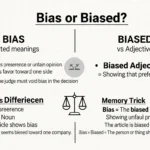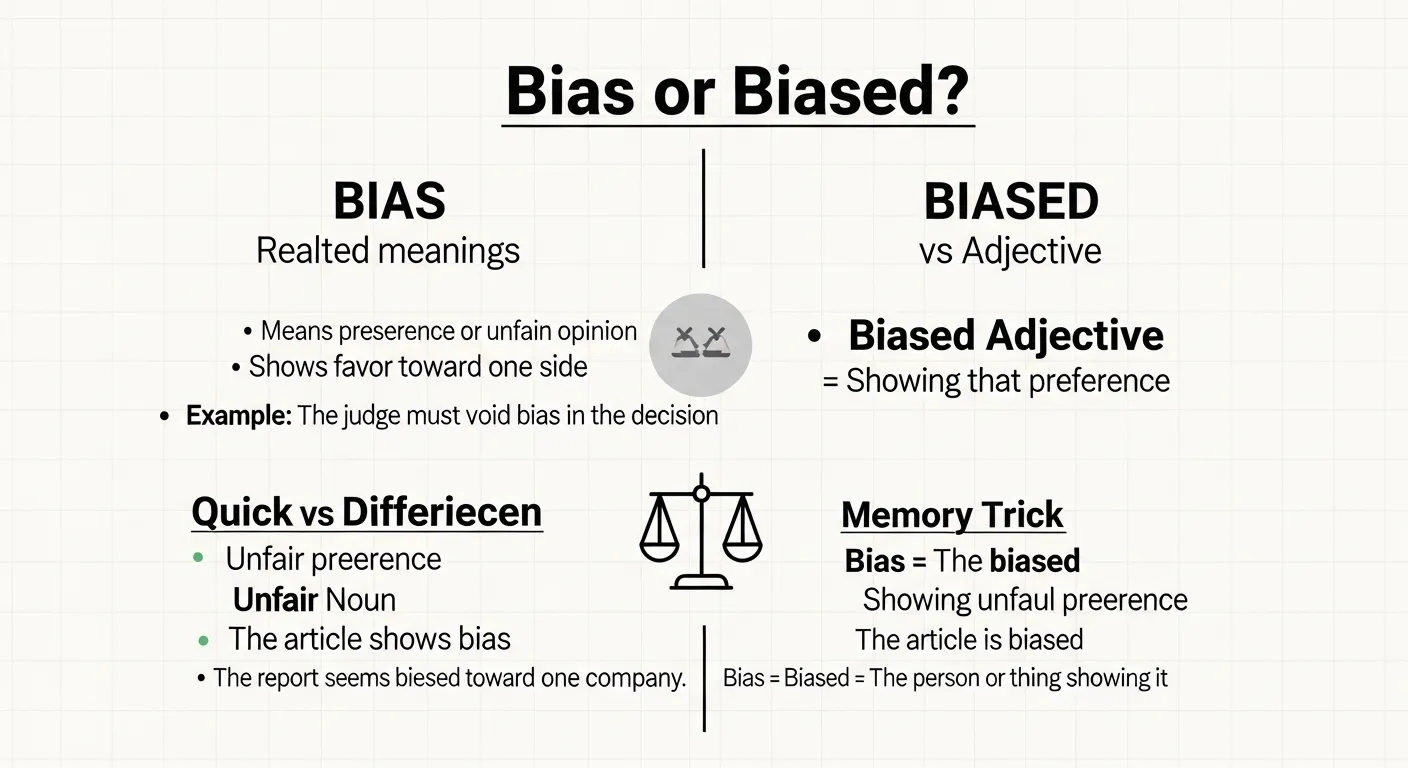
Bias is a noun referring to a preference or unfair tendency, while biased is an adjective describing someone who shows that preference.
I remember reading a news comment that said, “This article is bias,” and it sounded strange to me. After checking, I realized the correct word should have been biased.
Many people search “bias or biased” because the words look similar and are closely related in meaning. The confusion usually happens when writers are unsure whether they need a noun or an adjective.
Once you understand the grammatical role of each word, choosing the correct one becomes simple.
Bias or Biased : Quick Answer
Bias = a noun meaning a preference, opinion, or unfair tendency toward something.
Biased = an adjective describing someone who shows that preference or unfair opinion.
Examples:
- The report showed clear bias.
- The judge should not be biased.
Simple rule:
Bias → the preference itself (noun)
Biased → describing someone with that preference (adjective)
Meaning of Bias and Biased
The main difference between bias and biased is their part of speech.
Bias (Noun)
Bias refers to a preference or unfair opinion that influences judgment.
Examples:
- The article showed political bias.
- Personal bias can affect decisions.
- The report tried to avoid bias.
Bias can be positive or negative, but it usually suggests an unfair influence.
Biased (Adjective)
Biased describes a person or opinion that shows bias.
Examples:
- The reviewer seemed biased toward one product.
- A biased opinion is not objective.
- The article sounded biased.
In simple terms:
- Bias = the opinion or preference
- Biased = describing someone who has that opinion
Origin of Bias and Biased
The word bias originally came from Old French, where it meant a slanted or diagonal direction. Over time, the meaning expanded to describe a mental leaning or preference toward something.
The word biased developed later by adding ed, which turns the noun into an adjective describing someone who shows bias.
This pattern is common in English:
- interest → interested
- talent → talented
- bias → biased
Bias or Biased Grammar Rule
The easiest way to choose between bias and biased is to check whether the sentence needs a noun or an adjective.
| Word | Part of Speech | Meaning | Example |
| Bias | Noun | Preference or unfair opinion | The article shows bias. |
| Biased | Adjective | Showing preference | The article is biased. |
Examples:
- The report showed clear bias.
- The report is biased.
If the word describes a thing or person, use biased.
If it names the preference itself, use bias.
Biased or Bias in Everyday Examples
In News and Media
- Readers expect journalists to avoid bias.
- The article seems biased.
In Workplace Decisions
- Managers should avoid personal bias.
- A biased decision can affect the team.
Education
- Teachers try to prevent cultural bias.
- A biased viewpoint can influence students.
In Social Media
- Some comments show strong bias.
- The review sounded biased.
Common Mistakes with Bias or Biased
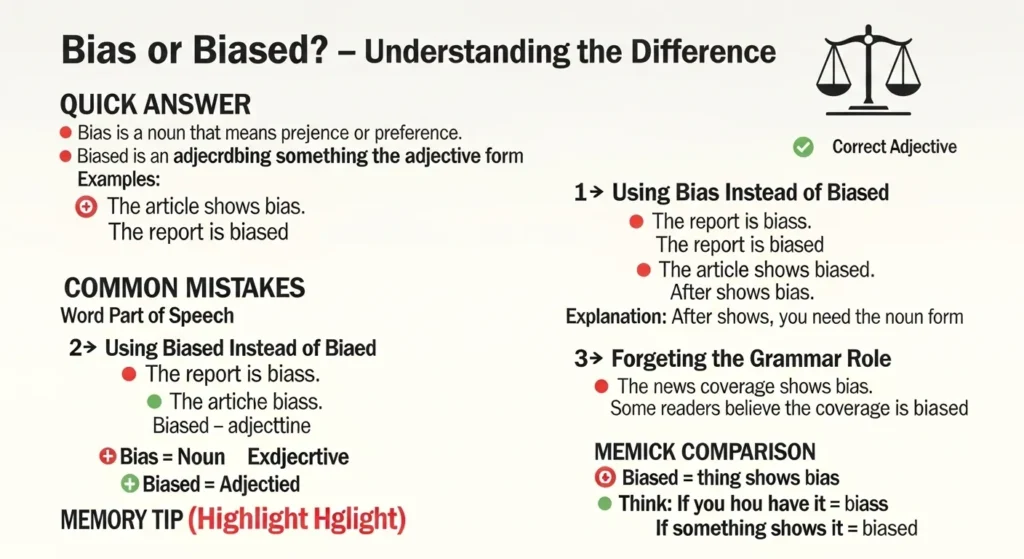
1. Using Bias Instead of Biased
❌ The report is bias.
✅ The report is biased.
2. Using Biased Instead of Bias
❌ The article shows biased.
✅ The article shows bias.
3. Forgetting the Grammar Role
Remember:
- Bias = noun
- Biased = adjective
Bias vs Biased : Side by Side Comparison
| Feature | Bias | Biased |
| Part of speech | Noun | Adjective |
| Meaning | Preference or unfair opinion | Showing preference |
| Example sentence | The report shows bias. | The report is biased. |
| Function | Names the idea | Describes a person or opinion |
Frequently Asked Questions
1. What is the difference between bias and biased?
Bias is the preference or unfair opinion, while biased describes someone who shows that preference.
Example:
- The report shows bias.
- The report is biased.
2. Is bias a noun or a verb?
Bias is mainly used as a noun, meaning a preference or unfair opinion.
Example:
- The article shows political bias.
3. Is biased an adjective?
Yes. Biased is an adjective used to describe a person or opinion that shows bias.
Example:
- The review seemed biased.
4. Why do people confuse bias and biased?
They are closely related words, and many writers are unsure whether the sentence needs a noun or an adjective.
5. How can I remember the difference between bias and biased?
Use this simple trick:
- Bias → the preference itself
- Biased → describing someone with that preference
Example:
- The report contains bias.
- The report is biased.
Conclusion
The difference between bias and biased is mainly grammatical. Bias is a noun that refers to a preference, opinion, or unfair tendency that influences judgment. Biased, on the other hand, is an adjective used to describe a person, opinion, or decision that shows that preference.
Many writers confuse these words because they look similar and are closely related in meaning. However, remembering that bias names the preference and biased describes someone who has it makes the rule easy to apply.
By paying attention to whether your sentence needs a noun or an adjective, you can confidently choose the correct word and avoid a common writing mistake.

I am Mignon Fogarty, an American author and language expert also known as “Grammar Girl.”
I focus on explaining grammar rules, spelling mistakes, and confusing words in a simple and friendly way.
My goal is to make correct English easy and approachable for everyday readers.