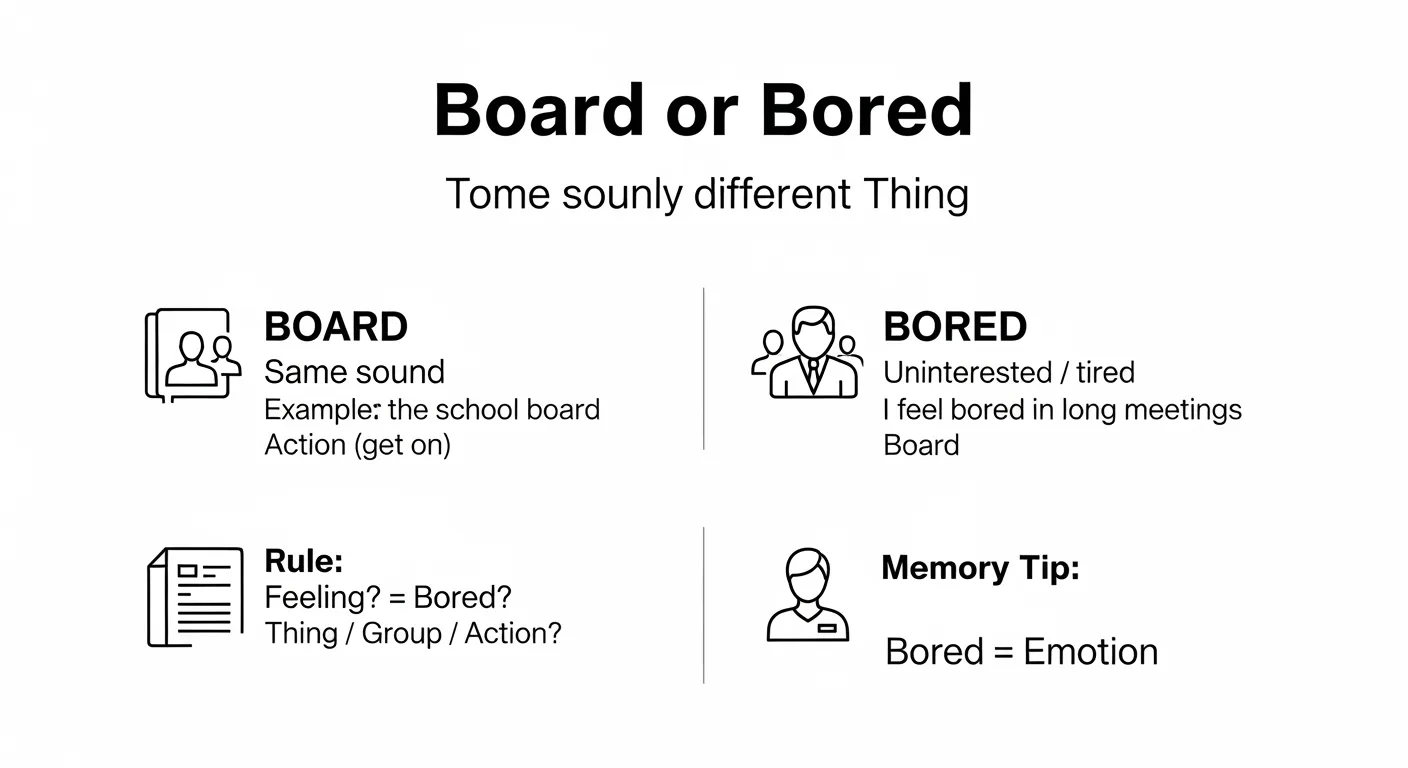
The Short Answer: Board relates to things, groups, or actions, while bored describes a feeling.
Board and bored sound the same, but they mean very different things. I still remember the first time I paused while writing a casual message and stared at this word. I typed, “I am board,” then stopped something felt wrong. Was it board or bored? That one letter changed the meaning completely.
Later, I noticed many people searching board or bored for the same reason. This confusion happens because English has many homophones words that sound the same but mean different things. Writers, students, and professionals want to avoid sounding careless.
This article solves that problem. I’ll explain the difference clearly and help you choose the correct word every time.
Board or Bored – Quick Answer
- Board → A noun or verb related to groups, surfaces, or getting on something
Example: She sits on the school board. - Bored → An adjective that describes feeling uninterested
Example: I feel bored during long meetings.
Simple Rule:
- Feeling? → bored
- Object, group, or action? → board
The Origin of Board or Bored
The word board comes from Old English bord, meaning a flat piece of wood. Over time, its meaning expanded to include tables, committees (like a board of directors), and meals (room and board).
The word bored comes from the verb bore, meaning to make someone lose interest. The past form bored became commonly used to describe the feeling of being uninterested or tired of something.
The confusion exists because:
- Both words sound exactly the same
- English spelling does not always match pronunciation
- Learners rely on sound instead of meaning
Knowing the origins helps separate object/action from emotion.
British English vs American English Spelling
There is no spelling difference between British and American English for board or bored. Both spellings and meanings are the same.
Key Rule:
This is a meaning difference, not a regional spelling difference.
Comparison Table
| Form | Meaning | UK English | US English |
| board | object / group / action | ✅ Same | ✅ Same |
| bored | feeling / emotion | ✅ Same | ✅ Same |
Which Spelling Should You Use?
Choose based on what you want to say, not where you live.
- US audience → Same rule
- UK or Commonwealth audience → Same rule
- Global audience → Meaning matters more than region
Quick Tip:
Ask yourself one question:
👉 Am I talking about a feeling?
- Yes → bored
- No → board
Common Mistakes with Board or Bored
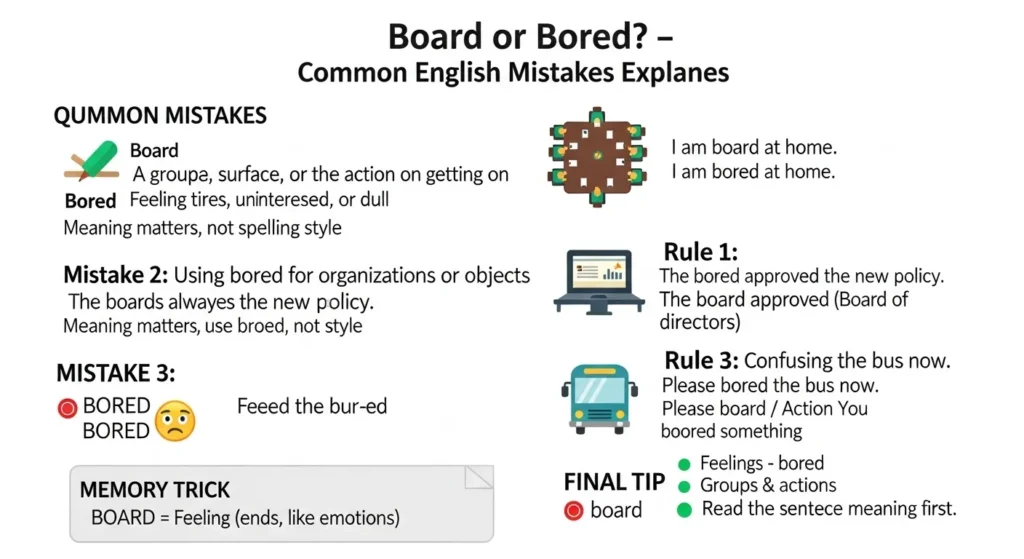
Mistake 1: Using board for emotions
❌ I am board at home.
✅ I am bored at home.
Mistake 2: Using bored for objects
❌ The bored approved the new policy.
✅ The board approved the new policy.
Mistake 3: Confusing verb forms
❌ Please bored the bus now.
✅ Please board the bus now.
Board or Bored in Everyday Examples
Emails
- The board will meet on Monday.
- I felt bored during the long call.
News
- The board of directors announced changes.
- Citizens are bored with repeated promises.
Social Media
- Waiting again… so bored 😴
- Proud to join the school board today!
Formal Writing
- The board reviewed the annual report.
- Employees felt bored due to repetitive tasks.
Board or Bored – Google Trends & Usage Data
Search data shows board or bored is commonly searched in:
- United States
- United Kingdom
- Canada
- Australia
- India
Why people search this keyword:
- These words sound identical
- Autocorrect does not always catch the mistake
- Writers want quick confirmation before posting
Usage Insight:
- Board appears more in business, education, and transport contexts
- Bored appears more in casual writing and social media
Board vs Bored – Side-by-Side Comparison
| Keyword | Correct Use | Example |
| board | noun / verb | She joined the board of directors. |
| bored | adjective (feeling) | He felt bored during the lecture. |
| boarding | verb form | Boarding starts at 8 a.m. |
FAQs: Board or Bored
1. Is “bored” always a feeling?
Yes. Bored always describes an emotion.
2. Can “board” be a verb?
Yes. You board a bus, plane, or train.
3. Is “board” used in business English?
Yes. A board often means a group of decision-makers.
4. Is “board or bored” different in UK English?
No. The rule is the same in UK and US English.
5. Which is correct: board meeting or bored meeting?
Board meeting is correct.
6. Why do people confuse board and bored?
Because they are homophones with different spellings.
7. Is “I am board” ever correct?
No. It should always be I am bored.
Conclusion
Understanding board or bored becomes easy once you focus on meaning. Board refers to an object, a group, or an action, such as boarding a bus or serving on a board. Bored describes a feeling of disinterest or lack of excitement. This rule does not change between British and American English, making it simple to apply anywhere.
I’ve learned that pausing to ask “Is this a feeling or a thing?” instantly removes confusion. In emails, formal writing, and social media, using the correct word helps you sound clear and professional. Once this habit forms, you will never mix up board or bored again.

I am Bryan A. Garner, an American writer and editor focused on English usage, grammar, and word choice.
I am best known for Garner’s Modern English Usage, a reference book widely used by writers, editors, and legal professionals.
My work centers on clarity, precision, and resolving confusing word comparisons in modern English.