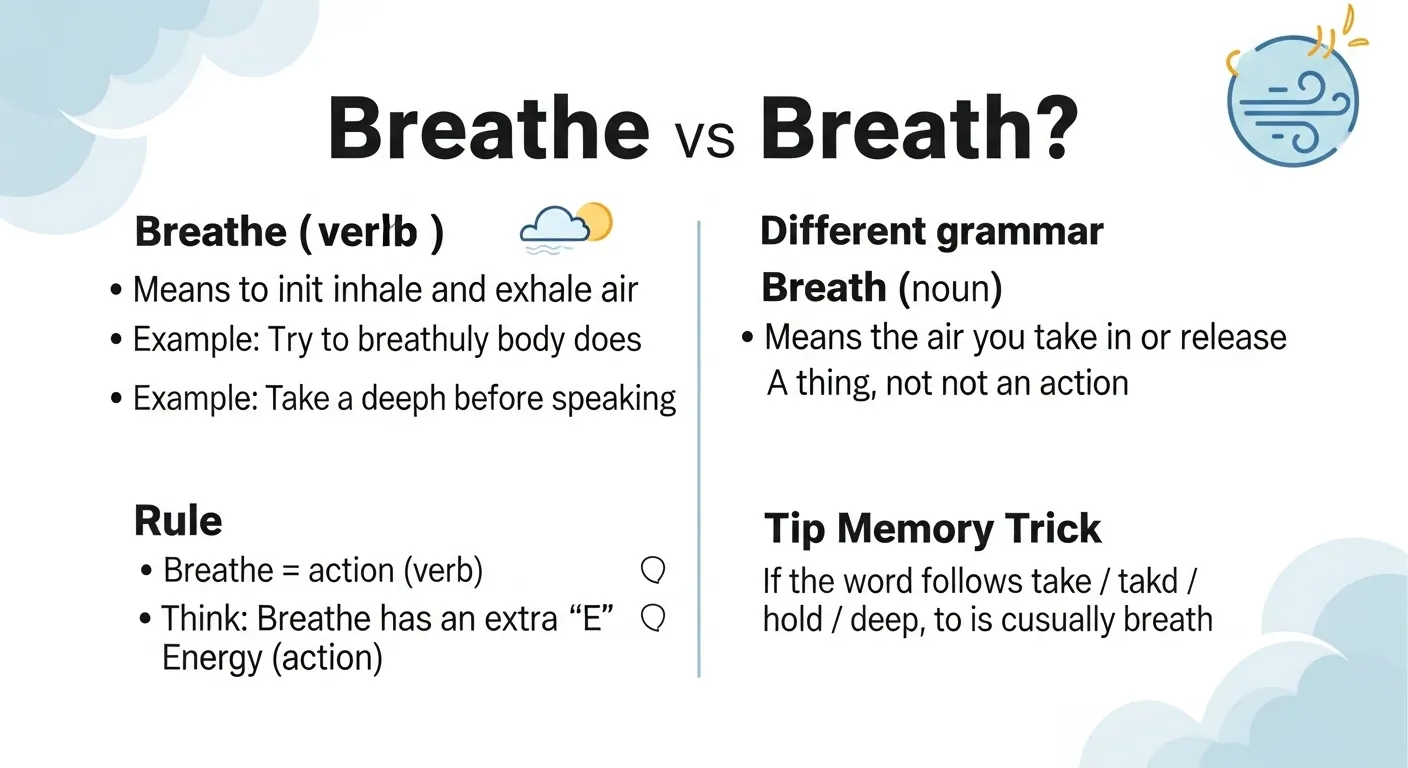
Breathe is a verb meaning to inhale and exhale air, while breath is a noun referring to the air taken into or released from the lungs.
I remember once writing “Take a deep breathe” in a message and realizing later that the correct word should be breath. This small spelling difference often confuses English learners because both words look very similar and are closely related in meaning.
Many people search “breathe or breath” to understand when to use each word correctly. The good news is that the rule is simple: one word describes the action of breathing, and the other describes the air itself.
Breathe or Breath : Quick Answer
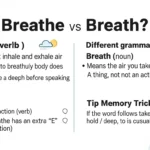
Breathe = a verb meaning to inhale and exhale air.
Breath = a noun meaning the air that goes in and out of the lungs.
Examples:
- Please breathe slowly and relax.
- Take a deep breath before speaking.
Simple rule:
Breathe → action (verb)
Breath → thing (noun)
Meaning of Breathe and Breath
The difference between breathe and breath comes from their grammatical roles.
Breathe (Verb)
Breathe describes the action of taking air into the lungs and releasing it.
Examples:
- It is important to breathe slowly during meditation.
- He stopped running to breathe for a moment.
- Try to breathe deeply when you feel stressed.
Because it is a verb, breathe shows an action happening in the sentence.
Breath (Noun)
Breath refers to the air taken in or released from the lungs.
Examples:
- She took a deep breath before starting the speech.
- His breath was cold in the winter air.
- I could hear his heavy breath after running.
Because breath is a noun, it refers to something rather than describing an action.
Origin of Breathe or Breath
Both words come from Old English and share the same root.
The word breath developed from an Old English word meaning air or vapor from the lungs. Later, English created the verb breathe by adding an extra “e” at the end to indicate the action related to that noun.
This pattern appears in several English word pairs where a noun and verb share similar spelling but different endings.
Breathe or Breath Grammar Rule
The easiest way to understand the difference is by identifying whether the sentence needs a noun or a verb.
| Word | Part of Speech | Meaning | Example |
| Breath | Noun | Air from lungs | Take a deep breath. |
| Breathe | Verb | To inhale and exhale | Please breathe slowly. |
Examples:
- She took a deep breath.
- She tried to breathe calmly.
If the word describes the air, use breath.
If it describes the action, use breathe.
Breathe and Breath in Pronunciation
Another helpful way to remember the difference is pronunciation.
- Breath ends with a soft “th” sound like in think.
- Breathe ends with a voiced “th” sound like in this.
Examples:
- Breath → breth
- Breathe → breeth
The extra “e” in breathe also makes the vowel sound slightly longer.
Common Mistakes with Breathe or Breath
1. Using “Breathe” as a Noun
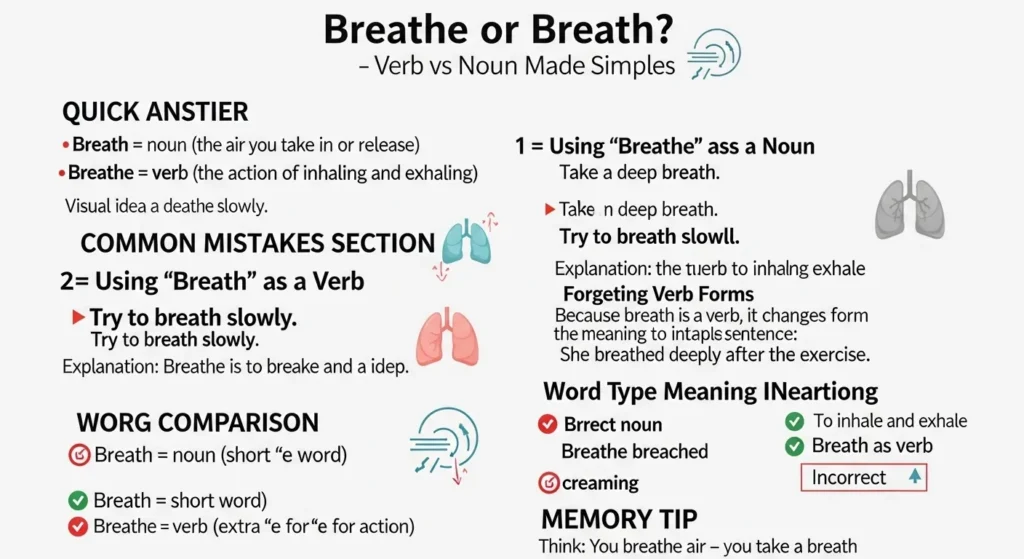
❌ Take a deep breathe.
✅ Take a deep breath.
2. Using “Breath” as a Verb
❌ Try to breath slowly.
✅ Try to breathe slowly.
3. Forgetting Verb Forms
Because breathe is a verb, it can change form.
Examples:
- breathe
- breathes
- breathed
- breathing
Example sentence:
- She breathed deeply after the exercise.
Breath or Breathe in Everyday Examples
In Health and Fitness
- Remember to breathe slowly during yoga.
- Take a deep breath before lifting the weight.
Stressful Situations
- Stop and breathe for a moment.
- Take a deep breath to calm down.
In Sports
- The runner struggled to breathe after the race.
- He took a quick breath before diving underwater.
In Conversation
- Just breathe and relax.
- I need a moment to catch my breath.
Comparison Table: Breathe vs Breath
| Feature | Breathe | Breath |
| Part of speech | Verb | Noun |
| Meaning | To inhale and exhale | Air from lungs |
| Example sentence | Please breathe slowly. | Take a deep breath. |
| Function | Action | Thing |
Frequently Asked Questions
1. Is breathe a noun or verb?
Breathe is a verb.
Example:
- Try to breathe slowly during meditation.
2. Is breath a noun or verb?
Breath is a noun.
Example:
- Take a deep breath before speaking.
3. What is the past tense of breathe?
The past tense of breathe is breathed.
Example:
- He breathed deeply after the run.
4. Why are breathe and breath confusing?
They look very similar in spelling and have related meanings, but breath is a noun and breathe is a verb.
5. How can I remember the difference between breathe and breath?
A simple trick is to remember the extra “e”:
- Breathe → action (verb)
- Breath → thing (noun)
Example:
- Please breathe slowly.
- Take a deep breath.
Conclusion
The difference between breathe and breath is simple once you understand their roles in a sentence. Breathe is a verb that describes the action of inhaling and exhaling air, while breath is a noun that refers to the air taken into or released from the lungs. Because the two words look almost identical, many English learners confuse them in writing.
If remembering that breathe is an action and breath is the air itself makes the distinction clear. By applying this rule, you can use both words correctly and avoid a common English grammar mistake.

I am Lynne Truss, a British writer and journalist who is best known for my work on English grammar. I have always been interested in language and punctuation, especially how small mistakes can change meaning. Through my books, I try to make grammar easy, interesting, and enjoyable for readers.