The correct word depends on meaning: but is a conjunction, while butt is a noun or verb.
I remember the first time I typed a sentence and paused, staring at the screen: “I wanted to go, it was raining.”
For a second, butt crossed my mind, and I laughed at myself. Still, that small doubt stayed. If you’re searching “butt or but,” you’re probably facing the same confusion. Both words sound the same, both are common, and one extra “t” can completely change meaning.
At first, I thought it was just a spelling mistake people make. Then I realized many learners genuinely don’t know the difference. This article clears that confusion step by step, so you’ll know exactly which word to use and why.
Butt or But: Quick Answer
But is a conjunction or preposition used to show contrast or exception.
Butt is a noun or verb with completely different meanings.
Examples:
- ✅ I wanted to help, but I was busy.
- ❌ I wanted to help, butt I was busy.
- ✅ He slipped and fell on his butt.
- ❌ He slipped and fell on his but.
If you are connecting ideas or showing contrast, but is correct.
If you are talking about a body part, cigarette end, or pushing action, butt is correct.
The Origin of Butt or But
The word but comes from Old English butan, meaning “outside” or “except.” Over time, it became a common word used to contrast ideas or introduce exceptions.
The word butt has multiple origins. One comes from Middle English butte, meaning “end” or “target.” That’s why butt can mean:
- The end of something (cigarette butt)
- A target (archery butt)
- The human backside
- A pushing action (to butt someone)
Because these words evolved from different roots, they are not related in meaning, even though they sound the same.
British English vs American English Spelling
This confusion is not about British vs American English.
Both but and butt are spelled the same way in all major English varieties.
Key point:
- British English: but, butt
- American English: but, butt
The difference is grammar and meaning, not region.
Comparison Table
| Word | British English | American English |
| but | Same spelling | Same spelling |
| butt | Same spelling | Same spelling |
| Meaning difference | Yes | Yes |
| Regional variation | No | No |
Which Spelling Should You Use?
Use the word based on function, not accent.
Audience-based advice:
- Students: Use but in sentences showing contrast.
- Writers: Use butt only when referring to a noun or physical action.
- Professional or global audience: Double-check context before choosing.
Quick rule:
- If you can replace the word with “however”, use but.
- If you’re talking about an object, body part, or forceful push, use butt.
Common Mistakes with Butt or But
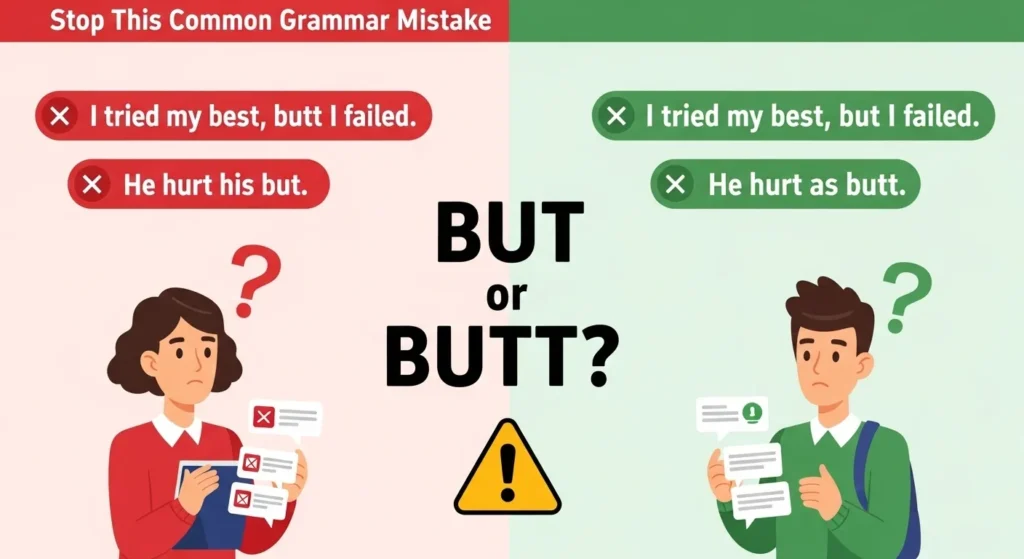
Here are the most common errors people make:
❌ Mistake 1: Using butt instead of but in sentences
✅ I tried my best, but I failed.
❌ Mistake 2: Using but for body parts
✅ He hurt his butt while skating.
❌ Mistake 3: Thinking extra “t” is optional
✅ Spelling changes meaning completely.
❌ Mistake 4: Casual texting habits
✅ Even in informal writing, correct usage improves clarity.
Butt or But in Everyday Examples
Seeing the words in real situations helps fix confusion.
Emails
- I would love to attend, but I have another meeting.
- Please don’t sit on the armrest, it hurts my butt.
News
- The plan was approved, but changes are expected.
- The athlete landed hard on his butt during the race.
Social Media
- I wanted to sleep early, but Netflix won.
- Gym day destroyed my legs and my butt.
Formal Writing
- The hypothesis was valid, but the sample size was small.
- The animal may butt if it feels threatened.
Butt or But: Google Trends & Usage Data
Search trends show that “butt or but” is commonly searched by:
- English learners
- Students
- Content writers
- ESL speakers
Usage patterns:
- But appears extremely frequently in:
- Articles
- Essays
- Emails
- Books
- Butt appears mostly in:
- Informal language
- Physical descriptions
- Idioms
Most searches come from countries where English is a second language, showing this is a learning based confusion, not a native-speaker issue.
Comparison Table: Butt vs But
| Feature | But | Butt |
| Part of speech | Conjunction / Preposition | Noun / Verb |
| Meaning | Contrast or exception | Body part, end, push |
| Common usage | Very frequent | Context-specific |
| Replaceable with “however” | Yes | No |
| Common mistake | Confused with butt | Confused with but |
FAQs: Butt or But
1. Is butt ever correct in a sentence?
Yes, when referring to a noun or action, like sit on your butt.
2. Can but be used as a noun?
Rarely. In modern English, it’s mostly a conjunction.
3. Why do people confuse but and butt?
They sound the same and differ by one letter.
4. Is butt informal?
Some meanings are informal, but it’s still correct English.
5. Can but start a sentence?
Yes. It’s grammatically correct in modern English.
6. Is this a spelling or grammar issue?
Both. It’s spelling tied to grammar and meaning.
7. Will using the wrong one change meaning?
Yes. It can make a sentence confusing or funny.
Conclusion
The confusion between butt or but may seem small, but it has a big impact on clarity. But is one of the most common words in English, used to connect ideas and show contrast. Butt, on the other hand, refers to a physical thing or action and has no linking function at all.
I’ve learned that most mistakes happen when we write quickly or rely on sound instead of meaning. The good news is that once you understand their roles, the confusion disappears. Just remember:
if you’re joining ideas, choose but. If you’re naming something or describing a push or body part. This simple rule will instantly improve your writing, whether it’s for exams, emails, or professional content.

I am Emily Carter, a British writer and linguistics enthusiast from London.
I specialize in studying the differences between British and American English.
I enjoy exploring how language changes across cultures and regions.
Through my writing, I aim to make English learning simple and interesting for students.