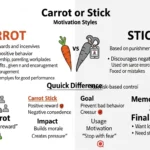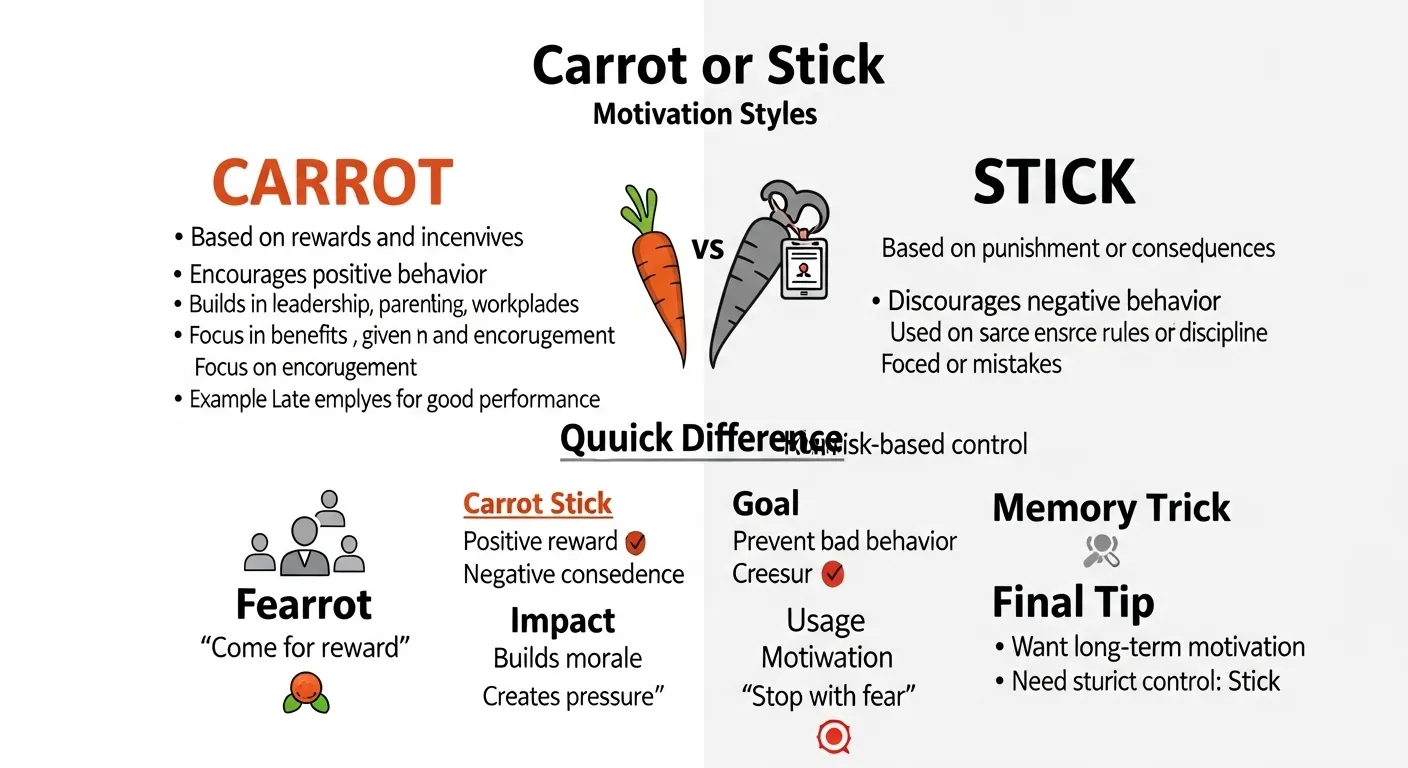
“Carrot or stick” means using rewards or punishments to influence behavior; a carrot motivates with benefits, while a stick pushes with consequences.
I remember hearing a manager say, “We need more carrot, less stick,” and I paused because I wasn’t sure what that meant.
Many people search “carrot or stick” because the phrase sounds simple but carries a deeper idea about motivation and control.
Once you understand how each approach works, it becomes easy to use the right method in real life.
Carrot or Stick : Quick Answer
Carrot = a reward or incentive used to encourage good behavior
Stick = a punishment or threat used to stop bad behavior
Examples:
- A bonus is a carrot for employees.
- A warning is a stick to correct behavior.
Simple rule:
Carrot → reward and motivation
Stick → pressure and discipline
Meaning of Carrot and Stick
The phrase explains two ways to influence people’s actions.
Carrot (Positive Motivation)
A carrot offers something good to encourage action.
Key ideas:
- Rewards
- Benefits
- Positive reinforcement
Examples:
- Extra pay for good work
- Praise for performance
Stick (Negative Pressure)
A stick uses fear or consequences to control behavior.
Key ideas:
- Punishment
- Threats
- Rules
Examples:
- Fines for mistakes
- Penalties for breaking rules
Origin of Carrot or Stick
The phrase comes from an old idea:
- A donkey moves forward for a carrot (reward)
- Or moves to avoid a stick (punishment)
This became a common way to explain motivation in work, politics, and daily life.
Carrot or Stick : Key Differences
| Feature | Carrot | Stick |
| Type | Reward | Punishment |
| Effect | Encourages action | Forces action |
| Feeling | Positive | Negative |
| Use | Motivation | Control |
Stick vs Carrot : Usage Comparison
| Situation | Better Approach | Example |
| Workplace motivation | Carrot | Bonus for success |
| Discipline | Stick | Warning for delay |
| Education | Carrot | Reward for good grades |
| Rules enforcement | Stick | Fine for breaking rules |
Which One Should You Use?
Choose based on your goal:
Use carrot when:
- You want to motivate
- You want long term results
- You want positive behavior
Use stick when:
- You need strict control
- Rules must be followed
- Immediate action is required
Best advice:
Use more carrot and less stick for better results.
Common Mistakes with Carrot or Stick
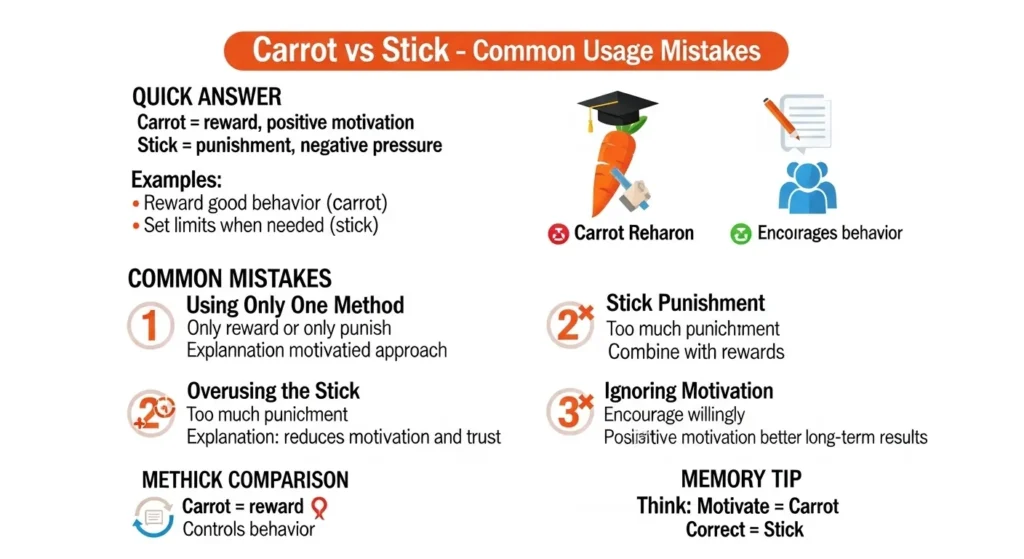
1. Using Only One Method
❌ Only reward or only punish
✅ Use a balanced approach
2. Overusing the Stick
❌ Too much punishment
✅ Combine with rewards
3. Ignoring Motivation
❌ Forcing behavior
✅ Encourage willingly
Carrot or Stick in Everyday Examples
In Work
- Bonus = carrot
- Warning = stick
In School
- Good grades reward = carrot
- Detention = stick
Parenting
- Treat for good behavior = carrot
- Time out = stick
In Government
- Tax benefits = carrot
- Penalties = stick
Carrot vs Stick : Side by Side Comparison
| Feature | Carrot | Stick |
| Method | Reward based | Punishment based |
| Result | Willing action | Forced action |
| Impact | Positive | Negative |
| Use | Motivation | Discipline |
Stick or Carrot : Usage Insight
Why people search this:
- Common phrase
- Used in many fields
- Meaning not always clear
General pattern:
- Carrot → preferred for motivation
- Stick → used for control
Important note:
A mix of both often works best.
Frequently Asked Questions
1. What does carrot or stick mean?
It means using rewards or punishments to influence behavior.
2. Which is better, carrot or stick?
Carrot is better for motivation, but both can be useful.
3. Is carrot positive?
Yes, it is based on rewards.
4. Is stick negative?
Yes, it involves punishment or pressure.
5. Can both be used together?
Yes, a balanced approach works best.
6. Where is this concept used?
In business, education, parenting, and politics.
7. Why is carrot more effective?
It creates positive motivation and long term results.
Conclusion
The concept of carrot or stick is a simple way to understand how people are motivated. A carrot uses rewards to encourage good behavior, making people feel positive and willing to act. A stick, on the other hand, relies on punishment or pressure to prevent bad behavior or force action.
Both methods can be useful in different situations, but they create very different results. In most cases, using rewards leads to better long term outcomes because people respond more positively to encouragement than fear.
If, rules and discipline sometimes require the use of consequences. The key is balance. By understanding when to use a carrot and when to use a stick, you can guide behavior more effectively in work, school, and daily life.

I am Mignon Fogarty, an American author and language expert also known as “Grammar Girl.”
I focus on explaining grammar rules, spelling mistakes, and confusing words in a simple and friendly way.
My goal is to make correct English easy and approachable for everyday readers.