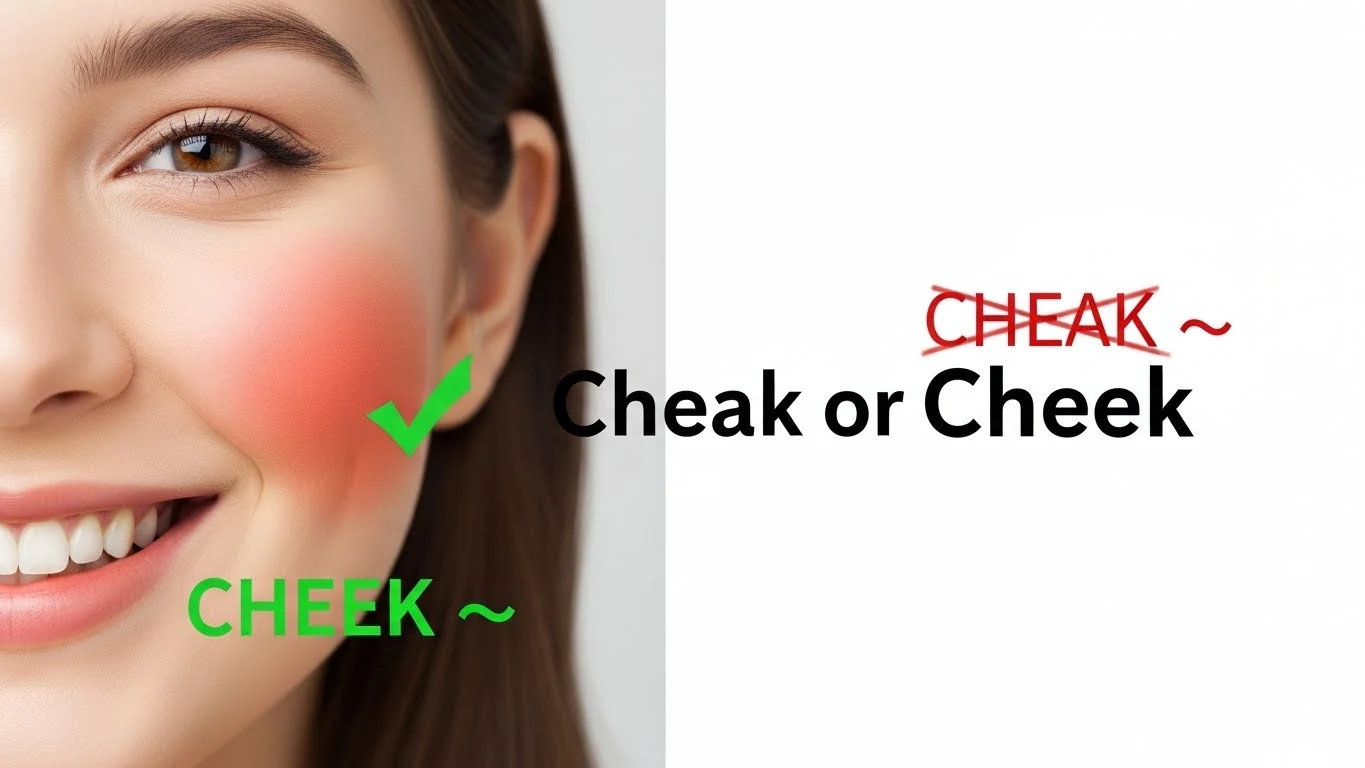
Cheek is the correct spelling for the part of the face or bold behavior; cheak is a spelling mistake and not a real English word.
Many people search for “cheak or cheek” because these two spellings look similar but have very different meanings:and only one is correct in most everyday situations.
You may have seen sentences like “He touched my cheak” or “She has rosy cheaks” and wondered whether cheak is an alternative spelling of cheek.
The confusion usually happens because people spell the word based on how it sounds. Since English pronunciation does not always match spelling, learners often guess the wrong form.
This article clears the confusion step by step. You’ll get a quick answer, learn the origin of the word, understand why people make this mistake, see correct usage in real-life examples, and get clear advice on which spelling to use.
By the end, you’ll confidently know when cheek is correct and why cheak is wrong.
Cheak or Cheek : Quick Answer
Cheek is the correct spelling.
Cheak is not a correct word in standard English.
Cheek refers to the soft part of the face below the eyes and is also used in idioms and expressions.
Examples:
- ✅ She has rosy cheeks.
- ❌ She has rosy cheaks.
- ✅ He kissed her on the cheek.
Read MOre: Abscent or Absent: Which Spelling Is Correct and Why It Matters
The Origin of Cheak or Cheek
The word cheek comes from Old English cēace or cēce, meaning jaw or face. It has been part of English for hundreds of years and is commonly used to describe facial features and expressions.
Over time, cheek also developed figurative meanings, such as:
- Bold or rude behavior (He has some cheek!)
- Informal expressions (cheeky)
Cheak, however, has no historical or linguistic origin in English. It usually appears because:
- People spell the word based on sound
- Confusion with similar-sounding words
- Typing or spelling habits
Despite how common the mistake is, cheak has never been an accepted English spelling.
British English vs American English Spelling
This is not a British vs American English issue.
Both varieties use:
- Cheek → correct
- Cheak → incorrect
Comparison Table
| English Variety | Correct Spelling | Incorrect Spelling |
| American English | Cheek | Cheak |
| British English | Cheek | Cheak |
| Australian English | Cheek | Cheak |
| Global English | Cheek | Cheak |
There is no regional spelling difference.
Which Spelling Should You Use?
The rule is simple and never changes.
- Anatomy or body parts: Cheek
- Idioms and expressions: Cheek
- Casual writing: Cheek
- Formal writing: Cheek
There is no context where cheak is correct.
If the sentence refers to the face or bold behavior, always use cheek.
Common Mistakes with Cheak or Cheek
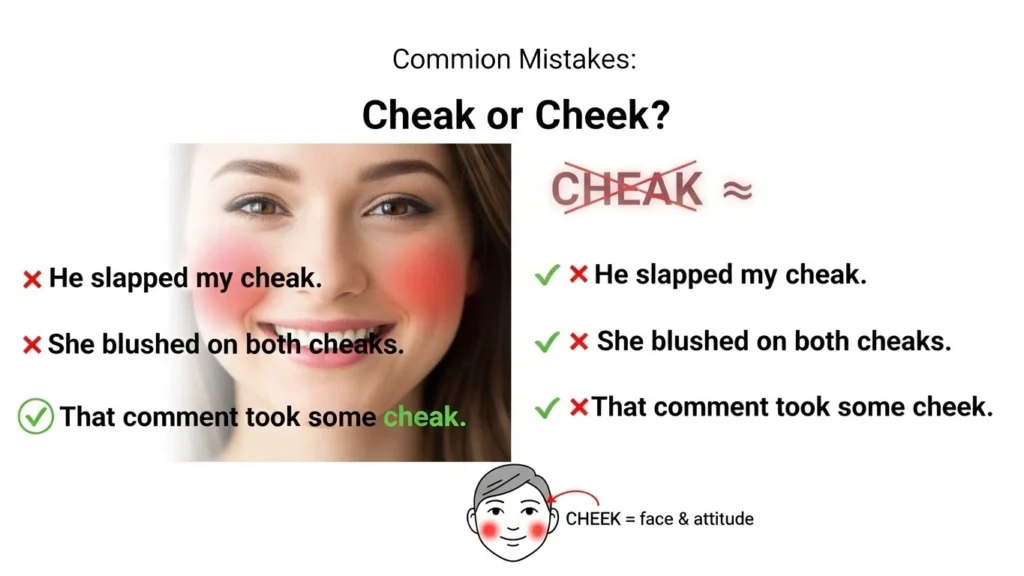
These mistakes are very common:
- ❌ He slapped my cheak.
✅ He slapped my cheek. - ❌ She blushed on both cheaks.
✅ She blushed on both cheeks. - ❌ That comment took some cheak.
✅ That comment took some cheek.
Helpful tip:
If the meaning relates to the face or attitude, the correct spelling is cheek.
Cheak or Cheek in Everyday Examples
Emails
- “He turned his cheek to the camera.”
News
- “The child had paint on his cheeks.”
Social Media
- “Sunburned cheeks after a long day outside ☀️”
Formal Writing
- “The patient showed swelling on the left cheek.”
Idioms
- “She had the cheek to argue with the manager.”
Cheak or Cheek : Google Trends & Usage Data
Search trend data shows that “cheak or cheek” is frequently searched in:
- South Asia
- Middle East
- ESL-learning regions
The confusion appears mostly in:
- School writing
- Exam answers
- Informal online communication
Cheek is widely used in textbooks, medical writing, news articles, and daily speech. Cheak appears almost entirely in spelling mistakes and learner searches. Search interest increases during exam seasons and writing practice periods.
Comparison Table: Cheak vs Cheek
| Word | Meaning | Correct Usage |
| Cheek | Part of the face; bold attitude | ✅ Correct |
| Cheak | No meaning in standard English | ❌ Incorrect |
FAQs: Cheak or Cheek
1. Is “cheak” ever correct?
No. It is not a recognized English word.
2. Is cheek a noun or a verb?
It is mainly a noun.
3. Is cheek spelled the same in British and American English?
Yes. The spelling is identical.
4. Why do people write cheak instead of cheek?
Because they spell it based on pronunciation.
5. What is the plural of cheek?
Cheeks.
6. What does “have the cheek” mean?
It means to be bold or rude.
7. Is cheek formal or informal?
It works in both contexts, depending on usage.
Conclusion
The confusion between cheak or cheek is common, but the rule is very simple. Cheek is the only correct spelling in modern English. It refers to the soft part of the face and is also widely used in idioms and expressions.
Cheak is a spelling mistake with no accepted meaning. Using it in exams, messages, or professional writing can make your English look weak or careless. Since cheek is a common word, learning its correct spelling is important for clear communication.
To avoid mistakes, remember this rule:
If the word refers to the face or bold behavior, the correct spelling is always cheek.
Mastering small spelling differences like this will greatly improve your confidence and accuracy in English writing.

I am Mignon Fogarty, an American author and language expert also known as “Grammar Girl.”
I focus on explaining grammar rules, spelling mistakes, and confusing words in a simple and friendly way.
My goal is to make correct English easy and approachable for everyday readers.