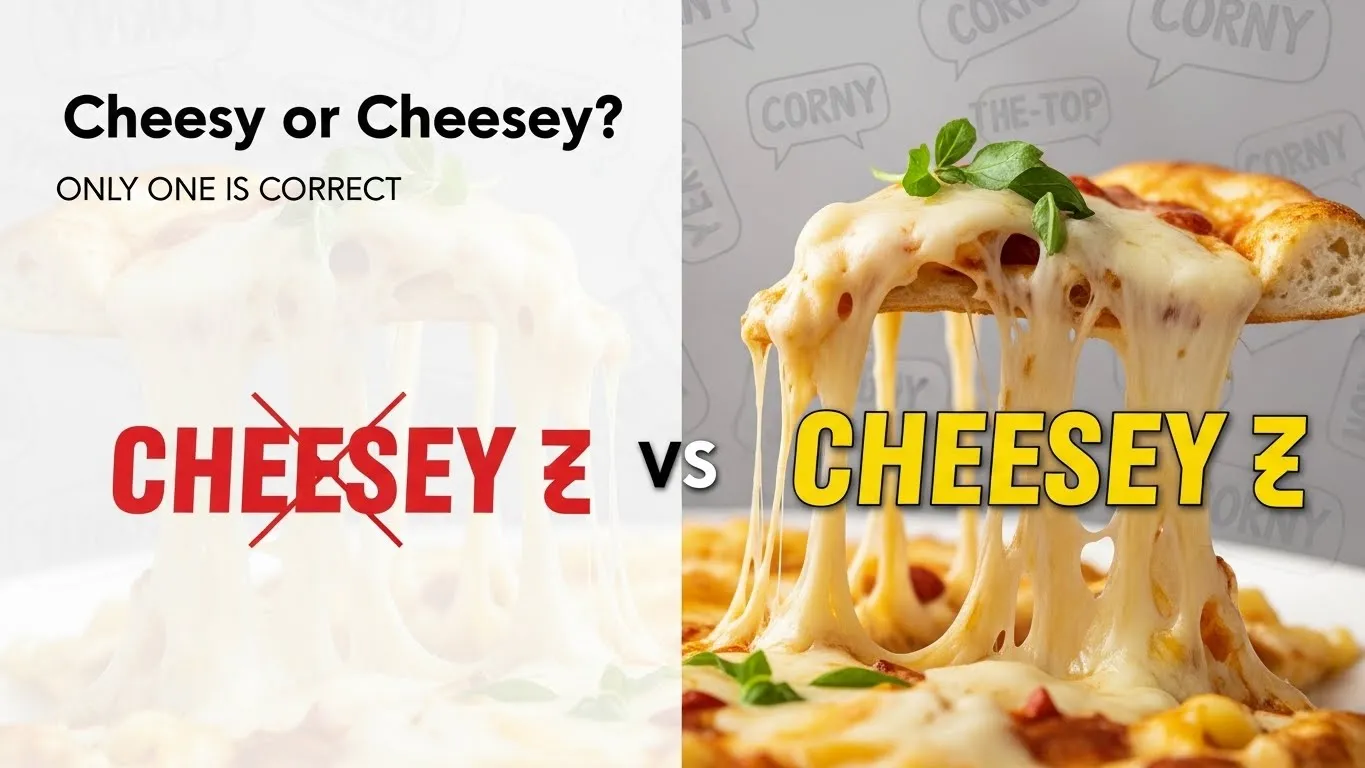
Cheesy is the correct spelling in all forms of English; cheesey is a common spelling mistake and is not accepted.
Many people search for “cheesy or cheesey” because both spellings look believable, but only one is correct in standard English.
This confusion appears often in food writing, restaurant reviews, movie criticism, social media captions, and casual conversations.
English spelling does not always match pronunciation, writers often add extra letters without realizing it.
You may have seen sentences like “That joke was cheesey” or “I love cheesey pizza” and wondered whether cheesey is just an alternative spelling.
This article clears up the confusion completely. You’ll get a quick answer, learn the origin of the word, understand why people make this mistake, see correct usage in everyday writing, and get clear advice on which spelling to use.
By the end, you’ll confidently know why cheesy is correct and cheesey is wrong.
Cheesy or Cheesey : Quick Answer
Cheesy is the correct spelling.
Cheesey is incorrect in standard English.
Cheesy means:
- Full of cheese
- Overly sentimental
- Corny or low quality
Examples:
- ✅ This pizza is very cheesy.
- ❌ This pizza is very cheesey.
- ✅ The movie had a cheesy ending.
Learn MOre: Habbit or Habit: Which Spelling Is Correct
The Origin of Cheesy or Cheesey
The word cheesy comes from cheese, with the adjective-forming suffix -y. In English, when many nouns end with -se, the e is dropped before adding -y.
For example:
- Noise → Noisy
- Grease → Greasy
- Cheese → Cheesy
This spelling rule explains why cheesy has only one e before y.
Cheesey has no historical or grammatical basis. It appears because:
- People spell based on sound
- Confusion with words like gooey
- Informal online writing habits
Despite its frequent appearance online, cheesey has never been correct.
British English vs American English Spelling
This is not a British vs American spelling difference.
Both varieties use:
- Cheesy → correct
- Cheesey → incorrect
Comparison Table
| English Variety | Correct Spelling | Incorrect Spelling |
| American English | Cheesy | Cheesey |
| British English | Cheesy | Cheesey |
| Australian English | Cheesy | Cheesey |
| Global English | Cheesy | Cheesey |
There is no regional variation.
Which Spelling Should You Use?
Always use cheesy, regardless of context or audience.
- Food writing: Cheesy
- Movie reviews: Cheesy
- Casual writing: Cheesy
- Professional writing: Cheesy
There is no situation where cheesey is acceptable.
If the word means full of cheese or corny, the spelling is always cheesy.
Common Mistakes with Cheesy or Cheesey
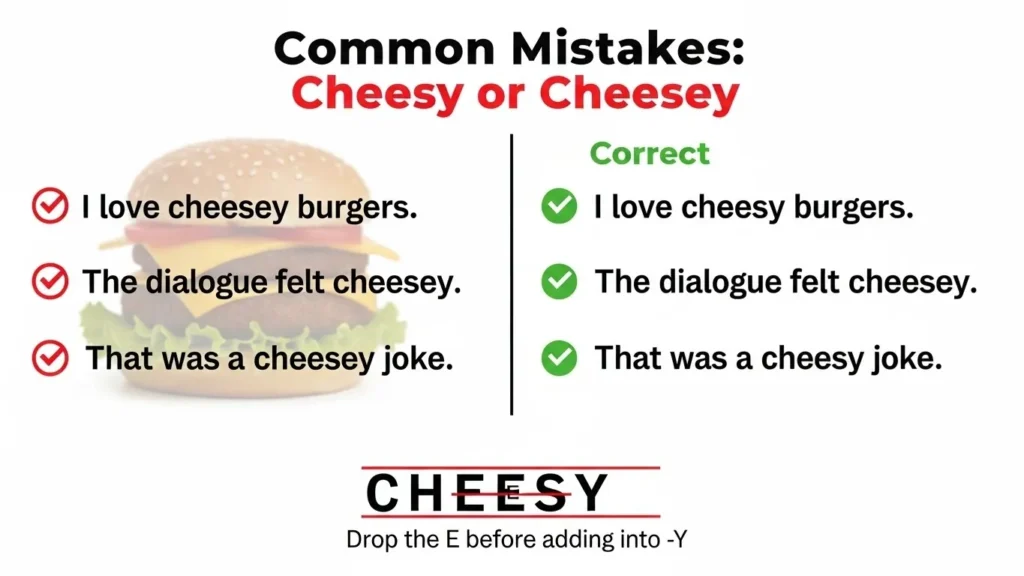
Here are frequent errors:
- ❌ I love cheesey burgers.
✅ I love cheesy burgers. - ❌ The dialogue felt cheesey.
✅ The dialogue felt cheesy. - ❌ That was a cheesey joke.
✅ That was a cheesy joke.
Helpful tip:
If the base word ends in -se, drop the e before adding -y.
Cheesy or Cheesey in Everyday Examples
Emails
- “The ad felt a bit cheesy, but effective.”
Food Reviews
- “The pasta was rich and cheesy.”
Social Media
- “Posting a cheesy family photo today 🧀”
News
- “Critics called the ending cheesy.”
Formal Writing
- “The campaign avoided cheesy slogans.”
Cheesy or Cheesey : Google Trends & Usage Data
Search trends show that “cheesy or cheesey” is commonly searched in:
- ESL-learning regions
- Food blogging communities
- Entertainment review audiences
Cheesy appears widely in books, articles, reviews, and dictionaries. Cheesey appears almost entirely in spelling mistakes and learner queries. Search interest increases around food-related content and entertainment reviews.
Comparison Table: Cheesy vs Cheesey
| Word | Meaning | Correct Usage |
| Cheesy | Full of cheese; corny | ✅ Correct |
| Cheesey | No meaning in standard English | ❌ Incorrect |
FAQs: Cheesy or Cheesey
1. Is “cheesey” ever correct?
No. It is not a recognized English spelling.
2. Is cheesy informal?
It can be both informal and formal, depending on context.
3. Can cheesy describe food and behavior?
Yes. It works for both meanings.
4. Why do people spell it cheesey?
Because of sound-based spelling and confusion with similar words.
5. Is cheesy negative or positive?
It can be either, depending on tone.
6. Is cheesy spelled the same in British English?
Yes. The spelling is the same worldwide.
7. What is the noun form of cheesy?
There is no direct noun form; it comes from cheese.
Conclusion
The confusion between cheesy or cheesey is common, but the rule is simple. Cheesy is the only correct spelling in standard English. It follows a clear spelling rule: when a word ending in -se adds -y, the e is dropped.
Cheesey is a spelling mistake with no accepted meaning. Using it in food writing, reviews, or professional content can weaken your credibility and distract readers. Since cheesy is often used in descriptive and opinion-based writing, spelling it correctly is especially important.
To avoid mistakes, remember this rule:
Cheese + y = cheesy (not cheesey).
Mastering common spelling confusions like this helps improve clarity, confidence, and professionalism in your English writing.

I am Lynne Truss, a British writer and journalist who is best known for my work on English grammar. I have always been interested in language and punctuation, especially how small mistakes can change meaning. Through my books, I try to make grammar easy, interesting, and enjoyable for readers.