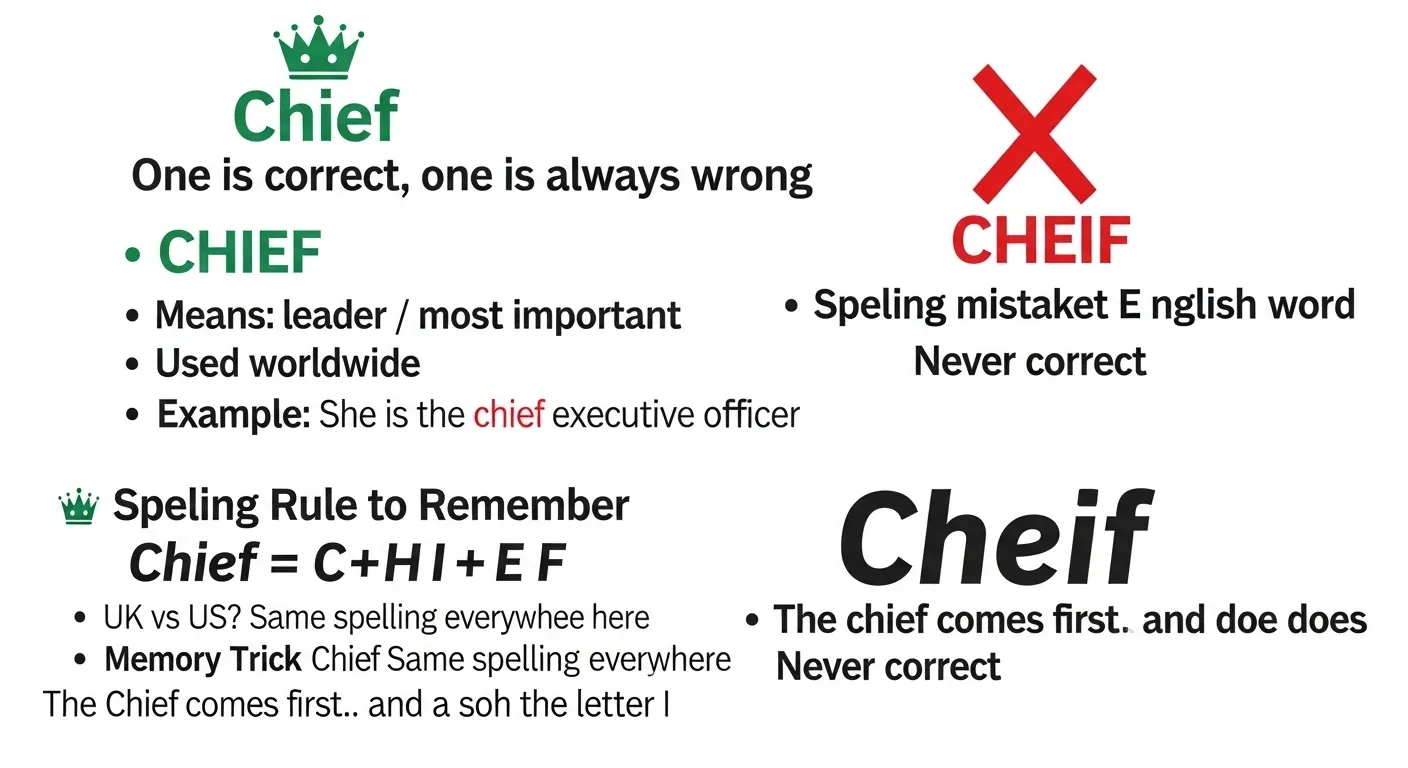
The Short Answer is : Chief is correct. “Cheif” is wrong.
I still remember typing cheif in an email once and feeling confident about it. A few minutes later, the red underline appeared. That small spelling mistake made me stop and think. Was it chief or cheif?
Many people search for this keyword because the letters “ie” and “ei” often confuse English learners. The sound feels the same, but the spelling changes everything. If you have ever paused while writing this word, you are not alone.
This guide will give you a quick answer, a clear rule, examples, and expert advice so you never mix them up again.
Chief or Cheif – Quick Answer
Chief is the correct spelling.
Cheif is a spelling mistake.
The correct order of letters is “ie”, not “ei.”
Examples:
- ✅ She is the chief executive officer.
- ✅ He became the chief of police.
- ❌ He is the cheif of the team.
If you write cheif, it is always wrong in standard English.
The Origin of Chief and Cheif
The word chief comes from Old French chef, which means “head” or “leader.” It later came from Latin caput, which also means “head.” Over time, English adopted the spelling chief.
The confusion happens because English has a common spelling rule:
“I before E, except after C.”
But this rule is not perfect. In the word chief, the letters “ie” come after “ch,” not just “c.” This breaks the simple memory trick people learn in school.
So people mistakenly write cheif, thinking “ei” should come after “c.” But in this word, that rule does not apply.
That is why chief is correct and cheif is always wrong.
British English vs American English Spelling
Good news: there is no difference between British and American English for this word.
Both use chief.
Neither uses cheif.
Here is a simple comparison:
| Version | Correct Spelling | Used In | Example |
| American English | chief | United States | Chief Justice of the Supreme Court |
| British English | chief | UK & Commonwealth | Chief of Defence Staff |
| Incorrect Form | cheif | Nowhere | ❌ Not accepted |
Unlike words such as “colour” and “color,” this word stays the same everywhere.
Which Spelling Should You Use?
You should always use chief, no matter where you live.
- 🇺🇸 In the United States → Use chief
- 🇬🇧 In the United Kingdom → Use chief
- 🌍 In Canada, Australia, India, Pakistan → Use chief
- 💼 In academic writing → Use chief
- 📧 In business emails → Use chief
There is no regional variation and no formal vs informal difference. There is only one correct spelling.
If you want to sound professional and credible, always write chief.
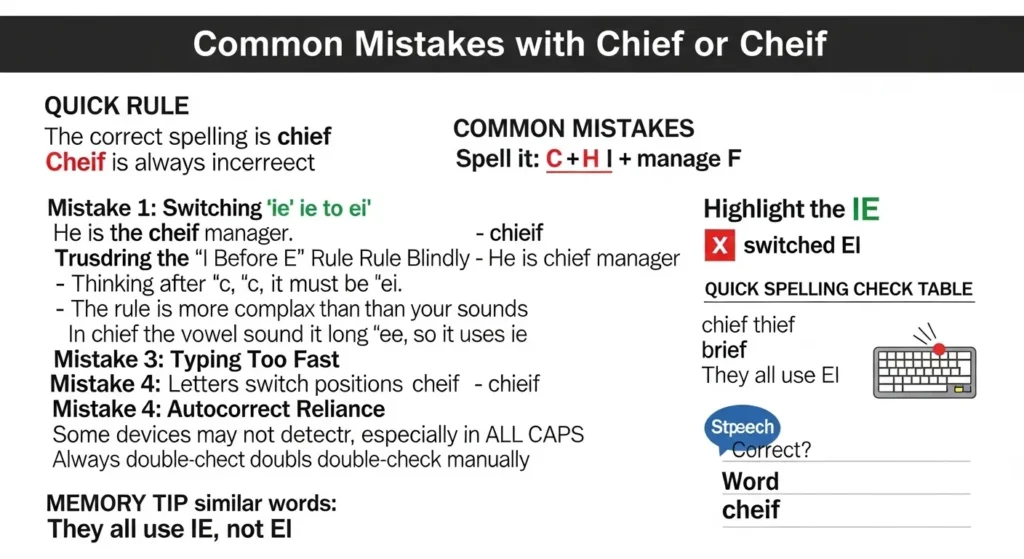
Common Mistakes with Chief or Cheif
Here are the most common errors people make:
❌Switching “ie” to “ei”
Wrong: He is the cheif manager.
Correct: He is the chief manager.
❌Trusting the “I before E” rule blindly
People think after “c,” it must be “ei.”
But chief does not follow that simple version of the rule.
❌ Typing too fast
Sometimes it is just a typing habit. Fingers move quickly, and letters switch places.
❌ Autocorrect reliance
Some devices may not catch the mistake if typed in capital letters.
The safest habit is to remember:
Chief = C + H + I + E + F
Chief or Cheif in Everyday Examples
Let’s see how this word appears in daily life.
📧 In Emails
- “Please speak to the Chief Financial Officer.”
- “The chief concern is customer safety.”
📰 In News
- “The Chief Minister announced new reforms.”
- “The Chief Justice delivered the verdict.”
📱 On Social Media
- “That’s my chief goal this year!”
- “She’s the chief of the squad!”
📄 In Formal Writing
- “The chief objective of this study is clarity.”
- “The chief complaint of the patient was pain.”
In all cases, the spelling stays the same.
Cheif or Chief : Google Trends & Usage Data
Search data shows that chief is searched far more often than cheif. However, many users type cheif by mistake.
Common search patterns include:
- “Is cheif correct?”
- “Chief spelling”
- “Chief meaning”
- “Chief or cheif difference”
The typo appears often in:
- Student writing
- Social media posts
- Informal chats
Countries where this confusion is common:
- United States
- United Kingdom
- India
- Pakistan
- Canada
The reason is simple: English spelling rules are not always consistent.
But in official books, dictionaries, and government documents, only chief appears.
Comparison Table: Chief vs Cheif
| Word | Is It Correct? | Meaning | Used Globally? |
| Chief | ✅ Yes | Leader, main person | Yes |
| Cheif | ❌ No | No meaning | No |
This table makes it simple: only one word is valid.
FAQs About Chief or Cheif
1. Is cheif ever correct?
No. Cheif is always a spelling mistake.
2. Why do people write cheif?
Because they mix up “ie” and “ei.” It is a common spelling confusion.
3. Does British English spell it differently?
No. British and American English both use chief.
4. How can I remember the correct spelling?
Think of it as: The chief is first (I before E).
5. Is chief a noun or adjective?
It can be both.
- Noun: She is the chief.
- Adjective: The chief reason is cost.
6. Is chief used in job titles?
Yes. For example:
- Chief Executive Officer (CEO)
- Chief Justice
- Chief of Police
7. What does chief mean?
It means “leader” or “most important.”
Conclusion: Chief or Cheif – Final Advice
If you remember only one thing from this article, let it be this: chief is correct, and cheif is wrong. There is no regional variation, no alternate spelling, and no formal exception. The confusion happens because English spelling rules are not always simple. Many people rely on the “I before E” rule, but that rule has limits. In this case, the correct order is always “ie.”
Using the correct spelling is important in emails, job titles, academic papers, and professional writing. A small spelling mistake can reduce your credibility. When you write chief, you show attention to detail and strong language skills.
The next time you hesitate, pause and remember: the chief comes first and so does the letter “I.” Once you lock this pattern in your mind, you will never write cheif again.

I am Emily Carter, a British writer and linguistics enthusiast from London.
I specialize in studying the differences between British and American English.
I enjoy exploring how language changes across cultures and regions.
Through my writing, I aim to make English learning simple and interesting for students.