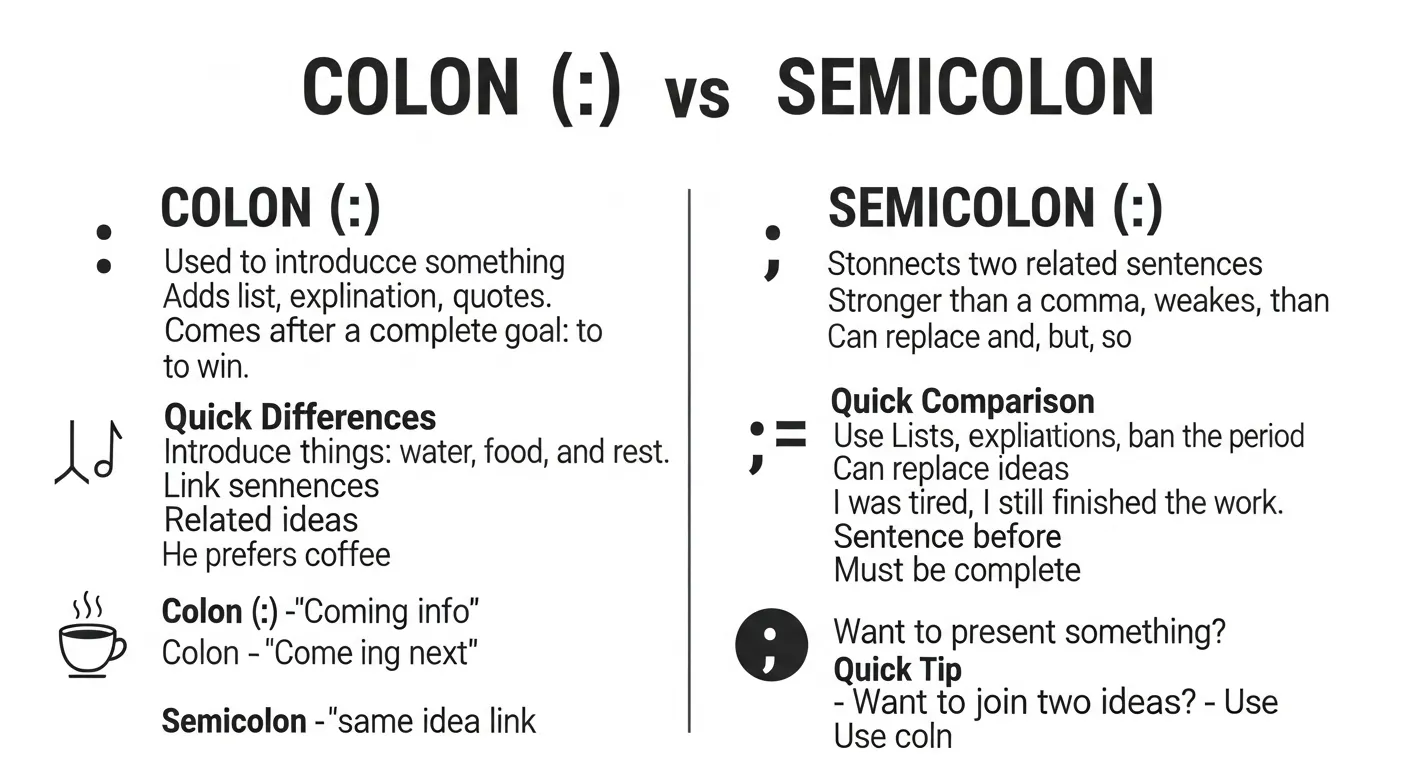
A colon introduces information, while a semicolon connects closely related sentences.
I remember pausing while writing a sentence and wondering if I should use a colon or a semicolon. Both marks looked similar, and I was not sure which one fit better. That small confusion made me realize how often writers mix them up.
Many people search “colon or semicolon” because both punctuation marks appear in formal writing and seem tricky to use.
The good news is that the difference is simple once you understand their purpose and usage.
Colon or Semicolon : Quick Answer
Colon (:) = a punctuation mark used to introduce lists, explanations, or examples.
Semicolon (;) = a punctuation mark used to link closely related independent clauses.
Examples:
- I bought three items: apples, bread, and milk.
- She was tired; she still finished her work.
Simple rule:
Colon → introduces something
Semicolon → connects sentences
Meaning of Colon and Semicolon
The difference between colon and semicolon comes from their function in a sentence.
Colon (:) : Introducing Information
A colon is used to present or introduce something that follows.
Common uses:
- Lists
- Explanations
- Quotes
Examples:
- He had one goal: success.
- Bring these items: pen, notebook, and water.
- She said this: “Never give up.”
Semicolon (;) : Connecting Ideas
A semicolon is used to connect two complete sentences that are closely related.
Examples:
- It was raining; we stayed inside.
- She loves reading; her brother prefers sports.
You can also use semicolons in complex lists.
Example:
- We visited Paris, France; Rome, Italy; and Berlin, Germany.
Origin of Colon or Semicolon
The colon comes from Greek, meaning a part of a sentence. It was used to signal a pause before additional information.
The semicolon was introduced later in the 15th century to show a pause stronger than a comma but weaker than a full stop.
Semicolon and Colon : Key Differences
| Feature | Colon (:) | Semicolon (;) |
| Function | Introduces information | Connects sentences |
| Use | Lists, explanations | Related clauses |
| Sentence type | Can follow a clause | Joins two clauses |
| Tone | Explanatory | Balanced |
Semicolon or Colon in Everyday Examples
In Writing
- She had a clear plan: work hard and stay focused.
- He was late; the meeting had already started.
Emails
- Please bring the following: documents, ID, and forms.
- I wanted to call you; I was busy all day.
In Formal Writing
- The result was clear: the method worked.
- The data was incomplete; further research is needed.
Common Mistakes with Colon or Semicolon
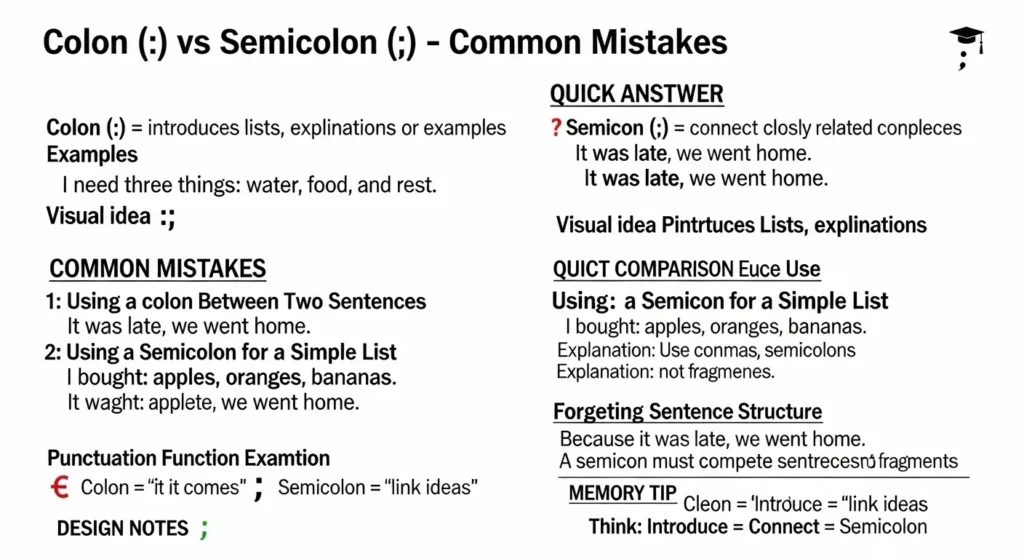
1. Using a Colon Between Two Sentences
❌ It was late: we went home.
✅ It was late; we went home.
2. Using a Semicolon for a List
❌ I bought: apples; oranges; bananas.
✅ I bought: apples, oranges, bananas.
3. Forgetting Sentence Structure
A semicolon connects complete sentences, not fragments.
Colon vs Semicolon : Side by Side Comparison
| Feature | Colon | Semicolon |
| Symbol | : | ; |
| Main Use | Introduce | Connect |
| Example | She wants one thing: peace. | She was tired; she kept working. |
| Strength | Strong introduction | Medium pause |
Frequently Asked Questions
1. What is the difference between a colon and a semicolon?
A colon introduces information, while a semicolon connects related sentences.
2. Can I use a colon before a list?
Yes. A colon is commonly used to introduce lists.
3. When should I use a semicolon?
Use a semicolon to link two complete sentences with related ideas.
4. Can a semicolon replace a full stop?
Yes, but only when the sentences are closely related.
5. Is a colon stronger than a semicolon?
Yes. A colon creates a stronger pause and introduces something important.
6. Can I use both in the same sentence?
Yes, especially in complex sentences.
Example:
- She had one goal: success; nothing else mattered.
Conclusion
Understanding the difference between colon and semicolon makes writing clearer and more professional. A colon is used to introduce information, such as lists, explanations, or examples. It prepares the reader for what comes next.
A semicolon, on the other hand, connects two closely related sentences without using a conjunction. It creates a smooth flow between ideas. Although both punctuation marks may look similar, their roles are very different.
By remembering that a colon introduces and a semicolon connects, you can avoid common mistakes and improve your writing. With practice, choosing the right punctuation becomes natural and helps your sentences sound more polished and clear.

I am Mignon Fogarty, an American author and language expert also known as “Grammar Girl.”
I focus on explaining grammar rules, spelling mistakes, and confusing words in a simple and friendly way.
My goal is to make correct English easy and approachable for everyday readers.