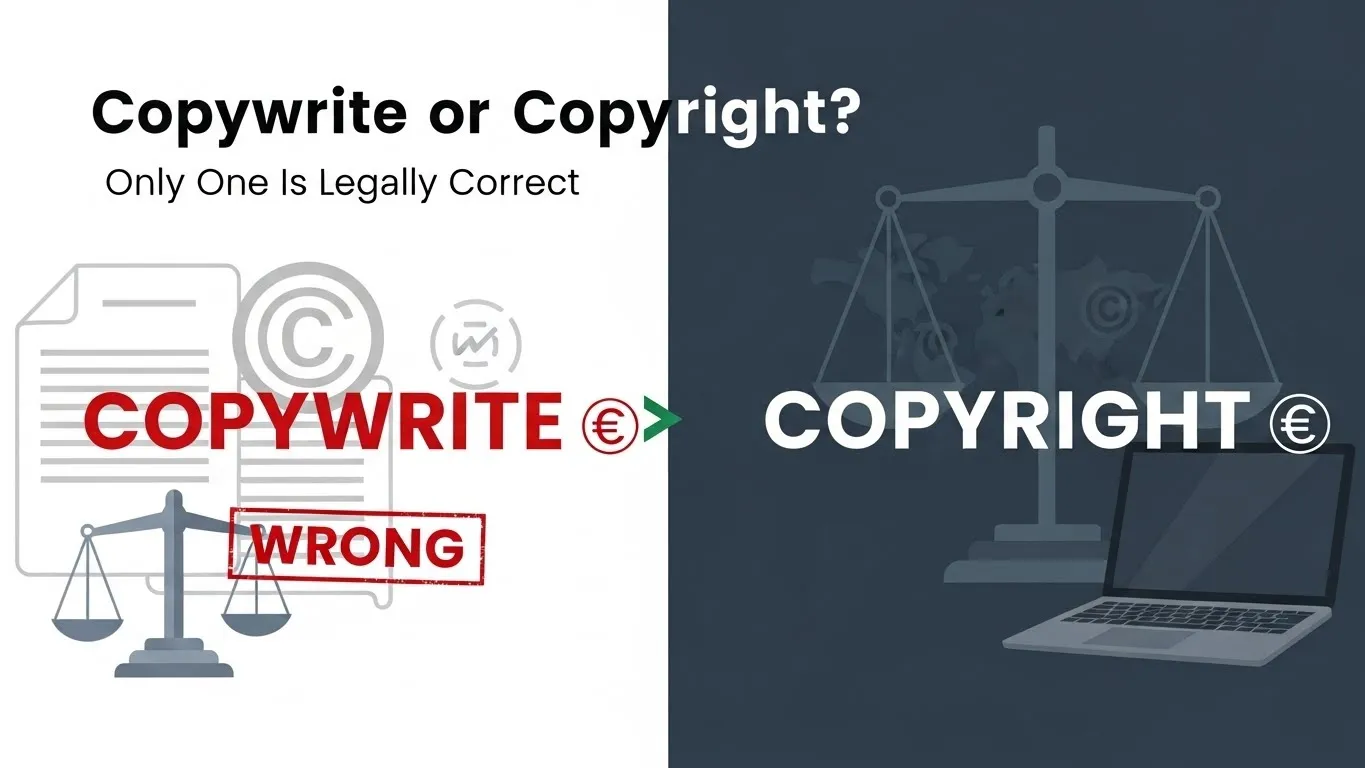
The correct term is Copyright. Copywrite is a spelling error and has no legal meaning in English.
I often see people confused about “copywrite or copyright”, and maybe you’ve been there too. I’ve noticed this mistake in emails, contracts, and even website footers, where one small word changes the whole meaning.
At first, copywrite feels logical, especially if you connect it with writing. I thought the same. Then I realized English doesn’t follow that logic here only copyright is correct. In this article, I’ll clear that confusion step by step and help you use the right term confidently in professional writing.
Copywrite or Copyright : Quick Answer
Copyright is the correct word when talking about legal ownership of creative work.
Copywrite is not correct when you mean legal rights.
Copyright means the legal right to control the use, copying, or distribution of creative content.
Examples:
- ✅ This book is protected by copyright.
- ❌ This book is protected by copywrite.
- ✅ The photographer owns the copyright to the images.
Discover More: Magestic or Majestic: Which Spelling Is Correct and Why It Matters
The Origin of Copywrite or Copyright
Copyright comes from two words:
- copy (a written work)
- right (a legal entitlement)
The term originated in English law in the 18th century, referring to the legal right to copy and distribute a creative work. Over time, it became a global legal concept used in publishing, music, film, software, and online content.
Copywrite, on the other hand, is not a legal term. It appears because:
- People assume it relates to “writing”
- It sounds logical in spoken English
- Writers confuse it with “copywriter” (a person who writes advertising copy)
Despite its frequent use online, copywrite is a spelling error in this context.
British English vs American English Spelling
This is not a British vs American spelling difference.
Both varieties use:
- Copyright → correct
- Copywrite → incorrect
Comparison Table
| English Variety | Correct Term | Incorrect Term |
| American English | Copyright | Copywrite |
| British English | Copyright | Copywrite |
| Australian English | Copyright | Copywrite |
| Global English | Copyright | Copywrite |
There is no regional variation for this word.
Which Spelling Should You Use?
Use copyright when:
- Talking about legal ownership
- Referring to books, music, videos, software, or images
- Writing website footers or contracts
- Discussing intellectual property
Do not use copywrite unless:
- You are referring to copywriting (the act of writing ads), and even then the correct word is copywriter, not copywrite.
For legal or professional writing, copyright is always the correct choice.
Common Mistakes with Copywrite or Copyright
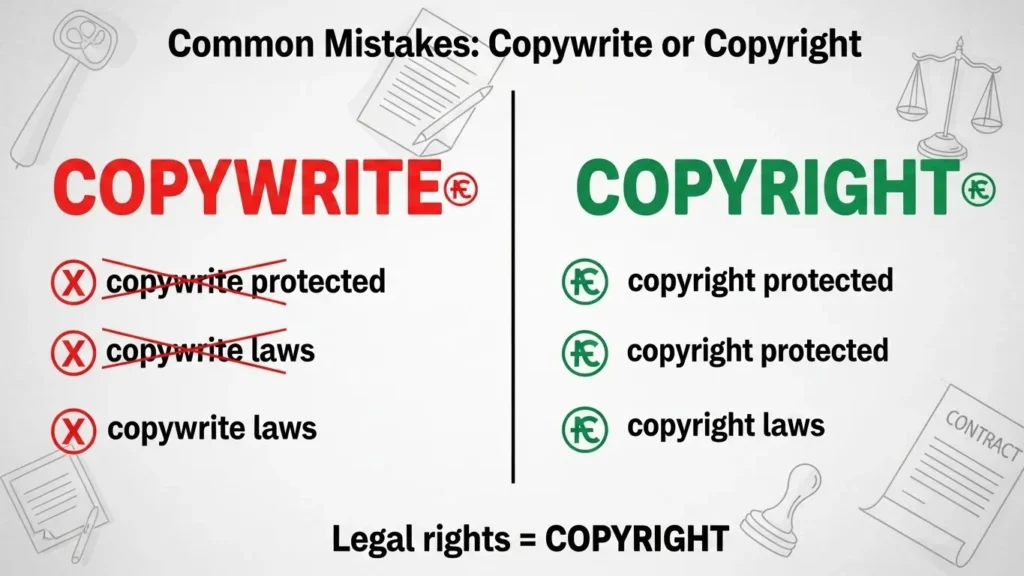
These errors are extremely common:
- ❌ This content is copywrite protected.
✅ This content is copyright protected. - ❌ He owns the copywrite of the song.
✅ He owns the copyright of the song. - ❌ Please respect the copywrite laws.
✅ Please respect the copyright laws.
Helpful tip:
If the sentence refers to legal rights, the word must be copyright.
Copywrite or Copyright in Everyday Examples
Emails
- “This document is protected by copyright.”
News
- “The company filed a copyright lawsuit.”
Social Media
- “No copyright infringement intended.”
Formal Writing
- “The author retains full copyright ownership.”
Websites
- “© 2025 All rights reserved. Copyright applies.”
Copywrite or Copyright : Google Trends & Usage Data
Search trend data shows that “copywrite or copyright” is frequently searched in:
- South Asia
- Middle East
- ESL-learning regions
- Freelancing and content-creation communities
The confusion appears mainly in:
- Blogging and YouTube content
- Freelance job descriptions
- Legal and academic writing
Copyright is used millions of times in legal documents, books, media platforms, and official websites. Copywrite appears mostly in spelling mistakes and learner searches. Interest spikes when people create websites, publish content, or learn about intellectual property rights.
Comparison Table: Copywrite vs Copyright
| Word | Meaning | Correct Usage |
| Copyright | Legal right over creative work | ✅ Correct |
| Copywrite | Incorrect form (confused with copywriting) | ❌ Incorrect |
FAQs: Copywrite or Copyright
1. Is “copywrite” ever correct?
No, not when referring to legal rights.
2. What is a copywriter?
A person who writes advertising or marketing content.
3. Is copyright a noun or verb?
It can be both, but is mostly used as a noun.
4. Is copyright spelled the same in US and UK English?
Yes. The spelling is identical.
5. Can I say “copyrighted”?
Yes. Example: “This image is copyrighted.”
6. Why do people confuse copywrite and copyright?
Because of the word “write” and confusion with copywriting.
7. Does copyright apply automatically?
Yes. In many countries, it applies as soon as the work is created.
Conclusion
The confusion between copywrite or copyright is very common, especially among writers, bloggers, and content creators. However, the rule is simple and clear. Copyright is the correct and legally recognized term for ownership and protection of creative work.
Copywrite is not a valid substitute and should never be used when talking about legal rights. Using it in contracts, websites, or professional writing can reduce credibility and cause misunderstanding.
To avoid mistakes, remember this rule:
If the topic is legal ownership or intellectual property, the correct word is always copyright.
Understanding and using this word correctly helps protect your work and makes your writing look professional and trustworthy.

I am Bryan A. Garner, an American writer and editor focused on English usage, grammar, and word choice.
I am best known for Garner’s Modern English Usage, a reference book widely used by writers, editors, and legal professionals.
My work centers on clarity, precision, and resolving confusing word comparisons in modern English.