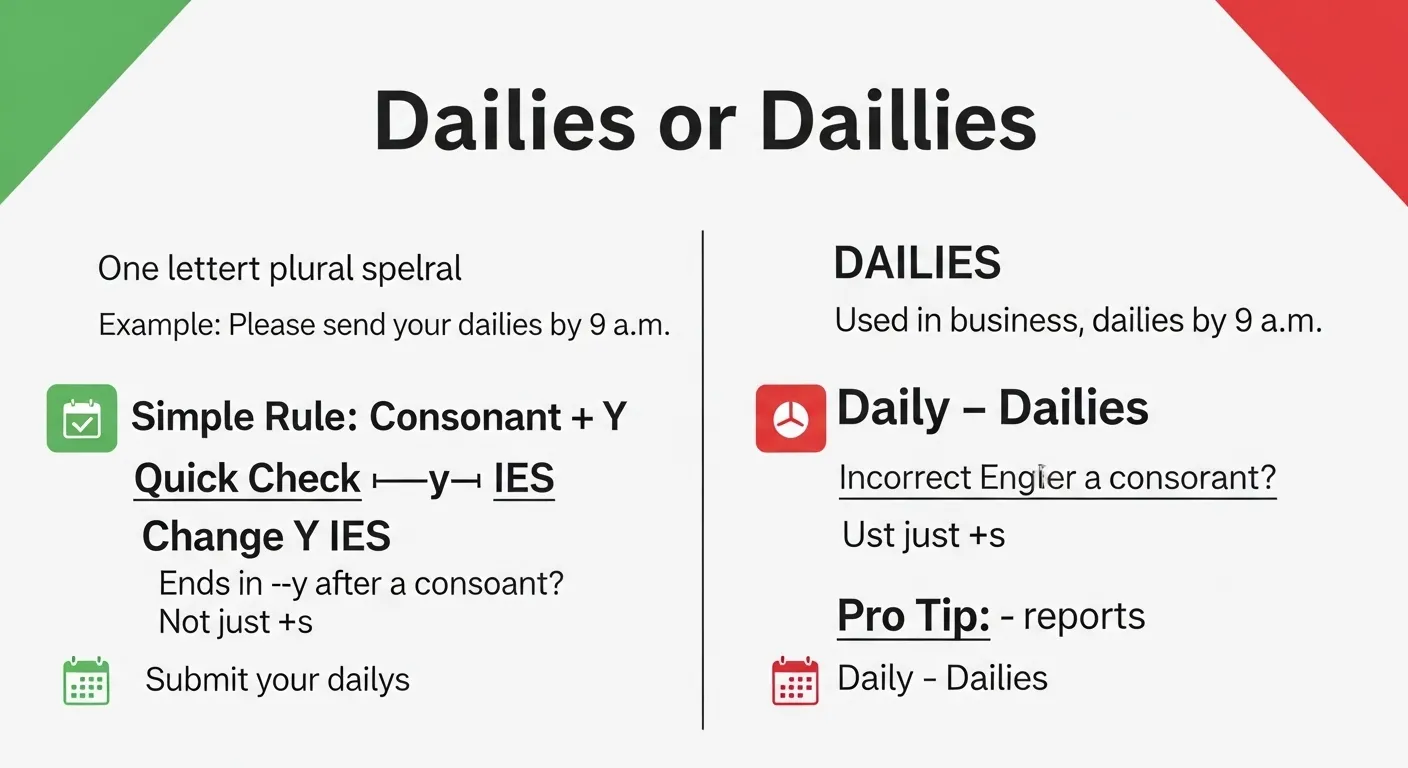
The short answer: dailies is correct, while dailys is incorrect.
Dailies or dailys confused me the first time I wrote a work update. I typed “Please send your dailys by 9 a.m.” and then hesitated. Something felt wrong. I searched online and found many people asking the same question: dailies or dailys.
This confusion happens because English plural rules are not always consistent. Writers, students, office workers, and content creators want to sound professional but fear small spelling mistakes.
This article clears that confusion completely and shows why dailies is correct and dailys is not.
Dailies or Dailys : Quick Answer
- dailies → Correct plural form
- dailys → Incorrect spelling
Examples:
✅ Please submit your dailies before the meeting.
❌ Please submit your dailys before the meeting.
Simple Rule:
Words ending in -y usually change y → ies in plural form.
The Origin of Dailies or Dailys
The word daily comes from Latin diurnalis, meaning “of the day.” Over time, English adopted daily as both an adjective and a noun.
When daily is used as a noun, it can be plural. English plural rules say:
- If a word ends in consonant + y, change y to ies
- This gives us dailies, not dailys
The confusion exists because:
- Some words just add -s
- English plural rules are mixed
- Writers apply the wrong rule
Knowing the origin helps you remember the correct form.
British English vs American English Spelling
There is no difference between British and American English for dailies. Both follow the same plural rule.
Comparison Table
| Form | Meaning | UK English | US English |
| dailies | plural noun | ✅ Same | ✅ Same |
| dailys | incorrect form | ❌ No | ❌ No |
This is a grammar rule, not a regional spelling choice.
Which Spelling Should You Use?
Always use dailies.
Audience-Based Advice
- US audience → Use dailies
- UK / Commonwealth → Use dailies
- Global audience → Use dailies
Quick Tip:
If the word ends in -y, check if you need -ies for the plural.
Common Mistakes with Dailies or Dailys
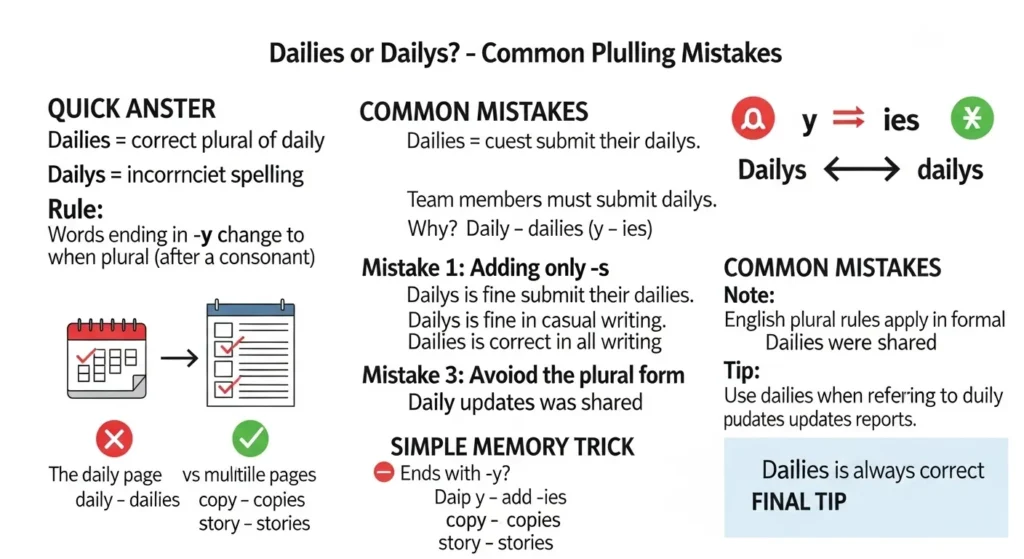
Mistake 1: Adding only -s
❌ Team members must submit their dailys.
✅ Team members must submit their dailies.
Mistake 2: Thinking dailys is informal
❌ Dailys is fine in casual writing.
✅ Dailies is correct in all writing.
Mistake 3: Avoiding the plural form
❌ Daily updates was shared.
✅ Dailies were shared.
Dailies or Dailys in Everyday Examples
Emails
- Please send your dailies by end of day.
News
- The editor reviewed the film dailies.
Social Media
- Posting my workout dailies 💪
Formal Writing
- Project dailies were documented for review.
Dailies or Dailys – Google Trends & Usage Data
Search data shows dailies or dailys is often searched in:
- United States
- United Kingdom
- India
- Australia
- Canada
Why people search this keyword:
- Office and project updates use “dailies”
- Film and media use “dailies” often
- Writers are unsure about plural -y rules
Usage Insight:
- Dailies appears in professional and creative fields
- Dailys appears mostly as a spelling error
Dailies vs Dailys – Side-by-Side Comparison
| Form | Status | Meaning | Example |
| daily | singular | one daily item | A daily report |
| dailies | plural | more than one daily item | The dailies arrived |
| dailys | incorrect | not standard English | ❌ Wrong |
FAQs: Dailies or Dailys
1. Is “dailys” ever correct?
No. It is always incorrect.
2. Why does daily become dailies?
Because it ends in consonant + y.
3. Is dailies used in British English?
Yes. Same rule applies.
4. Is dailies formal or informal?
It works in both formal and informal writing.
5. Can daily be both noun and adjective?
Yes. Only the noun form becomes plural.
6. Is dailies common in business writing?
Yes, especially for reports and updates.
7. How can I remember the rule?
Change y → ies for plural nouns.
Conclusion
The confusion between dailies or dailys comes from misunderstanding English plural rules. The correct form is always dailies. English does not accept dailys in standard writing. Once you remember the y → ies rule, this mistake disappears.
I’ve learned that checking plural endings saves time and embarrassment. Whether you are writing emails, reports, scripts, or social posts, using dailies correctly makes your writing look clean and professional. This rule works the same in British and American English, so you never need to worry about location. Master this one pattern, and many other spelling problems will feel easier too.
Discover More Articles:

I am Bryan A. Garner, an American writer and editor focused on English usage, grammar, and word choice.
I am best known for Garner’s Modern English Usage, a reference book widely used by writers, editors, and legal professionals.
My work centers on clarity, precision, and resolving confusing word comparisons in modern English.