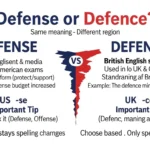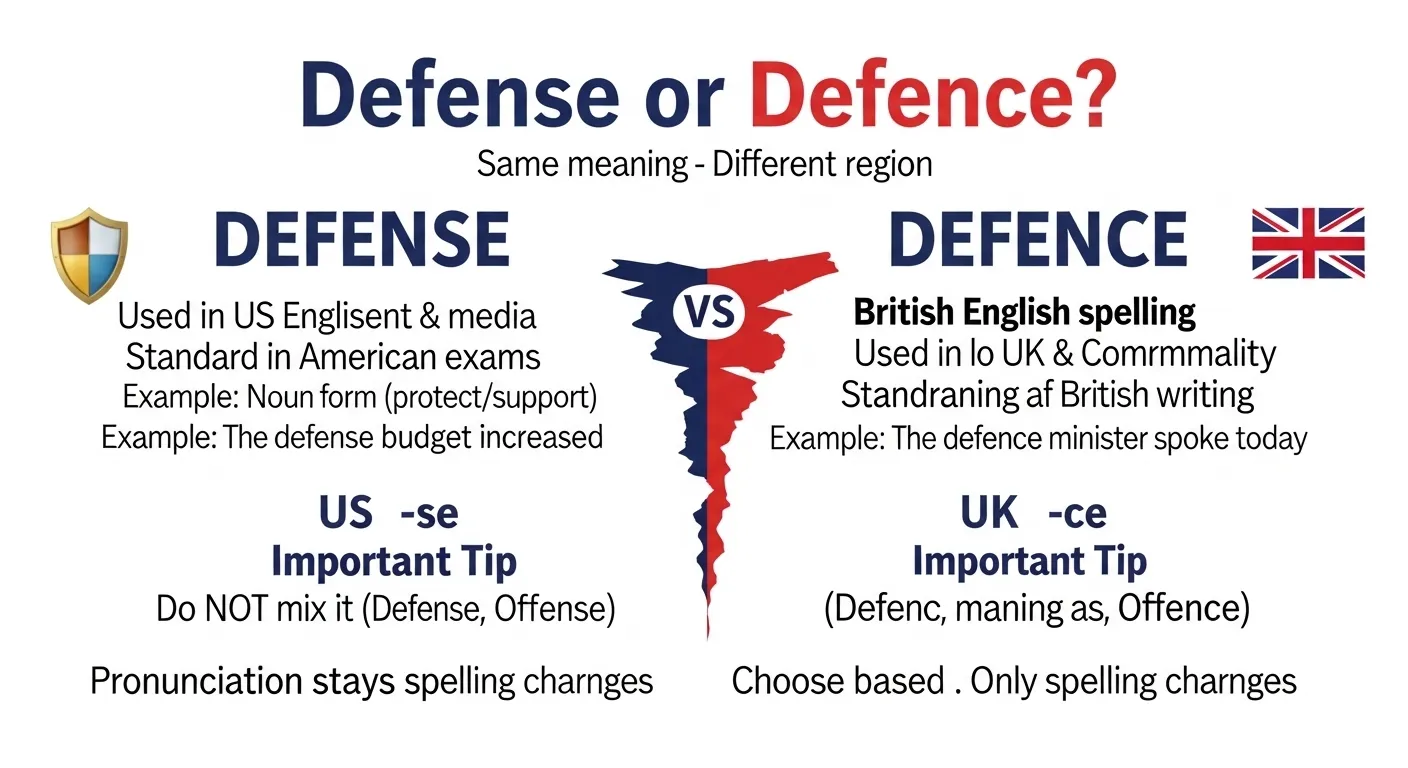
Defense or defence? The quick answer is simple: both are correct, but defense is American English, while defence is British English.
I once wrote an article about national security and used “defence.” Later, my US client changed every word to “defense.” At first, I thought I had made a spelling mistake. But I had not. The difference was only regional.
Many writers search “defense or defence” because the words look different but sound the same. The meaning does not change, but the spelling depends on where your audience lives.
This guide explains the difference clearly and helps you choose the right form.
Defense or Defence : Quick Answer
Both spellings mean the same thing. The difference is regional.
- Defense → American English
- Defence → British English
Examples:
🇺🇸 American English
✔ The country increased its defense budget.
🇬🇧 British English
✔ The country increased its defence budget.
If you write for a US audience, use defense.
If you write for a UK audience, use defence.
The Origin of Defense and Defence
The word comes from the Latin defensa, meaning protection. It entered English through Old French.
In early English, both “-ce” and “-se” endings were used. Over time:
- British English kept the -ce form in many nouns.
- American English simplified some spellings to -se.
This pattern appears in other words too:
- Licence (UK) / License (US)
- Practice (UK noun) / Practice (US noun)
- Offence (UK) / Offense (US)
So the difference is part of a larger spelling pattern between British and American English.
British English vs American English Spelling
This is a classic regional spelling difference.
🇺🇸 American English Rule
- Use -se in nouns like defense, offense.
- Preferred spelling: defense
🇬🇧 British English Rule
- Use -ce in nouns like defence, offence.
- Preferred spelling: defence
Comparison Table
| Version | Correct Spelling | Example |
| American English | Defense | The defense team prepared well. |
| British English | Defence | The defence minister spoke today. |
| International (Neutral) | Defense | The defense system failed. |
Globally, “defense” appears more often online due to American influence.
Which Spelling Should You Use?
Here is simple advice:
🇺🇸 Writing for an American Audience
Use defense. It matches US dictionaries and official style guides.
🇬🇧 Writing for a British or Commonwealth Audience
Use defence. It follows British spelling rules.
🌍 Writing for an International Audience
“Defense” is more widely recognized, but either form is correct if used consistently.
The key rule:
Do not mix both spellings in the same document.
Common Mistakes with Defense or Defence
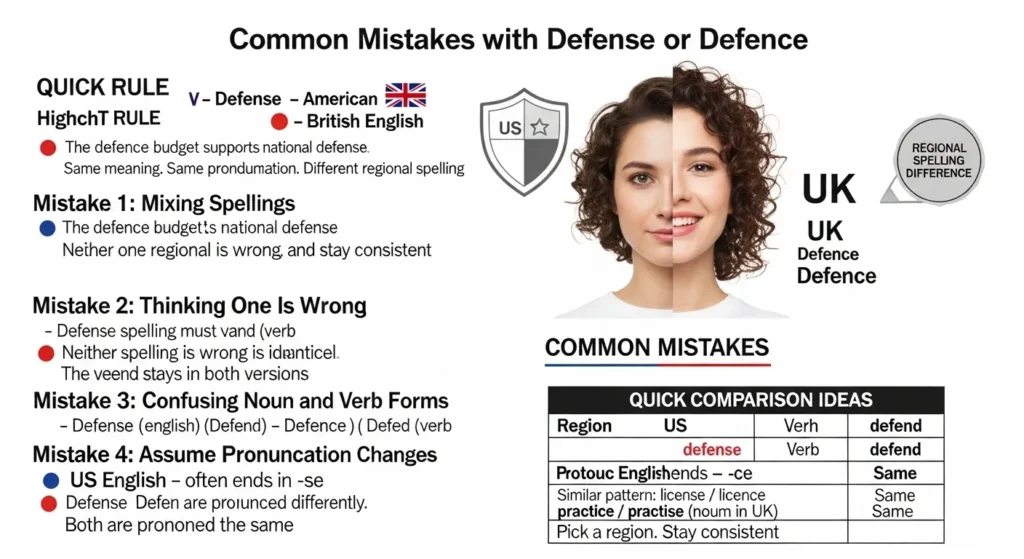
❌ Mistake 1: Mixing spellings
Wrong: The defence budget supports national defense.
Correct: Choose one style and stay consistent.
❌ Mistake 2: Thinking one is wrong
Neither spelling is incorrect. The meaning is identical.
❌ Mistake 3: Confusing noun and verb forms
In American English:
- Defense (noun)
- Defend (verb)
In British English:
- Defence (noun)
- Defend (verb)
The verb spelling stays the same in both versions.
❌ Mistake 4: Assuming pronunciation changes
Both words are pronounced the same.
Defence or Defense in Everyday Examples
📧 In Emails
- The legal defense was strong. (US)
- The legal defence was strong. (UK)
📰 In News Articles
- The defense department announced new policies.
- The defence secretary gave a speech.
📱 On Social Media
- Good defense wins games!
- Strong defence wins championships!
📄 In Academic Writing
- The theory lacks strong defense.
- The argument needs more defence.
The context does not change the meaning—only the audience changes the spelling.
Defense or Defence : Usage Trends
In the United States, “defense” is the standard spelling in government, law, sports, and education.
In the United Kingdom, Australia, and other Commonwealth countries, “defence” appears in official documents, news articles, and academic writing.
Why do people search this keyword?
- They work with international clients.
- They see both spellings online.
- Spell check suggests different versions.
- They are unsure which is correct for exams or formal writing.
Globally, “defense” appears more often because American English dominates online content. However, “defence” remains strong in British publications.
Comparison Table: Defense vs Defence
| Word | Region | Meaning | Correct? |
| Defense | US | Protection, support | Yes |
| Defence | UK | Protection, support | Yes |
| Defend | US/UK | Verb form | Yes |
| Defensive | US/UK | Adjective | Yes |
The meaning stays exactly the same.
FAQs
1. Is “defence” wrong in American English?
Yes, it is considered non-standard in the US.
2. Is “defense” wrong in British English?
It is understood but not the preferred spelling.
3. Do both words mean the same thing?
Yes. There is no meaning difference.
4. Is pronunciation different?
No. Both are pronounced the same way.
5. Which spelling is more common worldwide?
“Defense” appears more often globally due to American influence.
6. Should I use one spelling in academic writing?
Yes. Follow your country’s spelling rules.
7. Can I mix both forms in one article?
No. Choose one style and remain consistent.
Conclusion
The difference between defense and defence is simple and clear. Both words mean protection or support. The only difference is regional spelling. American English uses “defense” with an “s,” while British English uses “defence” with a “c.”
This spelling pattern appears in other similar words as well, such as offense and offence. The pronunciation does not change, and the meaning stays the same. The choice depends entirely on your audience.
If you are writing for an American reader, use “defense.” If your audience is British or from a Commonwealth country, use “defence.” For international content, “defense” is often more common, but consistency is the most important rule.
Once you understand that this is only a regional spelling difference, the confusion disappears. Pick the correct version for your audience, stay consistent, and your writing will remain clear and professional.

I am Mignon Fogarty, an American author and language expert also known as “Grammar Girl.”
I focus on explaining grammar rules, spelling mistakes, and confusing words in a simple and friendly way.
My goal is to make correct English easy and approachable for everyday readers.