The short answer is this: dissociate is the original and preferred form, but disassociate is also accepted in modern English.
I remember clearly when I was editing an article and paused at one sentence: “The company decided to disassociate itself from the scandal.” My mind instantly asked, Is that spelling right, or should it be dissociate? I searched “disassociate or dissociate”, just like many writers, students, and professionals do.
The confusion comes from spelling, pronunciation, and dictionary differences. Once I understood the history and usage patterns, the doubt disappeared. In this guide, I’ll walk you through that realization and give you a clear solution you can confidently apply in any context.
Disassociate or Dissociate: Quick Answer
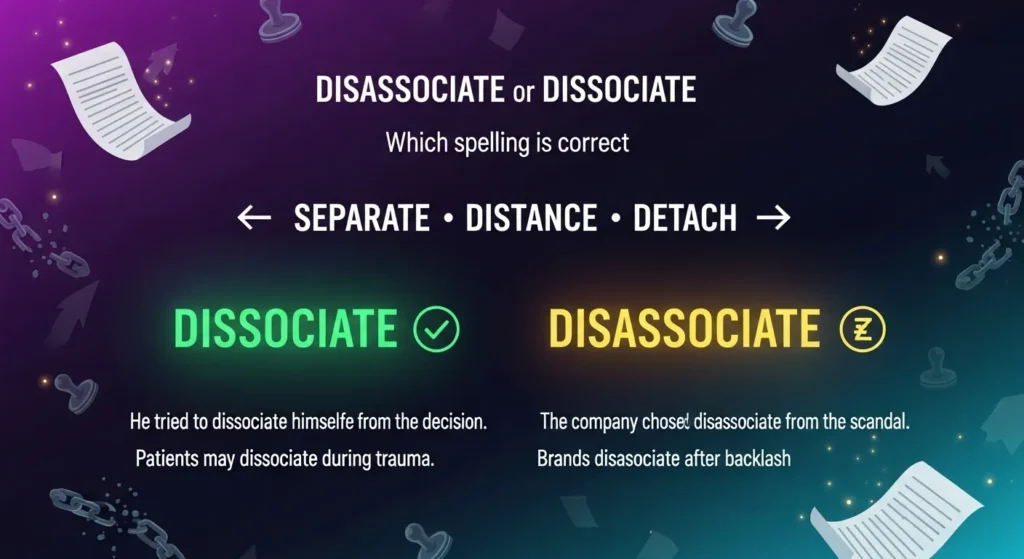
Dissociate is the original, traditional, and more widely recommended form.
Disassociate is a later variant and is considered acceptable, especially in American English.
Examples:
- ✔ He tried to dissociate himself from the decision.
- ✔ The brand moved to disassociate from the controversy.
👉 If you want the safest and most formal choice, use dissociate.
The Origin of Disassociate or Dissociate
Understanding the origin clears most of the confusion.
Dissociate comes from the Latin dissociatus, meaning to separate or detach. This form entered English first and has long been the standard in formal writing, psychology, law, and academia.
Disassociate developed later through a process called spelling extension. Because many English words begin with the prefix dis- (disagree, disconnect, disapprove), people naturally formed disassociate by analogy.
Why confusion exists:
- Both forms appear in dictionaries
- Pronunciation sounds similar
- Prefix dis- feels more familiar to modern writers
Historically, however, dissociate came first and remains the primary form.
British English vs American English Spelling
This is partly a regional preference issue, but not a strict one.
- British English → Strongly prefers dissociate
- American English → Accepts both, but still favors dissociate
- Academic & professional writing → Prefers dissociate
Examples:
- UK: The minister sought to dissociate himself from the remarks.
- US: The company announced plans to disassociate from the event.
Comparison Table
| Form | British English | American English | Formal Writing |
| Dissociate | Preferred | Preferred | Strongly preferred |
| Disassociate | Rare | Accepted | Less preferred |
Which Spelling Should You Use?
Your choice depends on audience and tone.
- US audience (casual or corporate) → Either works
- UK/Commonwealth audience → Dissociate
- Global, academic, or legal writing → Dissociate
Simple rule:
If you want to avoid all risk, always choose dissociate.
It is universally accepted and stylistically safer.
Common Mistakes with Disassociate or Dissociate
Here are errors I see frequently.
❌ Dissassociate (double “s” and “a”)
✅ Dissociate
❌ Thinking disassociate is incorrect
✅ It is acceptable, just less preferred
❌ Mixing forms in the same document
✅ Choose one form and stay consistent
Quick tip:
If you see two s’s in the middle, you’re likely on the right track: dissociate.
Disassociate or Dissociate in Everyday Examples
Emails
- “I want to dissociate myself from that decision.”
- “The firm chose to disassociate from the campaign.”
News Writing
- “The actor tried to dissociate from the controversy.”
- “Sponsors disassociated themselves after backlash.”
Social Media
- “I completely dissociate from this opinion.”
- “Brands are quick to disassociate these days.”
Formal & Academic Writing
- “Patients may dissociate during traumatic experiences.”
- “The organization formally dissociated itself from the actions.”
Disassociate or Dissociate: Google Trends & Usage Data
Search data shows “disassociate or dissociate” is common among:
- Students
- ESL learners
- Journalists
- Business writers
Usage patterns:
- Dissociate dominates in:
- Academic papers
- Psychology
- Legal writing
- Formal journalism
- Disassociate appears more in:
- Corporate statements
- Press releases
- Informal US writing
Regional interest:
- United States (both forms searched)
- United Kingdom (mostly dissociate)
- India, Pakistan, Australia (formal preference)
This confirms that disassociate exists, but dissociate leads globally.
Comparison Table: Disassociate vs Dissociate
| Feature | Dissociate | Disassociate |
| Original form | Yes | No |
| Dictionary accepted | Yes | Yes |
| Formal writing | Preferred | Less preferred |
| British English | Standard | Rare |
| American English | Common | Acceptable |
| Academic usage | Very common | Rare |
FAQs: Disassociate or Dissociate
1. Is disassociate grammatically correct?
Yes, it is accepted in modern English.
2. Which word came first?
Dissociate came first.
3. Is dissociate more formal?
Yes, it is preferred in formal and academic writing.
4. Do dictionaries allow both?
Yes, most modern dictionaries list both.
5. Which should I use in exams?
Use dissociate.
6. Are meanings different?
No, both mean to separate or distance oneself.
7. Can I mix them in one article?
No. Choose one and stay consistent.
Conclusion
The confusion between disassociate and dissociate is understandable, especially because both appear correct at first glance. But once you look deeper, the solution becomes clear.
Dissociate is the original, historically established, and stylistically preferred form across British English, American English, and global professional writing.
Disassociate is not wrong, but it is a later variant that works best in informal or corporate American contexts. If your goal is clarity, credibility, and universal acceptance, dissociate is the safest choice. Small spelling decisions like this shape how polished your writing appears.
Now that you know the difference, you can choose confidently and never second-guess this word again.

I am Mignon Fogarty, an American author and language expert also known as “Grammar Girl.”
I focus on explaining grammar rules, spelling mistakes, and confusing words in a simple and friendly way.
My goal is to make correct English easy and approachable for everyday readers.