An either or fallacy is a thinking error that presents only two choices when more options actually exist.
I remember hearing a debate where someone said, “You are either with us or against us.” It sounded strong, but something felt wrong. The situation was clearly more complex than just two sides.
That moment made me realize how common this mistake is. Many people search “either or fallacy” because they see it in arguments, media, and daily conversations.
Once you understand how it works, you can easily spot it and avoid using it in your own thinking.
Either or Fallacy : Quick Answer
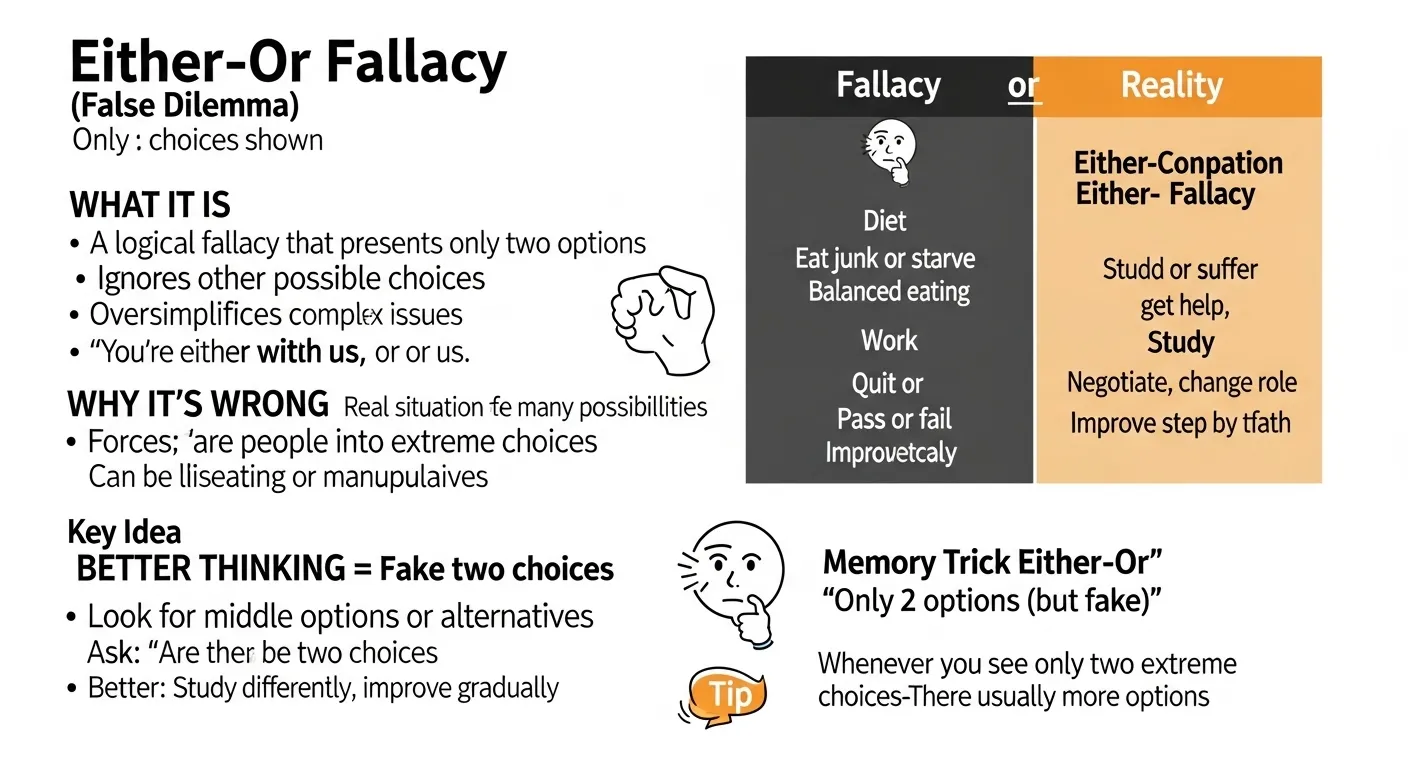
Either or fallacy = a logical error that limits a situation to only two choices when more possibilities exist
Examples:
- You either succeed or fail.
- You are either smart or not.
Simple rule:
Either or fallacy → false two choices
Reality → many possible options
Meaning of Either or Fallacy
The either or fallacy happens when someone forces a situation into only two options, even though more choices are available.
It is also called a false dilemma.
Key idea:
- The argument ignores other possibilities
- It simplifies complex situations
- It pressures people to choose one side
Examples:
- You either study all night or you will fail.
- We either cut costs or the company will collapse.
In reality, there are usually more balanced solutions.
Origin of Either and Fallacy
The concept comes from the field of Logic, where thinkers study correct and incorrect reasoning.
The term false dilemma has been used for centuries to describe arguments that present limited choices.
It became popular in debates, politics, and education as a way to identify weak reasoning.
Fallacy vs Either : Key Characteristics
| Feature | Description |
| Limited choices | Only two options are presented |
| Ignored alternatives | Other possibilities are hidden |
| Simplification | Complex issue made too simple |
| Persuasion tactic | Used to influence decisions |
Which One Should You Use?
The either or fallacy is not something you should use intentionally in clear and honest communication.
Instead:
Use it carefully only when:
- There are truly only two options
Avoid it when:
- The situation is complex
- Multiple solutions exist
Quick tip:
Ask yourself:
- Are there more than two choices?
→ Yes → Avoid this fallacy
Common Mistakes with Either or Fallacy
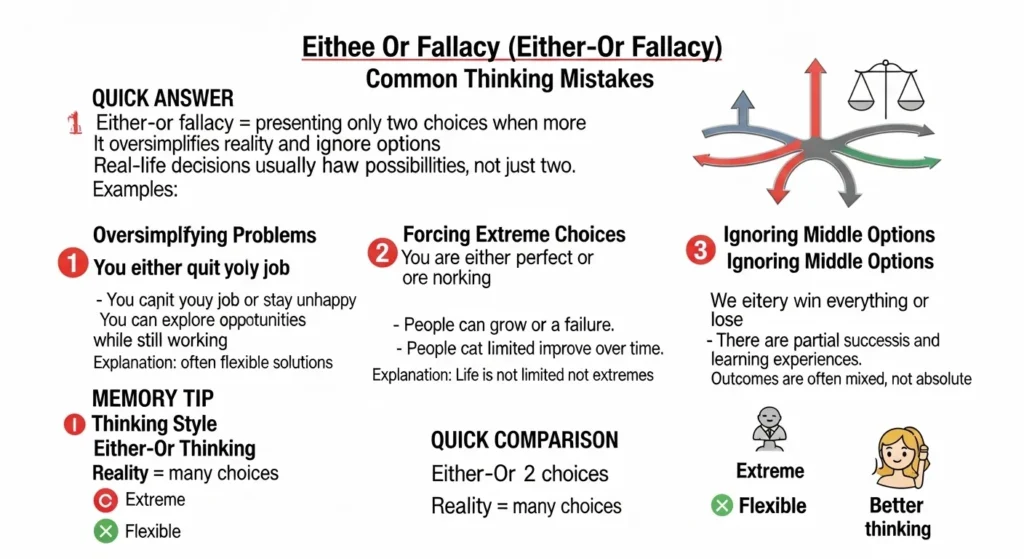
1. Oversimplifying Problems
❌ You either quit your job or stay unhappy.
✅ You can look for new opportunities while working.
2. Forcing Extreme Choices
❌ You are either perfect or a failure.
✅ People can improve over time.
3. Ignoring Middle Options
❌ We either win everything or lose everything.
✅ There are partial successes and lessons.
Either or Fallacy in Everyday Examples
In Conversations
- You either agree with me or you are wrong.
Social Media
- You are either successful or lazy.
In News and Debate
- We either take action now or face disaster.
In Personal Thinking
- I either do this perfectly or not at all.
These examples show how common the fallacy is.
Either or Fallacy : Real Life Impact
This fallacy can:
- Create unnecessary pressure
- Limit creative solutions
- Increase conflict
- Reduce critical thinking
Recognizing it helps you think more clearly.
Either vs Fallacy : Comparison
| Either or Fallacy | Reality |
| Two choices only | Many possibilities |
| Extreme thinking | Balanced thinking |
| Simplified view | Complex understanding |
| Limited solutions | Flexible solutions |
Fallacy or Either : Usage Insight
This fallacy appears often in:
- Politics
- Advertising
- Debates
- Daily arguments
Why people use it:
- To persuade quickly
- To simplify ideas
- To push a strong opinion
Why it is risky:
- It hides the full picture
- It can mislead people
Frequently Asked Questions
1. What is an either or fallacy?
It is a logical error that presents only two choices when more options exist.
2. Is either or fallacy the same as false dilemma?
Yes. Both terms mean the same thing.
3. Why is this fallacy a problem?
Because it ignores other possible solutions.
4. Can it ever be correct?
Yes, but only when there are truly only two options.
5. How can I avoid this fallacy?
Ask if more choices are possible before deciding.
6. Where is it commonly used?
In debates, media, and everyday conversations.
7. How do I identify it?
Look for statements that force only two options.
Conclusion
Understanding the either or fallacy is important for clear thinking and better decision making. This fallacy happens when a situation is wrongly limited to only two choices, even though more options exist. It often appears in arguments, debates, and everyday conversations because it simplifies complex issues and makes them easier to understand.
If this simplicity can be misleading. Real life situations are rarely limited to just two extremes. By recognizing this fallacy, you can avoid being influenced by incomplete arguments and make more balanced decisions. The key is to always ask if there are other possibilities.
When you consider multiple options, your thinking becomes more flexible, accurate, and effective. Over time, this habit will help you communicate better and understand problems more deeply.

I am Mignon Fogarty, an American author and language expert also known as “Grammar Girl.”
I focus on explaining grammar rules, spelling mistakes, and confusing words in a simple and friendly way.
My goal is to make correct English easy and approachable for everyday readers.