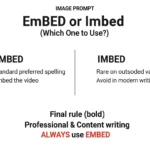
The short answer is this: Embed is the preferred and widely accepted spelling, while imbed is a less common variant.
I remember the first time I searched embed or imbed. I was adding a video to a blog post and paused before clicking publish. My grammar tool suggested embed, but a dictionary showed imbed too. That moment of doubt is exactly why people search this keyword.
Both spellings look correct, sound identical, and appear in reputable sources. At first, I thought it was just another British vs American spelling issue. Then I realized it wasn’t that simple. One spelling clearly dominates modern usage. Once I understood why, the confusion disappeared.
In this guide, I’ll explain the difference, history, correct usage, and which spelling you should confidently use today.
Embed or Imbed: Quick Answer
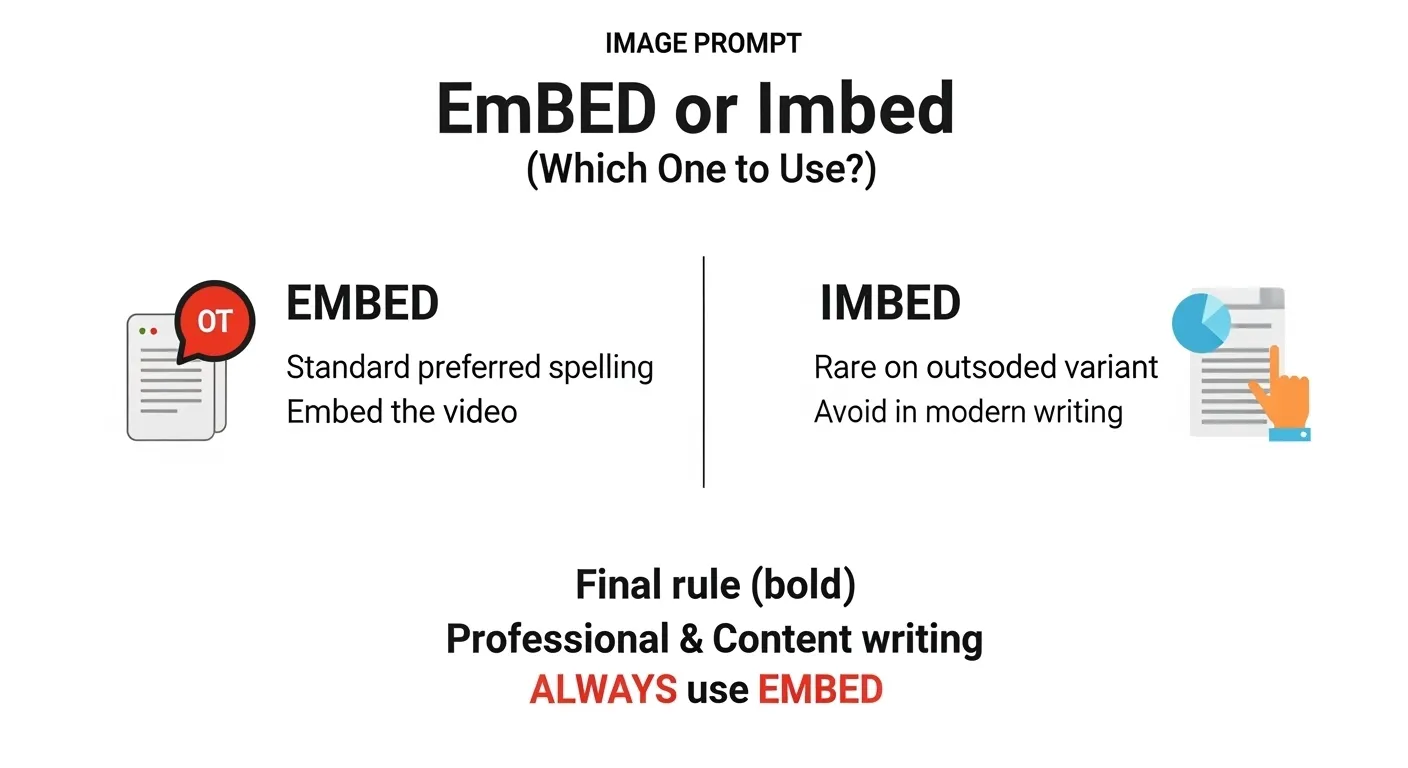
Embed is the standard and preferred spelling in modern English.
Imbed is an acceptable but rare variant.
Simple examples:
- Please embed the video in the article.
- The journalist embedded a photo in the report.
While imbed is not wrong, embed is strongly recommended in almost all writing.
The Origin of Embed or Imbed
Both words come from the same origin, which explains the confusion.
- The word comes from Old French embede, meaning to fix firmly.
- The prefix em- is a variation of en-, meaning in or into.
Over time:
- Embed became the dominant spelling.
- Imbed appeared as a phonetic alternative but never gained the same popularity.
So the spelling difference exists because English sometimes allows alternate prefixes but usage decided the winner.
British English vs American English Spelling
Here’s a common misconception:
👉 This is NOT a British vs American spelling difference.
Both British and American English:
- Prefer embed
- Recognize imbed, but rarely use it
Comparison Table
| Spelling | UK Usage | US Usage | Recommendation |
| Embed | ✔ Common | ✔ Common | ✅ Use this |
| Imbed | ❌ Rare | ❌ Rare | ⚠ Avoid |
If you want safe, professional writing, embed is the clear choice.
Which Spelling Should You Use?
The answer is simple for every audience.
Use embed when:
- Writing blogs or articles
- Working with websites or software
- Writing academic or professional content
- Creating instructions or documentation
Examples:
- Embed the image below the heading.
- The reporter was embedded with the troops.
Should you ever use imbed?
- Only if you are quoting historical text
- Or intentionally following a style guide that allows it
For most people, there is no practical reason to use imbed.
Common Mistakes with Embed or Imbed
Let’s clear up common errors.
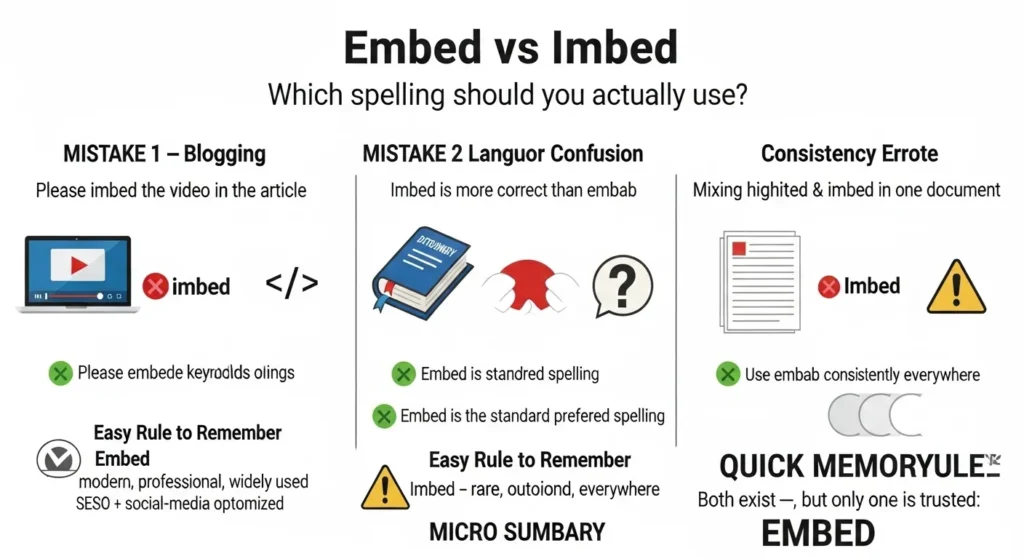
❌ Mistake 1:
Imbed is more correct because “in” means inside.
✅ Correction:
Correctness is based on usage, and embed is standard.
❌ Mistake 2:
Embed is only for technology.
✅ Correction:
Embed works in physical, abstract, and digital contexts.
❌ Mistake 3:
Mixing both spellings in the same document.
✅ Tip:
Choose embed and use it consistently.
Embed or Imbed in Everyday Examples
Emails
- Please embed the file in the email body.
- The logo is embedded in the document.
News
- The journalist was embedded with the army unit.
- Data is embedded in the report.
Social Media
- Just embedded a video in my blog 🎥
- Tweets can be embedded on websites.
Formal Writing
- The artifact was embedded in the stone.
- Values are embedded in the organization’s culture.
Embed or Imbed: Google Trends & Usage Data
Search trends clearly show:
- Embed dominates searches worldwide
- Imbed shows minimal and declining interest
By context:
- Technology and web development → embed
- Journalism and academia → embed
- Everyday writing → embed
This tells us something important:
👉 People search embed or imbed to confirm correctness, not to choose between equals.
Embed vs Imbed: Comparison Table
| Feature | Embed | Imbed |
| Accepted spelling | ✔ Yes | ✔ Yes |
| Common usage | ✔ Very common | ❌ Rare |
| Professional writing | ✔ Recommended | ❌ Avoid |
| Digital contexts | ✔ Standard | ❌ Rare |
| Reader familiarity | ✔ High | ❌ Low |
FAQs: Embed or Imbed
1. Is imbed incorrect?
No, but it is outdated and uncommon.
2. Which spelling do dictionaries prefer?
Most list embed first and mark imbed as a variant.
3. Is embed American English?
No. It is standard in both British and American English.
4. Can embed be used metaphorically?
Yes. “Traditions are embedded in the culture.”
5. Which spelling should I use in SEO content?
Always use embed.
6. Is imbed ever required?
Almost never, unless quoting or following a specific style guide.
7. Why does imbed still exist?
English sometimes preserves alternate spellings even when one dominates.
Conclusion
The confusion around embed or imbed comes from the fact that both spellings technically exist. But modern English has made its choice clear.
Embed is the standard, trusted, and widely accepted spelling across all fields technology, journalism, academia, and everyday writing.
Imbed may appear in dictionaries, but it feels unfamiliar to most readers and can distract from your message. I used to hesitate too, wondering if I was missing a rule.
Once I looked at real-world usage, the answer became obvious. If your goal is clarity, professionalism, and reader trust, choose embed every time. It’s simple, safe, and correct in almost all situations.

I am Bryan A. Garner, an American writer and editor focused on English usage, grammar, and word choice.
I am best known for Garner’s Modern English Usage, a reference book widely used by writers, editors, and legal professionals.
My work centers on clarity, precision, and resolving confusing word comparisons in modern English.