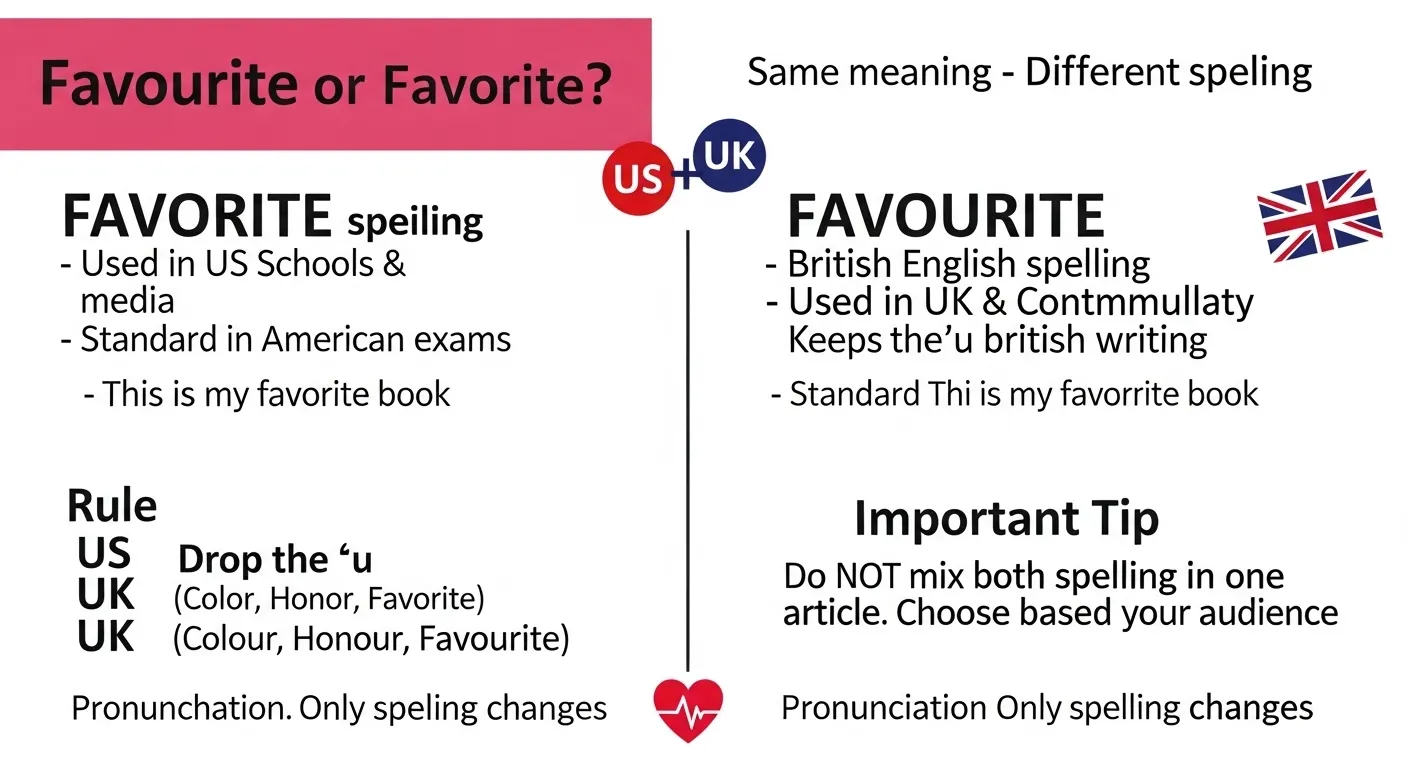
Favourite or favorite? The quick answer is simple: both are correct, but favorite is American English, while favourite is British English.
I remember writing, “This is my favourite movie,” in a post for a US brand. The editor changed it to “favorite.” At first, I thought I made a spelling mistake. But I had not. The difference was only regional.
Many people search “favourite or favorite” because they see both spellings online. The meaning stays the same, but the spelling changes depending on the country.
This guide explains the difference clearly and helps you choose the right one.
Favourite or Favorite : Quick Answer
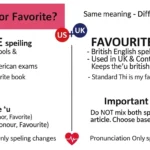
Both words mean the same thing. The difference is regional spelling.
- Favorite → American English
- Favourite → British English
Examples:
🇺🇸 American English
✔ Pizza is my favorite food.
🇬🇧 British English
✔ Pizza is my favourite food.
If you write for the US, use favorite.
If you write for the UK, use favourite.
The Origin of Favourite and Favorite
The word comes from the Latin favor, meaning kindness or support. It entered English through Old French as favor or favour.
In British English, many words keep the “ou” spelling:
- Colour
- Honour
- Labour
- Favourite
American English simplified many of these words by removing the “u”:
- Color
- Honor
- Labor
- Favorite
This change happened in the 1800s when American dictionaries promoted simpler spellings.
So the difference is part of a larger spelling pattern.
British English vs American English Spelling
This is a common and clear regional difference.
🇺🇸 American English Rule
- Drop the “u”
- Use favorite
🇬🇧 British English Rule
- Keep the “ou”
- Use favourite
Comparison Table
| Version | Correct Spelling | Example |
| American English | Favorite | She is my favorite singer. |
| British English | Favourite | She is my favourite singer. |
| International (Neutral) | Favorite | This is a fan favorite. |
Globally, “favorite” appears more often online because American English is widely used on the internet.
Which Spelling Should You Use?
Here is simple advice:
🇺🇸 Writing for an American Audience
Use favorite. It matches US spelling standards.
🇬🇧 Writing for a British or Commonwealth Audience
Use favourite. It follows British spelling rules.
🌍 Writing for an International Audience
“Favorite” is more widely recognized, but either is correct if used consistently.
The key rule:
Do not mix both spellings in the same document.
Common Mistakes with Favourite or Favorite
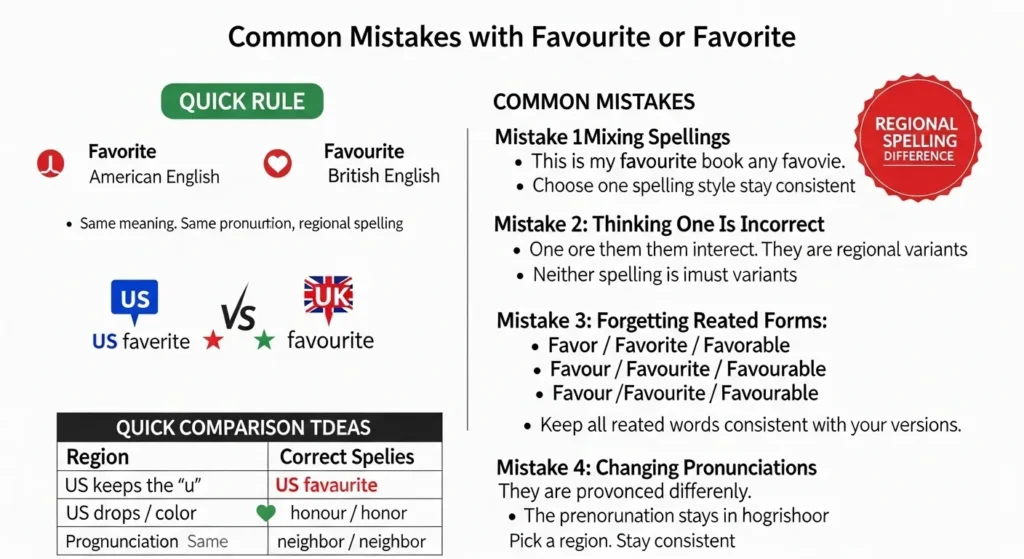
❌ Mistake 1: Mixing spellings
Wrong: This is my favourite book and my favorite movie.
Correct: Choose one spelling style.
❌ Mistake 2: Thinking one is incorrect
Neither spelling is wrong. They are regional variants.
❌ Mistake 3: Forgetting related forms
Remember the same pattern applies to:
- Favor / Favour
- Favorite / Favourite
- Favorable / Favourable
❌ Mistake 4: Changing pronunciation
The pronunciation stays the same in both versions.
Favorite or Favourite in Everyday Examples
📧 In Emails
- That is my favorite option. (US)
- That is my favourite option. (UK)
📰 In News
- The team is a fan favorite.
- The team is a crowd favourite.
📱 On Social Media
- This is my new favorite song!
- This is my new favourite song!
📄 In Academic Writing
- Shakespeare remains a student favourite.
- The professor is a class favorite.
The meaning stays the same in all cases.
Favourite or Favorite : Usage Trends
In the United States, “favorite” is the standard spelling in schools, media, and business writing.
In the United Kingdom, Australia, and other Commonwealth countries, “favourite” is the official and common spelling.
People search this keyword because:
- They see both spellings online.
- Spell check gives different suggestions.
- They write for international audiences.
- They prepare for exams with specific spelling rules.
Globally, “favorite” appears more often due to American influence in digital content. However, “favourite” remains strong in British publications.
Comparison Table: Favourite vs Favorite
| Word | Region | Meaning | Correct? |
| Favorite | US | Most liked | Yes |
| Favourite | UK | Most liked | Yes |
| Favor | US | Support or kindness | Yes |
| Favour | UK | Support or kindness | Yes |
The meaning never changes. Only the spelling does.
FAQs
1. Is “favourite” wrong in American English?
Yes, it is not the standard US spelling.
2. Is “favorite” wrong in British English?
It is understood but not preferred.
3. Do both words mean the same thing?
Yes. There is no meaning difference.
4. Why does British English use “ou”?
Because it keeps the older French spelling pattern.
5. Why did American English remove the “u”?
To simplify spelling in the 19th century.
6. Which spelling is more common worldwide?
“Favorite” appears more often globally due to US influence.
7. Should I follow one spelling style?
Yes. Always stay consistent in one document.
Conclusion
The difference between favourite and favorite is purely regional. American English uses “favorite” without the “u,” while British English uses “favourite” with the “ou.” The meaning and pronunciation remain exactly the same.
This spelling difference is part of a larger pattern seen in words like color and colour, honor and honour, and labor and labour. Once you recognize this pattern, the confusion becomes easy to manage.
If you are writing for a US audience, use “favorite.” If you are writing for a British or Commonwealth audience, use “favourite.” For international writing, “favorite” is more common, but consistency matters more than choice.
Pick the correct version for your readers and use it throughout your document. That simple step keeps your writing clear, professional, and polished.

I am Bryan A. Garner, an American writer and editor focused on English usage, grammar, and word choice.
I am best known for Garner’s Modern English Usage, a reference book widely used by writers, editors, and legal professionals.
My work centers on clarity, precision, and resolving confusing word comparisons in modern English.