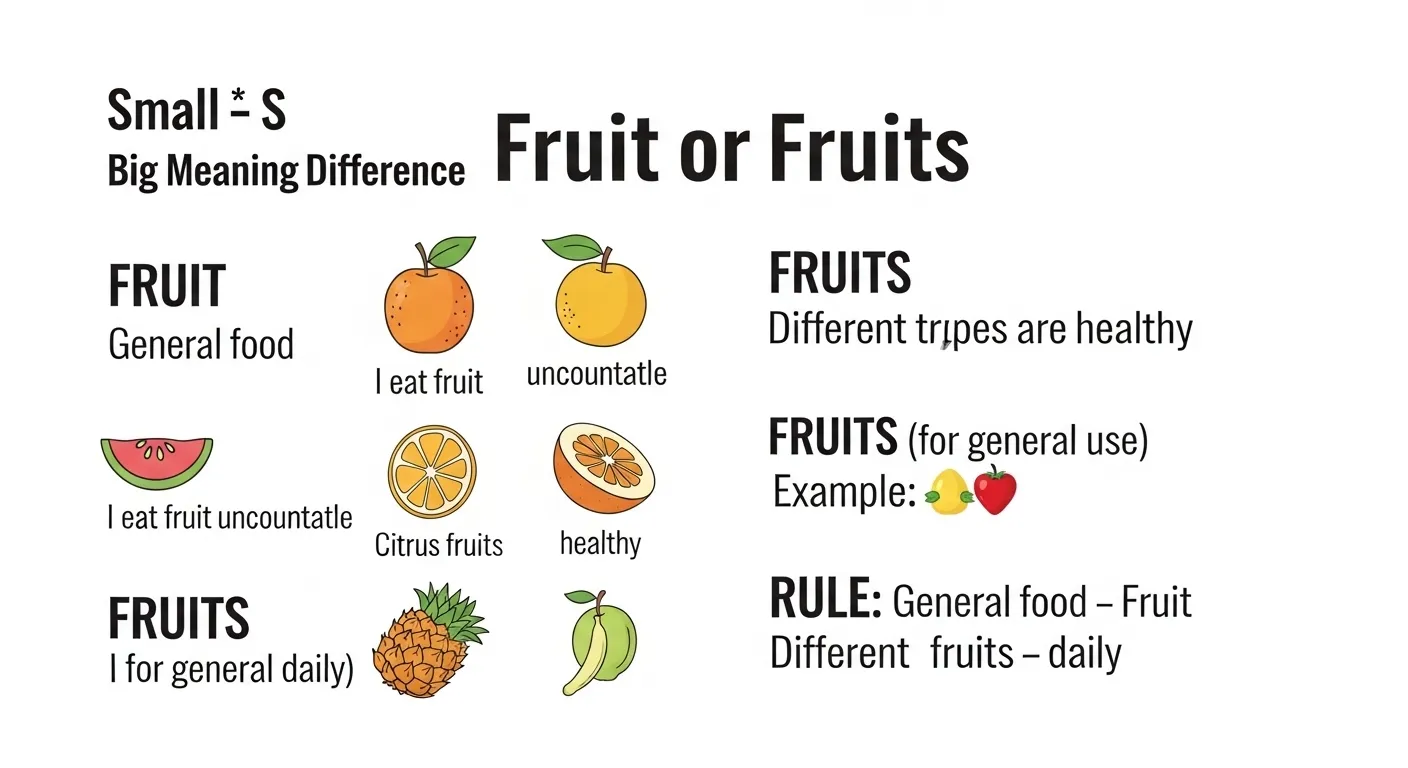
The Short Answer: Fruit is usually singular or uncountable, while fruits is used when talking about different types or varieties.
Fruit is the more common form, but fruits is also correct in certain situations. I still remember the first time I paused while writing a short paragraph about healthy food and stared at this word. I wrote “I eat fruit every day,” then wondered should it be fruit or fruits? That small “s” made me doubt the sentence.
Later, I noticed many people searching fruit or fruits for the same reason. The confusion happens because English treats some food words as uncountable. Writers, students, and even fluent speakers often hesitate.
This article solves that exact problem. I’ll explain the difference clearly and help you choose the correct form every time.
Fruit or Fruits – Quick Answer
- Fruit → Uncountable or general use
Example: I eat fruit every morning. - Fruits → Countable, used for different kinds or varieties
Example: Tropical fruits are rich in vitamins.
Simple Rule:
- General or food in bulk → fruit
- Different types or kinds → fruits
The Origin of Fruit or Fruits
The word fruit comes from the Latin word fructus, meaning enjoyment, produce, or result. In early English, fruit referred to agricultural produce in general, not individual items. That is why fruit became an uncountable noun in many contexts.
Over time, English also developed fruits to describe varieties or categories, especially in formal or scientific writing.
The confusion exists because:
- Some nouns can be both countable and uncountable
- Spoken English doesn’t show grammatical categories clearly
- Learners expect all nouns to form plurals the same way
Understanding the history makes the rule easier to remember.
British English vs American English Spelling
There is no spelling difference between British and American English for fruit or fruits. Both follow the same usage rules.
Key Rule:
This is a grammar difference, not a spelling difference.
Comparison Table
| Form | Meaning | UK English | US English |
| fruit | general / uncountable | ✅ Same | ✅ Same |
| fruits | different kinds or varieties | ✅ Same | ✅ Same |
Which Spelling Should You Use?
Choose based on meaning, not location.
- US audience → Same rule applies
- UK or Commonwealth audience → Same rule applies
- Global audience → Clear meaning matters more than region
Quick Tip:
Ask yourself one question:
👉 Am I talking about food in general or about different types?
- General → fruit
- Types or varieties → fruits
Common Mistakes with Fruit or Fruits
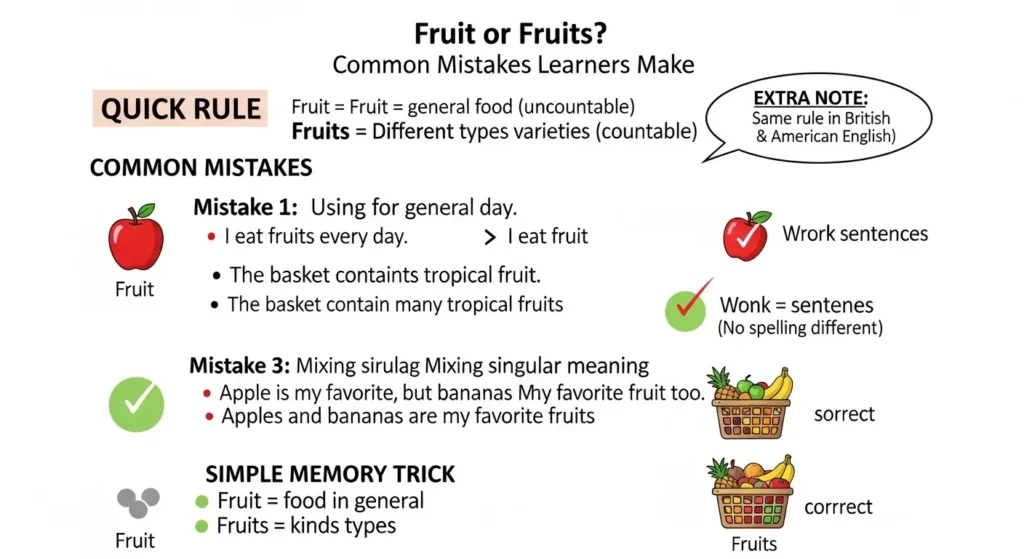
Mistake 1: Using “fruits” for general food
❌ I eat fruits every day.
✅ I eat fruit every day.
Mistake 2: Using “fruit” when types are listed
❌ The basket contains many tropical fruit.
✅ The basket contains many tropical fruits.
Mistake 3: Mixing singular meaning
❌ Apple is my favorite fruit, but bananas are my favorite fruit too.
✅ Apples and bananas are my favorite fruits.
Fruit or Fruits in Everyday Examples
Emails
- Please include fresh fruit in the lunch order.
- We offer seasonal fruits to our customers.
News
- Eating fruit daily reduces health risks.
Social Media
- Don’t forget to eat fruit today 🍎
- Summer fruits hit different 😍
Formal Writing
- Fruit consumption is linked to better health.
- The study compared citrus fruits and berries.
Fruit or Fruits – Google Trends & Usage Data
Search data shows fruit or fruits is commonly searched in:
- United States
- United Kingdom
- India
- Australia
- Canada
Why people search this keyword:
- ESL learners struggle with countable vs uncountable nouns
- Health and food content uses both forms
- Writers want quick confirmation before publishing
Usage Insight:
- Fruit appears more in everyday and health writing
- Fruits appears more in academic, scientific, and descriptive contexts
Fruit vs Fruits – Side-by-Side Comparison
| Keyword | Correct Use | Example |
| fruit | general or uncountable noun | Fruit is good for your health. |
| fruits | types or varieties | Citrus fruits are rich in vitamin C. |
| fruits | plural in formal usage | The fruits of the harvest were sold. |
FAQs: Fruit or Fruits
1. Is “fruit” singular or plural?
Fruit is usually uncountable and does not change form.
2. Is “fruits” ever wrong?
No. It is correct when talking about different kinds.
3. Can I say “a fruit”?
Yes, when referring to one item, like an apple or banana.
4. Is “fruit or fruits” different in UK English?
No. The rule is the same in UK and US English.
5. Which is correct: fruit juice or fruits juice?
Fruit juice is correct.
6. Why do people confuse fruit and fruits?
Because some nouns don’t follow regular plural rules.
7. Is “fruits” more formal?
Yes, it often sounds more formal or scientific.
Conclusion
Understanding fruit or fruits becomes easy once you know the rule. Use fruit when talking about food in general or in an uncountable sense. Use fruits when you are talking about different kinds, varieties, or categories. This rule stays the same in British and American English, so you can apply it confidently anywhere.
I’ve learned that asking one simple question “Am I talking about general food or different types?” removes all doubt. In everyday writing, health articles, academic work, and social media, choosing the correct form improves clarity and sounds natural. Once this habit forms, you will never hesitate again when deciding between fruit or fruits.

I am Emily Carter, a British writer and linguistics enthusiast from London.
I specialize in studying the differences between British and American English.
I enjoy exploring how language changes across cultures and regions.
Through my writing, I aim to make English learning simple and interesting for students.