The Short answer is : Have is used with I, you, we, and they, while has is used with he, she, and it.
I remember writing a sentence in school: “She have a new book.” It sounded slightly wrong, but I wasn’t sure why. That small confusion made me realize how important subject verb agreement is in English.
Many learners search “have or has” because both words mean the same thing, yet they change depending on the subject.
In this guide, I will clearly explain the meaning, grammar rules, examples, and common mistakes so you can use both forms confidently.
Have or Has Quick Answer
Have = a verb meaning to own, hold, experience, or receive (used with plural subjects and I/you).
Has = the same verb, but used with singular third person subjects (he, she, it).
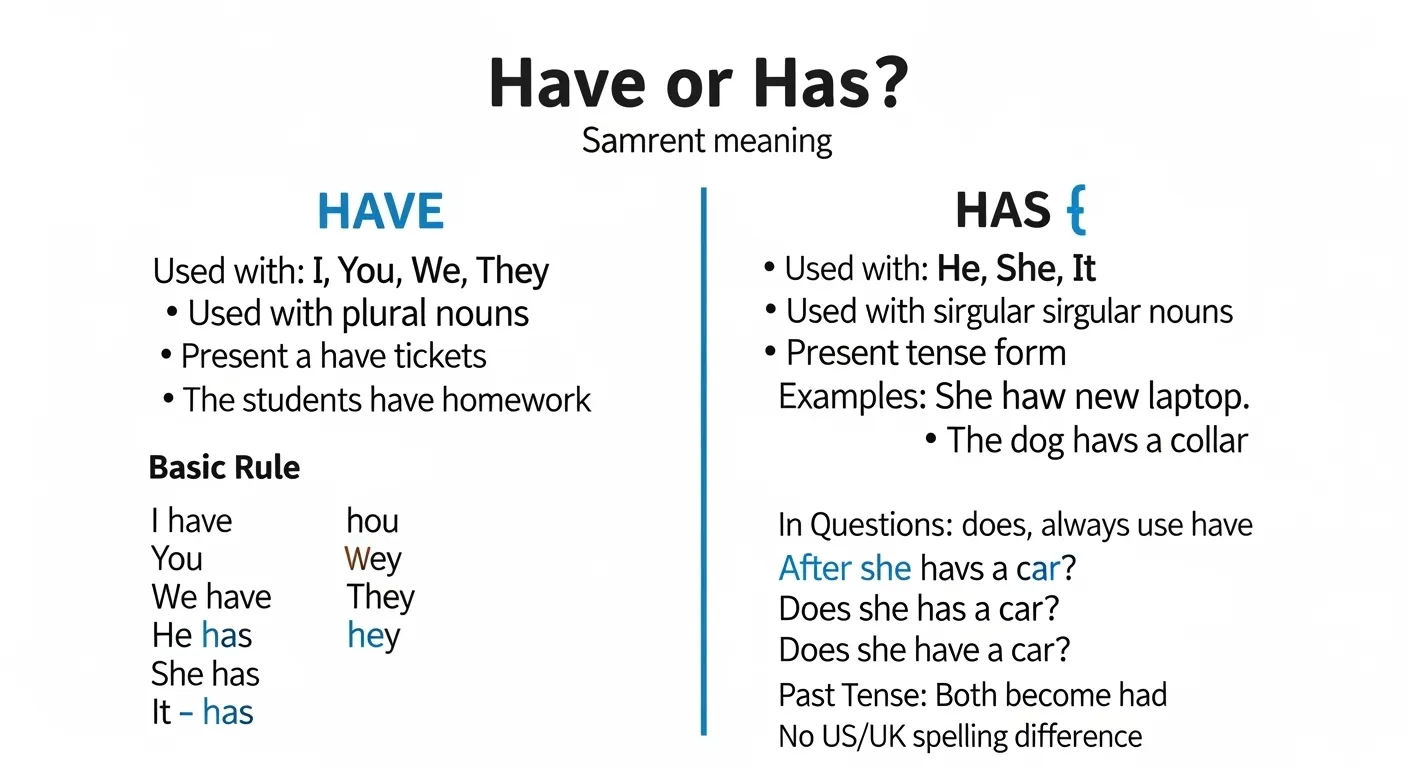
Basic Rule:
- I have
- You have
- We have
- They have
- He has
- She has
- It has
Examples:
- I have a meeting today.
- She has a meeting today.
The meaning is the same. The difference depends on the subject.
The Meaning of Have and Has
Both have and has can mean:
- To own something → She has a car.
- To experience something → They have a problem.
- To eat or drink → We have lunch at 1 PM.
- To receive something → He has a message for you.
They are different forms of the same verb.
Subject Verb Agreement Rule
The difference between have and has follows subject verb agreement.
Use has with singular third person subjects:
- He
- She
- It
- Any singular noun
Examples:
- Ahmed has a laptop.
- The dog has a collar.
- She has two sisters.
Use have with:
- I
- You
- We
- They
- Plural nouns
Examples:
- I have an idea.
- They have tickets.
- The students have homework.
This rule works in present tense only.
Have or Has in Questions
When forming questions, we often use do/does.
Examples:
- Do you have a pen?
- Does she have a pen?
Notice:
After does, we use have, not has.
❌ Does she has a pen?
✅ Does she have a pen?
This is a very common mistake.
Have or Has in Perfect Tense
Have and has are also used as helping verbs in present perfect tense.
Structure:
Subject + have/has + past participle
Examples:
- I have finished my work.
- She has finished her work.
- They have completed the project.
- He has completed the project.
The same subject rule applies.
British English vs American English Usage
There is no spelling difference between British and American English for have and has.
Both follow the same grammar rules.
| Subject | American English | British English |
| I | have | have |
| He | has | has |
| They | have | have |
However, in British English, people sometimes say:
- Have you got a pen?
In American English:
- Do you have a pen?
Both are correct, but usage style may differ slightly.
Common Mistakes with Have or Has
1. Using Have with He/She/It
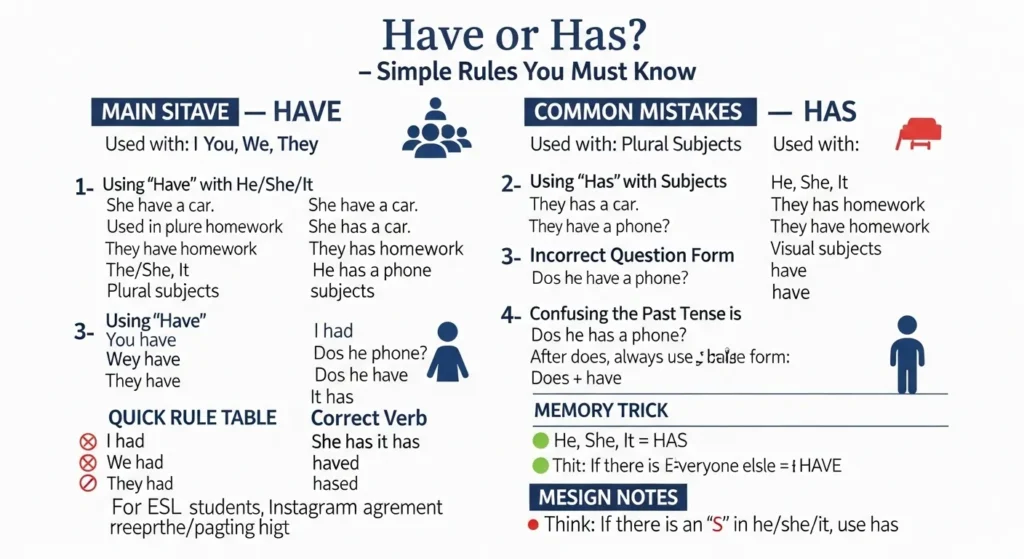
❌ She have a car.
✅ She has a car.
2. Using Has with Plural Subjects
❌ They has homework.
✅ They have homework.
3. Incorrect Question Form
❌ Does he has a phone?
✅ Does he have a phone?
4. Confusing Past Tense
Past tense of both is had.
- I had
- She had
- They had
Not “haved” or “hased.”
Have or Has in Everyday Examples
In Emails
- I have attached the file.
- She has replied to your message.
Conversations
- Do you have time?
- He has no idea.
In News Articles
- The company has announced new plans.
- Citizens have expressed concern.
On Social Media
- She has amazing talent!
- We have great news!
The difference always depends on the subject.
Comparison Table: Have vs Has
| Feature | Have | Has |
| Meaning | To own/experience | Same meaning |
| Used With | I, you, we, they | He, she, it |
| Plural Subjects | Yes | No |
| Singular Third Person | No | Yes |
| Past Tense | Had | Had |
The meaning stays the same. Only the subject changes.
Frequently Asked Questions (FAQs)
1. What is the difference between have and has?
Have is used with I, you, we, and they. Has is used with he, she, and it.
2. Which is correct: she have or she has?
She has is correct.
3. Is “they has” correct?
No. The correct form is “they have.”
4. What is the past tense of have and has?
Both become had.
5. Do we use has in questions?
Yes, but only in statements. In questions, we use does + have.
Example:
- Does she have a car?
6. Is there a spelling difference in British English?
No. The spelling is the same.
7. Can have and has be helping verbs?
Yes. They are used in present perfect tense.
Conclusion
The difference between have and has is simple but very important. Both words have the same meaning, but they change depending on the subject. Use have with I, you, we, they, and plural nouns. Use has with he, she, it, and singular nouns. This rule applies in both main verb and helping verb forms.
There is no regional spelling difference between British and American English. The key to mastering this pair is remembering subject verb agreement. If the subject is singular third person, use has. In all other present tense cases, use have. Once you understand this pattern, your sentences will sound natural and grammatically correct.

I am Lynne Truss, a British writer and journalist who is best known for my work on English grammar. I have always been interested in language and punctuation, especially how small mistakes can change meaning. Through my books, I try to make grammar easy, interesting, and enjoyable for readers.