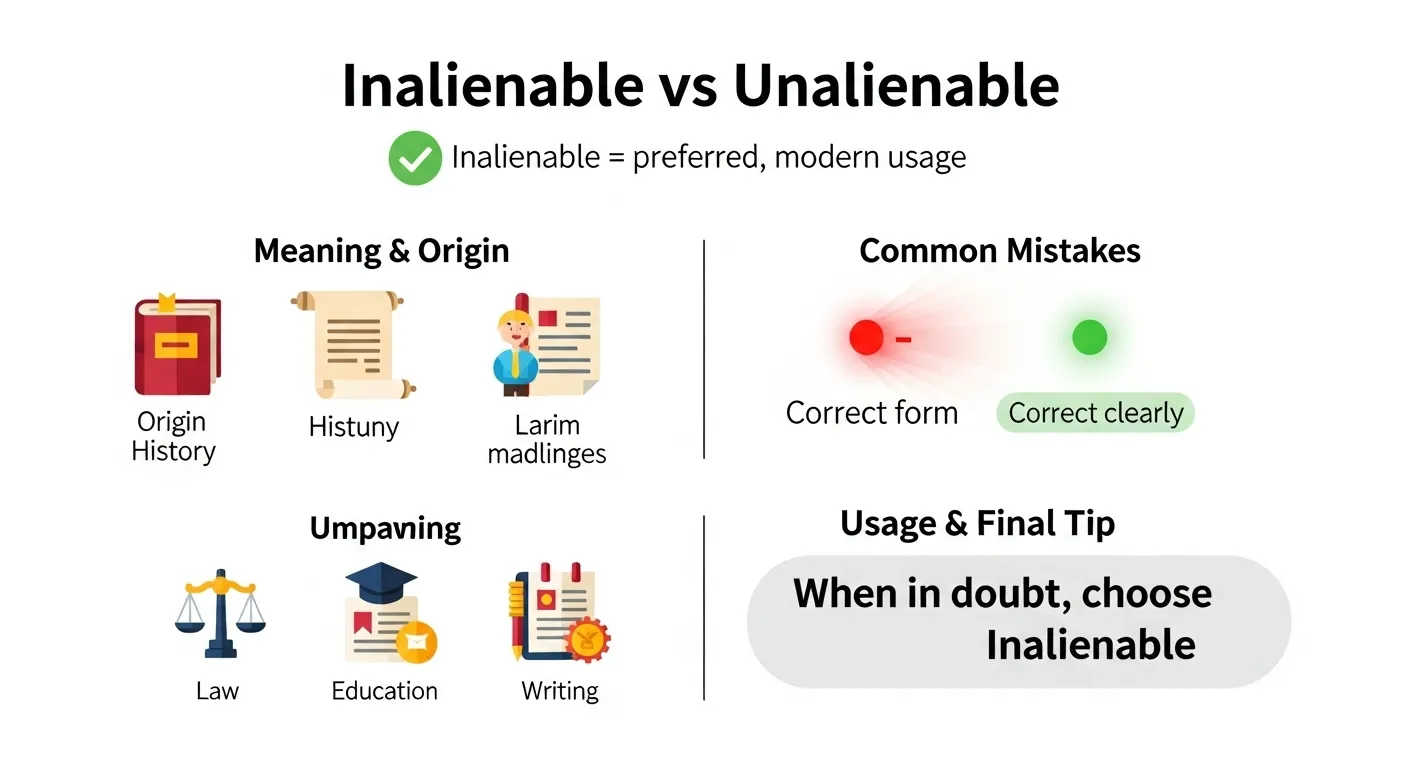
The short answer is this: inalienable is the more common and preferred word, while unalienable is also correct but less widely used.
I remember reading the phrase “unalienable rights” in an old text and then seeing “inalienable rights” everywhere else.
That made me stop and think: Are these two different words, or is one wrong? Like many readers and writers, I searched “inalienable or unalienable” to clear the confusion.
The mix-up happens because both words look correct, sound formal, and appear in legal or historical writing. Once I understood their origins and usage, the confusion disappeared.
In this article, I’ll explain everything clearly and simply, so you can choose the right word with confidence.
Inalienable or Unalienable: Quick Answer
Inalienable means unable to be taken away or given up.
Unalienable means the same thing but is used less often today.
Examples:
- ✔ Freedom of speech is an inalienable right.
- ✔ The Declaration refers to unalienable rights.
👉 Modern, common usage? → Inalienable
👉 Historical or stylistic choice? → Unalienable
The Origin of Inalienable or Unalienable
The story behind these words explains why both exist.
Both words come from the Latin alienare, meaning to transfer or give away. The idea is simple: if something is alienable, it can be transferred. If it is not alienable, it cannot be taken away.
- Inalienable uses the Latin-based prefix in-, meaning not.
- Unalienable uses the Germanic prefix un-, also meaning not.
Historically, unalienable appeared earlier in English. Over time, inalienable became more popular, especially in legal, philosophical, and academic writing.
That’s why both are correct, but one clearly dominates modern usage.
British English vs American English Spelling
This is not a strict British vs American spelling issue.
Both varieties recognize:
- Inalienable → Standard and preferred
- Unalienable → Correct but less common
However:
- American English strongly favors inalienable
- British English also prefers inalienable
Comparison Table
| Word | British English | American English | Modern Usage |
| Inalienable | Preferred | Preferred | Very common |
| Unalienable | Rare | Rare | Mostly historical |
Which Spelling Should You Use?
Your choice depends on context and audience.
- Academic, legal, professional writing → Inalienable
- Modern blogs, essays, exams → Inalienable
- Historical documents or quotations → Unalienable (if quoting)
Audience-based advice:
- US audience → Inalienable
- UK/Commonwealth audience → Inalienable
- Global audience → Inalienable (clear and familiar)
Easy memory trick:
If you see the word in modern writing, it’s almost always inalienable.
Common Mistakes with Inalienable or Unalienable
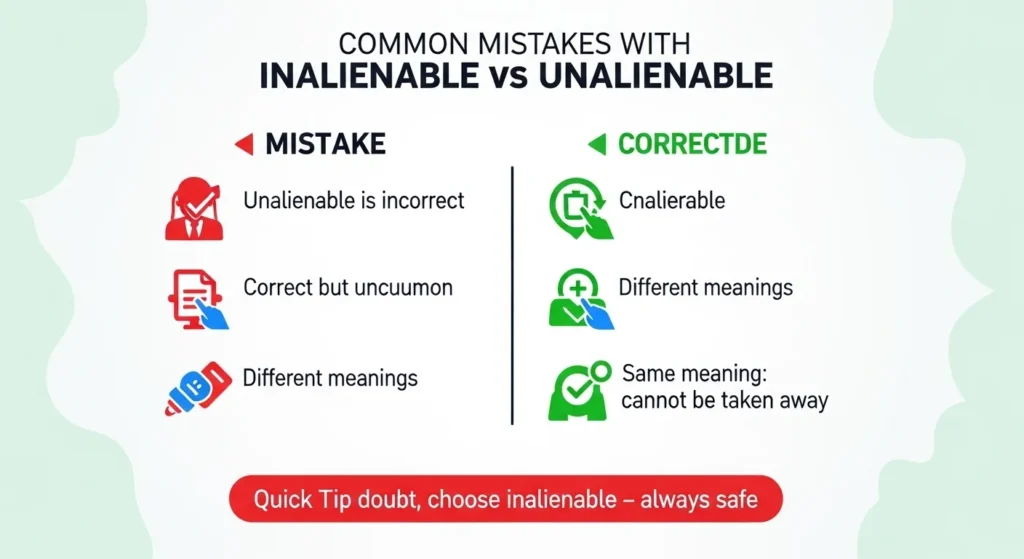
Here are mistakes I often notice.
❌ Thinking unalienable is incorrect
✅ It is correct, just uncommon
❌ Mixing both forms in the same document
✅ Choose one and stay consistent
❌ Assuming the meanings are different
✅ Both mean cannot be taken away
Quick tip:
When in doubt, choose inalienable. It is always safe.
Inalienable or Unalienable in Everyday Examples
Emails
- “Privacy is an inalienable right.”
- “Human dignity is inalienable.”
News Writing
- “The court affirmed inalienable freedoms.”
- “The text refers to unalienable rights.”
Social Media
- “Freedom is inalienable.”
- “These rights are inalienable, no debate.”
Formal Writing
- “Life and liberty are inalienable human rights.”
- “The constitution protects inalienable freedoms.”
Inalienable or Unalienable: Google Trends & Usage Data
Search data shows that “inalienable or unalienable” is often searched by:
- Students
- Law learners
- History readers
- ESL writers
Usage patterns:
- Inalienable dominates in:
- Law
- Politics
- Philosophy
- Education
- Unalienable appears mostly in:
- Historical documents
- Quotations (e.g., Declaration of Independence)
- Older texts
Regional interest:
- United States
- United Kingdom
- India
- Pakistan
- Australia
The trend clearly favors inalienable worldwide.
Comparison Table: Inalienable vs Unalienable
| Feature | Inalienable | Unalienable |
| Meaning | Cannot be taken away | Same |
| Modern usage | Very common | Rare |
| Formal writing | Preferred | Less preferred |
| Historical use | Common | Older |
| Exam-safe choice | Yes | No |
FAQs: Inalienable or Unalienable
1. Are both words correct?
Yes, both are grammatically correct.
2. Which word is more common today?
Inalienable.
3. Why does the Declaration say “unalienable”?
It reflects older English usage at the time.
4. Should I use unalienable in modern writing?
Only if quoting historical texts.
5. Do the meanings differ?
No. They mean the same thing.
6. Is this a US vs UK issue?
No. Both prefer inalienable today.
7. Which word should I use in exams?
Always use inalienable.
Conclusion
The confusion between inalienable and unalienable comes from history, not meaning. Both words describe rights or qualities that cannot be taken away. However, language evolves, and usage patterns change. Today, inalienable is the clear winner in modern English.
It appears in legal texts, academic writing, journalism, and everyday communication. Unalienable survives mainly in historical documents and direct quotations.
If your goal is clarity, professionalism, and universal acceptance, inalienable is the best choice. Remember this simple rule: same meaning, different popularity. Once you know that, choosing the right word becomes easy and your writing instantly sounds more polished.
The confusion between inalienable and unalienable comes from history not meaning. Both describe rights or qualities that cannot be taken away. However, modern English strongly prefers inalienable.It appears in legal texts, academic writing, journalism, and everyday communication across the world.
Unalienable now survives mainly in historical documents and direct quotations. If your goal is clarity, professionalism, and global acceptance, inalienable is always the safest choice. Once you understand this difference, your writing becomes clearer, more confident, and more natural to modern readers everywhere.

I am Bryan A. Garner, an American writer and editor focused on English usage, grammar, and word choice.
I am best known for Garner’s Modern English Usage, a reference book widely used by writers, editors, and legal professionals.
My work centers on clarity, precision, and resolving confusing word comparisons in modern English.