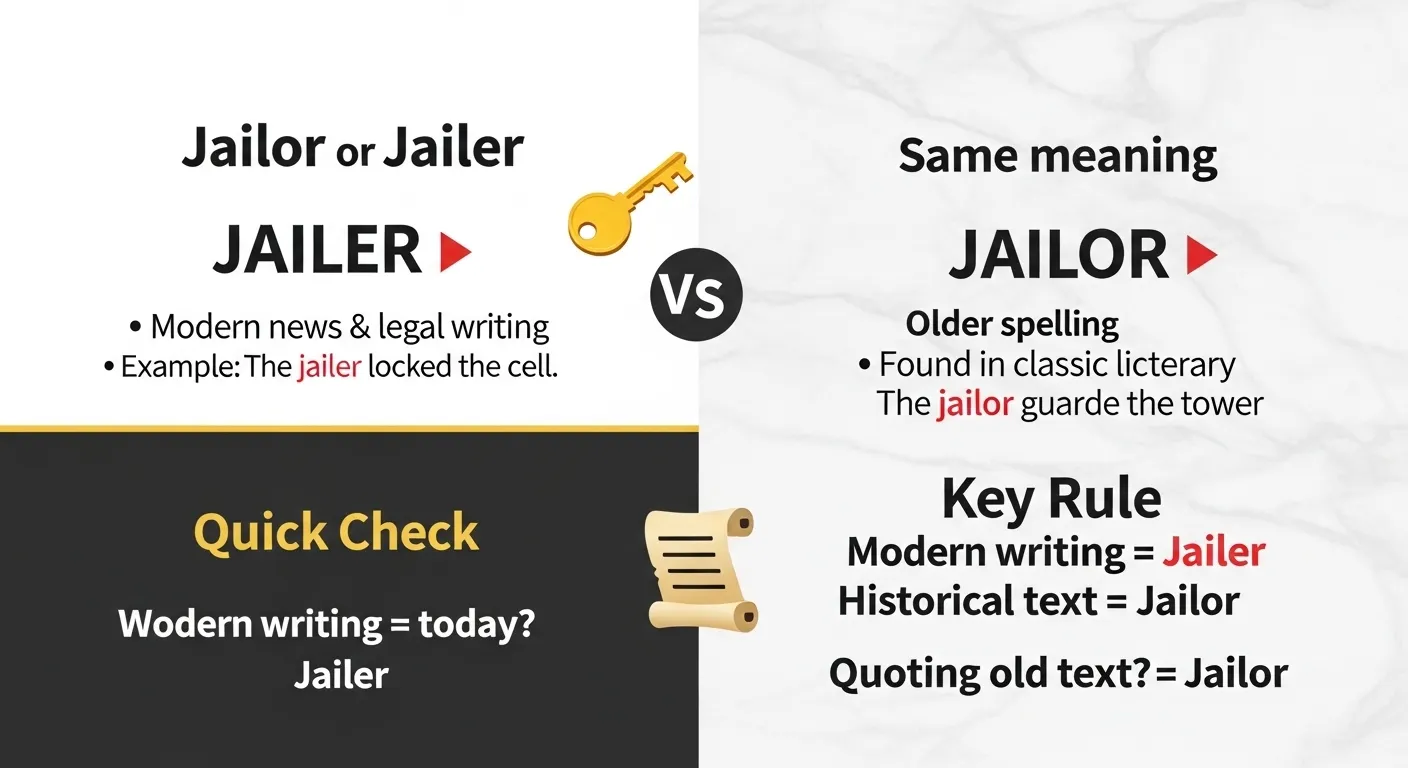
The short answer: jailer is the modern and preferred spelling, while jailor is an older, less common variant.
Jailor or jailer confused me the first time I edited a crime-related article. I wrote, “The jailor escorted the inmate,” and paused. The spelling did not look wrong, but it also did not feel right. I wondered if I was using an outdated word. When I searched jailor or jailer, I realized thousands of writers ask the same question. This confusion happens because both spellings exist in books, dictionaries, and online content.
Writers, students, journalists, and editors want to sound professional and modern but fear choosing the wrong spelling. This article solves that exact problem clearly and completely.
Jailor or Jailer : Quick Answer
- jailer → Modern, preferred spelling
- jailor → Older, less common spelling
Examples:
✅ The jailer opened the prison gate.
⚠️ The jailor opened the prison gate. (correct but outdated)
Simple Rule:
👉 Use jailer in modern writing
👉 Use jailor only in historical or quoted text
The Origin of Jailor and Jailer
The word comes from Old French gaolier, meaning “keeper of a jail.” When English adopted the word, spelling was not fixed. Writers spelled words based on sound, habit, or region.
That is how two spellings developed:
- jailor (older form)
- jailer (newer form)
In earlier English, -or endings were common. Over time, English shifted toward -er endings because they matched pronunciation better. As dictionaries became standardized, jailer became the preferred spelling.
The confusion exists because:
- Old books still use jailor
- Both spellings appear in dictionaries
- People assume older spelling is wrong
Understanding this history helps you see that this is not a grammar mistake—it is a spelling evolution.
British English vs American English Spelling
There is no strict British vs American difference for jailor or jailer. Both varieties recognize both spellings. However, jailer is strongly preferred in modern usage across regions.
Comparison Table of Jailer vs Jailor
| Spelling | Meaning | UK English | US English |
| jailer | prison guard (modern) | ✅ Preferred | ✅ Preferred |
| jailor | prison guard (older) | ⚠️ Rare | ⚠️ Rare |
Key Point:
This choice is about modern vs outdated, not UK vs US.
Which Spelling Should You Use?
In almost all situations, jailer is the correct choice.
Audience-Based Advice
- US audience → Use jailer
- UK / Commonwealth audience → Use jailer
- Global audience → Use jailer
When is “jailor” acceptable?
- Quoting older books or documents
- Writing historical fiction
- Preserving original spelling in citations
Quick Tip:
If your content is modern, professional, or academic, always choose jailer.
Common Mistakes with Jailor or Jailer
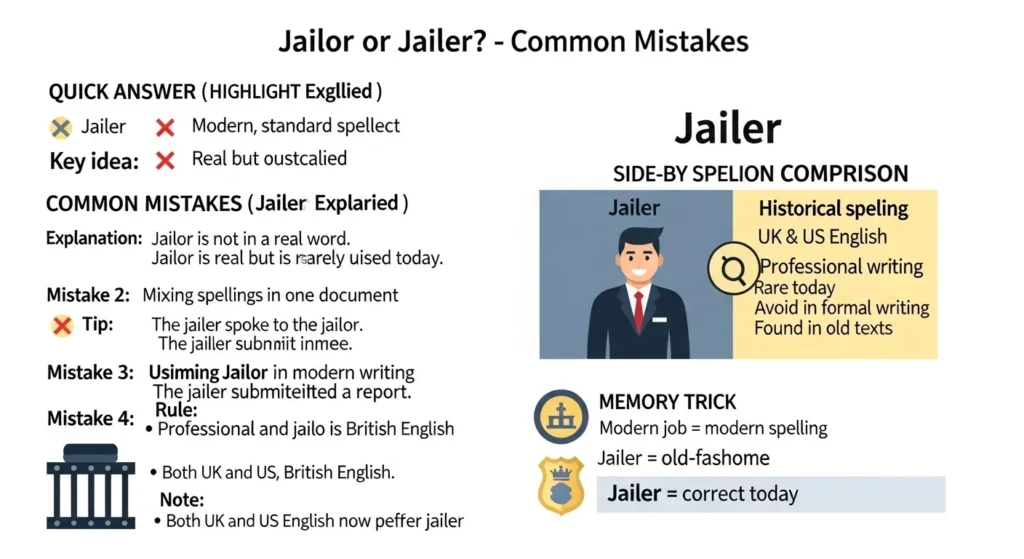
Mistake 1: Thinking jailor is incorrect
❌ Jailor is not a real word.
✅ Jailor is real but outdated.
Mistake 2: Mixing spellings in one document
❌ The jailer spoke to the jailor.
✅ The jailer spoke to the inmate.
Mistake 3: Using jailor in modern professional writing
❌ The jailor submitted a report.
✅ The jailer submitted a report.
Mistake 4: Assuming jailor is British-only
❌ Jailor is only British English.
✅ Jailor is historical, not regional.
Jailer or Jailor in Everyday Examples
Emails
- The jailer will escort visitors at noon.
- Please contact the jailer for access approval.
News
- The jailer testified during the trial.
- Authorities questioned the jailer about security lapses.
Social Media
- A film shows the daily life of a prison jailer 🎬
- Reading an old novel where the jailor guards the cell
Formal Writing
- The jailer is responsible for inmate safety.
- Duties of the jailer are defined by law.
Jailor or Jailer : Google Trends & Usage Data
Search behavior shows jailer is far more common than jailor in:
- United States
- United Kingdom
- Canada
- Australia
- India
Why people search this keyword:
- They see “jailor” in old books
- Spell-check suggests “jailer”
- They want modern, correct spelling
Usage Insight:
- Jailer dominates news, legal, and academic writing
- Jailor appears mostly in classic literature
Jailor vs Jailer – Side-by-Side Comparison
| Form | Part of Speech | Usage Level | Best Used In | Example |
| jailer | noun | modern | current writing | The jailer closed the cell. |
| jailor | noun | outdated | historical text | The jailor held the keys. |
FAQs: Jailor or Jailer
1. Is “jailor” grammatically wrong?
No. It is correct but old-fashioned.
2. Which spelling do dictionaries recommend?
Most list jailer as the main entry.
3. Is jailor used in British English today?
Very rarely. Jailer is preferred.
4. Can I use jailor in fiction?
Yes, especially historical or period fiction.
5. Why did English change jailor to jailer?
Language evolved toward clearer spelling patterns.
6. Does pronunciation change?
No. Both are pronounced the same.
7. Which spelling looks more professional?
Jailer.
Conclusion
The difference between jailor or jailer is not about meaning or grammar. Both words refer to the same role, but time has changed which spelling feels correct. Jailer is the modern, preferred form used in professional, academic, and everyday writing. Jailor still exists, but it belongs mostly to older texts and historical contexts.
I have learned that choosing modern spelling improves clarity and credibility. When readers see jailer, they immediately recognize it as current and correct. Using jailor in modern writing can distract readers or make content feel outdated. If your goal is clear, professional communication, jailer is always the safest and smartest choice. Remember this one rule, and you will never hesitate again.

I am Lynne Truss, a British writer and journalist who is best known for my work on English grammar. I have always been interested in language and punctuation, especially how small mistakes can change meaning. Through my books, I try to make grammar easy, interesting, and enjoyable for readers.