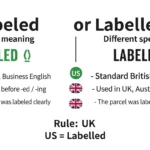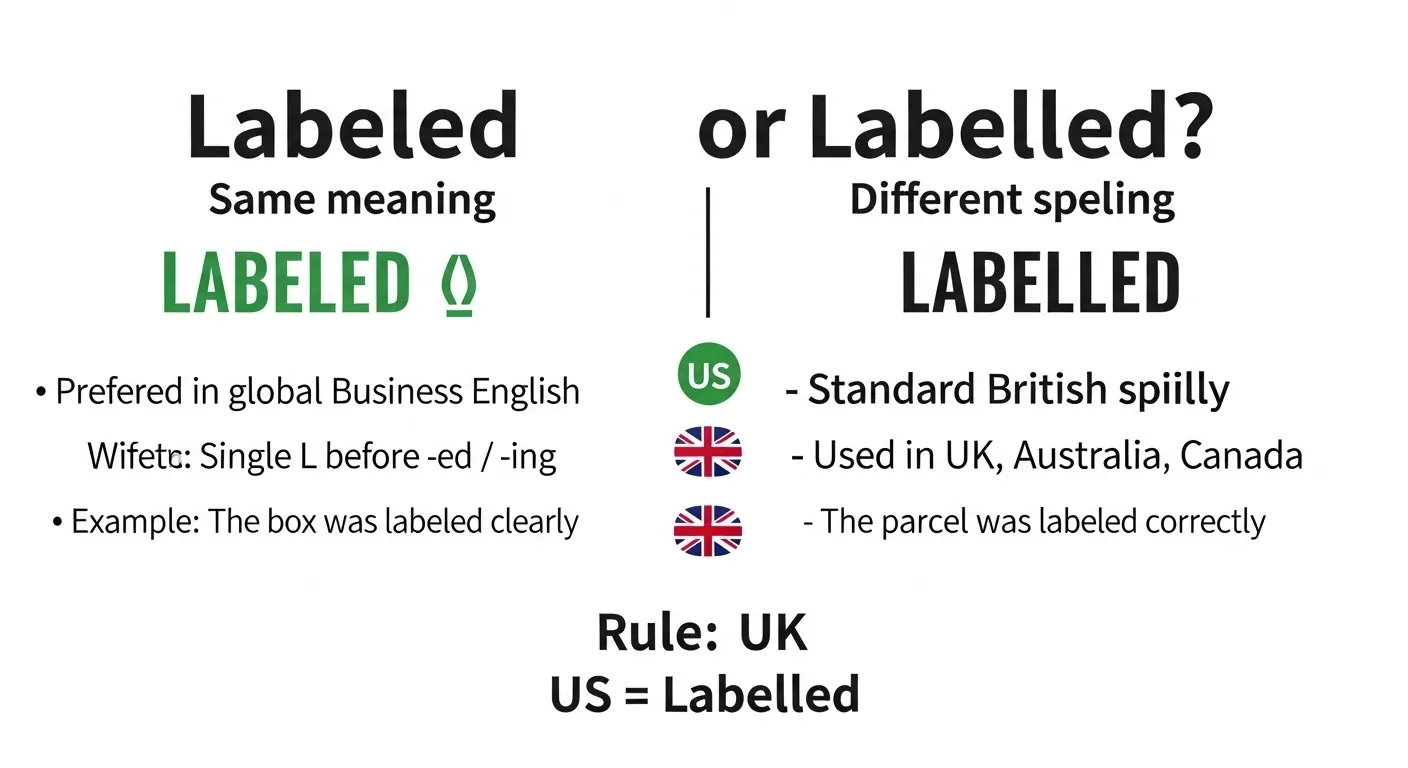
Labeled or labelled? The quick answer is simple: both are correct, but labeled is preferred in American English, while labelled is more common in British English.
I once submitted an article to a UK website and wrote “The product was labeled incorrectly.” The editor changed it to “labelled.” Later, I wrote for a US client and they removed the extra “l.” That small letter made a big difference.
Many writers search “labeled or labelled” because they are unsure about double consonant rules.
This guide will explain the spelling difference clearly and help you choose the correct form for your audience.
Labeled or Labelled : Quick Answer
Both spellings are correct. The difference depends on region.
- Labeled → American English (preferred)
- Labelled → British English (common)
Examples:
🇺🇸 American English
✔ The box was labeled clearly.
🇬🇧 British English
✔ The parcel was labelled correctly.
If you write for a US audience, use labeled.
If you write for a UK audience, labelled is the standard form.
The Origin of Labeled and Labelled
The word “label” comes from Old French label, meaning a tag or strip. It entered English in the 14th century.
The confusion comes from the rule about doubling consonants when adding -ed or -ing.
In British English:
- When a word ends in a vowel + “l,” the “l” is often doubled before adding endings.
Example: - Travel → Travelled
- Cancel → Cancelled
- Label → Labelled
In American English:
- The final “l” is usually not doubled unless the stress is on the last syllable.
Example: - Travel → Traveled
- Cancel → Canceled
- Label → Labeled
Because “label” has stress on the first syllable (LA-bel), American English does not double the “l.”
British English vs American English Spelling
This is a clear regional spelling difference.
🇺🇸 American English Rule
- Do not double the “l”
- Preferred form: labeled
🇬🇧 British English Rule
- Double the “l”
- Standard form: labelled
Comparison Table
| Version | Preferred Spelling | Example |
| American English | Labeled | The chart was labeled properly. |
| British English | Labelled | The diagram was labelled clearly. |
| International/Neutral | Labeled | Each file was labeled correctly. |
Globally, “labeled” appears more often online because of American influence.
Which Spelling Should You Use?
Here is simple advice:
🇺🇸 Writing for American Audience
Use labeled. It matches US dictionaries and academic standards.
🇬🇧 Writing for British or Commonwealth Audience
Use labelled. It follows British spelling rules.
🌍 Writing for Global or Content
Use labeled. It is more widely recognized internationally.
Most global companies prefer American spelling in digital content.
Common Mistakes with Labeled or Labelled
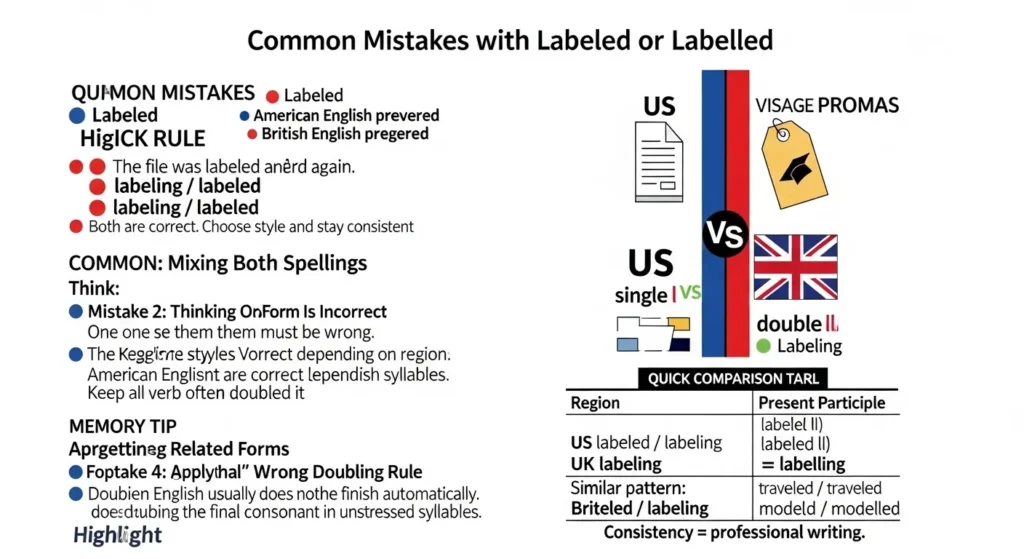
❌ Mistake 1: Mixing both spellings
Wrong: The file was labeled and later labelled again.
Correct: Choose one spelling style.
❌ Mistake 2: Thinking one form is incorrect
Both are correct depending on region.
❌ Mistake 3: Forgetting related forms
Remember the same pattern applies to:
- Labeling (US) / Labelling (UK)
- Labeled (US) / Labelled (UK)
❌ Mistake 4: Applying wrong doubling rule
American English usually does not double the final “l” in unstressed syllables.
Labelled or Labeled in Everyday Examples
📧 In Emails
- The document was labeled incorrectly. (US)
- The envelope was labelled clearly. (UK)
📰 In News
- The product was labeled unsafe.
- The package was labelled fragile.
📱 On Social Media
- I accidentally labeled the wrong person!
- The photo was labelled with the wrong date.
📄 In Academic Writing
- The diagram was clearly labeled.
- Each section was properly labelled.
In international writing, “labeled” is slightly more common.
Labeled or Labelled : Google Trends & Usage Data
Search data shows:
- “Labeled” is far more common in the United States.
- “Labelled” is standard in the United Kingdom, Australia, and Canada.
Globally, “labeled” has higher overall usage because American English dominates online content.
People search this keyword because:
- Spell check offers both options.
- They write for international audiences.
- They are unsure about double “l” rules.
For content targeting a broad audience, “labeled” usually performs better.
Comparison Table: Labeled vs Labelled
| Word | Region | Correct? | Usage Context |
| Labeled | US | Yes | Business, academic, global writing |
| Labelled | UK | Yes | British publications |
| Labeling | US | Yes | Present form |
| Labelling | UK | Yes | Present form |
This table shows the full spelling pattern clearly.
FAQs
1. Is “labelled” wrong?
No. It is correct in British English.
2. Is “labeled” correct in the UK?
Yes.
3. Why does British English double the “l”?
Because British spelling often doubles final “l” before adding endings.
4. Why doesn’t American English double it?
Because the stress is not on the last syllable.
5. Which spelling is more common worldwide?
“Labeled” is more common globally.
6. Should I use the same spelling throughout my document?
Yes. Always stay consistent.
7. Which spelling is better for Content ?
“Labeled” often has higher search volume globally.
Conclusion
The difference between labeled and labelled comes down to regional spelling rules. American English prefers “labeled” with one “l,” while British English uses “labelled” with a double “l.” Both are correct, and both mean the same thing.
The rule connects to how each version of English handles final consonants before adding endings like “-ed” and “-ing.” British English often doubles the “l,” even when the stress is not on the last syllable. American English usually does not.
If you are writing for a US audience or for global online content, “labeled” is the safest choice. If your audience is British, “labelled” is the correct and natural form.
The most important rule is consistency. Pick one spelling style and use it throughout your writing. That small detail keeps your content clear, professional, and polished.

I am Bryan A. Garner, an American writer and editor focused on English usage, grammar, and word choice.
I am best known for Garner’s Modern English Usage, a reference book widely used by writers, editors, and legal professionals.
My work centers on clarity, precision, and resolving confusing word comparisons in modern English.