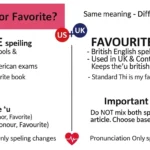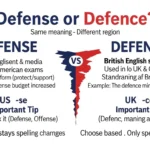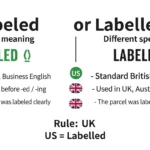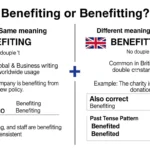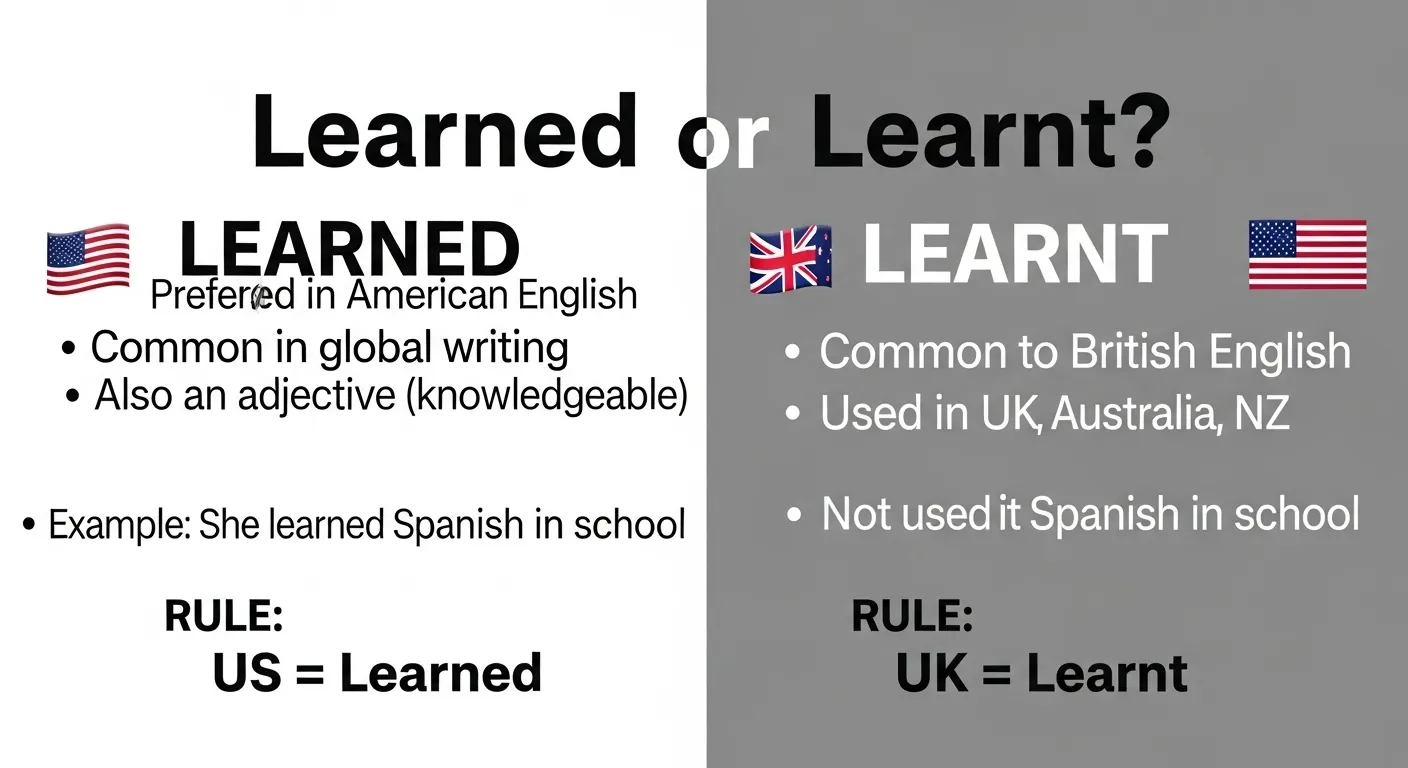
Learned or learnt? The quick answer is simple: both are correct, but learned is preferred in American English, while learnt is more common in British English.
I remember correcting a blog post where I wrote, “I learnt this lesson the hard way.” My US editor changed it to “learned.” I was confused at first. I thought both were the same. That small change made me search the rule.
Many writers type “learned or learnt” into Google for this reason. The words mean the same thing. They sound similar. But the spelling depends on region and style.
This guide will explain the difference clearly and help you choose the right one.
Learned or Learnt : Quick Answer
Both spellings are correct. The difference is regional.
- Learned → American English (preferred)
- Learnt → British English (common)
Examples:
🇺🇸 American English
✔ She learned French in school.
🇬🇧 British English
✔ She learnt French at school.
If you write for a US audience, use learned.
If you write for a UK audience, learnt is perfectly fine.
The Origin of Learned and Learnt
The verb “learn” comes from Old English leornian, meaning to gain knowledge.
In early English, many verbs had two past tense forms:
- One ending in -ed
- One ending in -t
Examples:
- Burned / Burnt
- Dreamed / Dreamt
- Spoiled / Spoilt
Over time:
- American English mostly kept the -ed form.
- British English kept both forms, especially the -t version.
That is why both “learned” and “learnt” exist today.
British English vs American English Spelling
This difference is purely regional.
🇺🇸 American English
- Preferred form: learned
- “Learnt” is rare but still understood.
🇬🇧 British English
- Both forms are correct.
- “Learnt” is more common in everyday use.
Comparison Table
| Version | Preferred Spelling | Example |
| American English | Learned | He learned quickly. |
| British English | Learnt | He learnt quickly. |
| Global/Neutral | Learned | She learned new skills. |
In international business writing, learned is more widely used.
Which Spelling Should You Use?
Here is simple advice:
🇺🇸 Writing for the US
Use learned. It matches American style guides.
🇬🇧 Writing for the UK or Commonwealth
You can use learnt. It sounds natural in British English.
🌍 Writing for Global or SEO Content
Use learned. It has broader international acceptance.
Also remember:
Consistency is important. Do not mix both spellings in one document.
Common Mistakes with Learned or Learnt
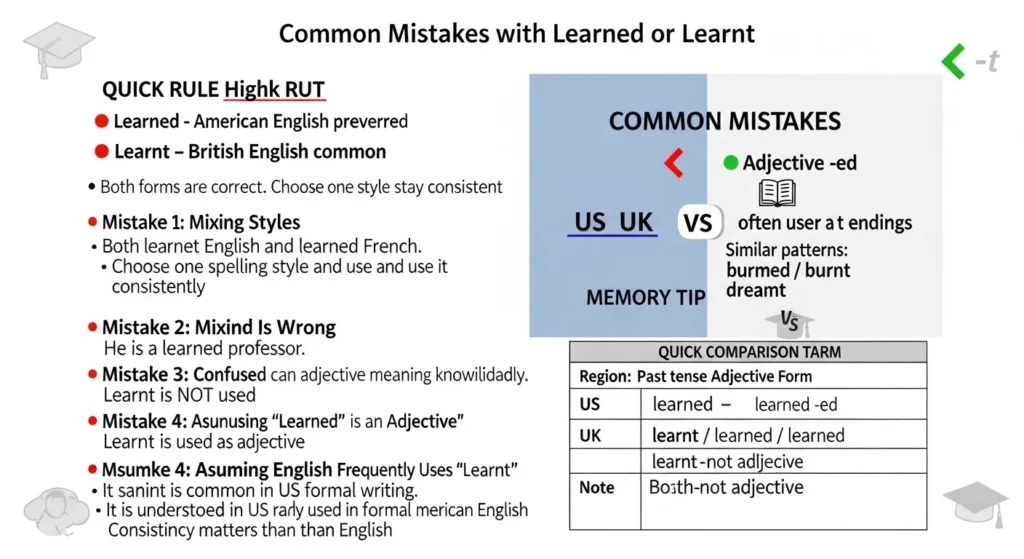
❌ Mistake 1: Thinking one is wrong
Both forms are correct.
❌ Mistake 2: Mixing styles
Wrong: She learnt English and learned French.
Correct: Choose one style.
❌ Mistake 3: Confusing “learned” (adjective)
“Learned” can also be an adjective meaning knowledgeable.
Example:
✔ He is a learned professor.
“Learnt” is not used as an adjective.
❌ Mistake 4: Assuming American English accepts “learnt” often
It is understood but rarely used in US formal writing.
Learnt or Learned in Everyday Examples
📧 In Emails
- I learned about the meeting today. (US)
- I learnt about the meeting today. (UK)
📰 In News Articles
- She learned important lessons from the event.
- He learnt valuable skills during training.
📱 On Social Media
- Today I learned something new!
- I learnt a big lesson this week.
📄 In Academic Writing
- The students learned new techniques.
- The pupils learnt basic grammar.
Both forms communicate the same meaning.
Learned or Learnt : Google Trends & Usage Data
Search data shows:
- “Learned” is more common in the United States.
- “Learnt” appears more often in the United Kingdom, Australia, and New Zealand.
Globally, “learned” has higher overall usage because American English dominates online content.
People search this keyword because:
- They work with international clients.
- Spell check shows different suggestions.
- They are unsure which form is correct in exams or business writing.
For SEO and global writing, “learned” usually performs better.
Comparison Table: Learned vs Learnt
| Word | Region | Correct? | Usage |
| Learned | US | Yes | Standard American past tense |
| Learnt | UK | Yes | Common British past tense |
| Learned (adj.) | US/UK | Yes | Means knowledgeable |
| Learnt (adj.) | — | No | Not used as adjective |
This table makes the difference clear.
FAQs
1. Is “learnt” wrong?
No. It is correct in British English.
2. Is “learned” correct in the UK?
Yes. It is also accepted.
3. Which spelling is more common worldwide?
“Learned” is more common globally.
4. Can I use both in one essay?
No. Choose one style and stay consistent.
5. Is “learned” an adjective?
Yes. It can mean knowledgeable or scholarly.
Example: a learned judge.
6. Why does British English use “learnt”?
Because older English kept the “-t” ending for some verbs.
7. Which is better for exams?
Follow the spelling style required by your country or test system.
Conclusion
The difference between learned and learnt is about regional spelling, not meaning. Both forms are correct past tense versions of “learn.” American English prefers “learned,” while British English often uses “learnt.” The meaning stays the same in both cases.
If you are writing for a US audience, choose “learned.” If your audience is British, “learnt” sounds natural and correct. For global writing, “learned” is usually the safer choice because it is more widely used online.
One important detail is that “learned” can also be an adjective meaning knowledgeable. “Learnt” does not have that function. This small difference can matter in formal writing.
In the end, the key rule is consistency. Pick one spelling style and use it throughout your document. That simple decision will keep your writing clear, professional, and polished.

I am Mignon Fogarty, an American author and language expert also known as “Grammar Girl.”
I focus on explaining grammar rules, spelling mistakes, and confusing words in a simple and friendly way.
My goal is to make correct English easy and approachable for everyday readers.