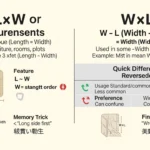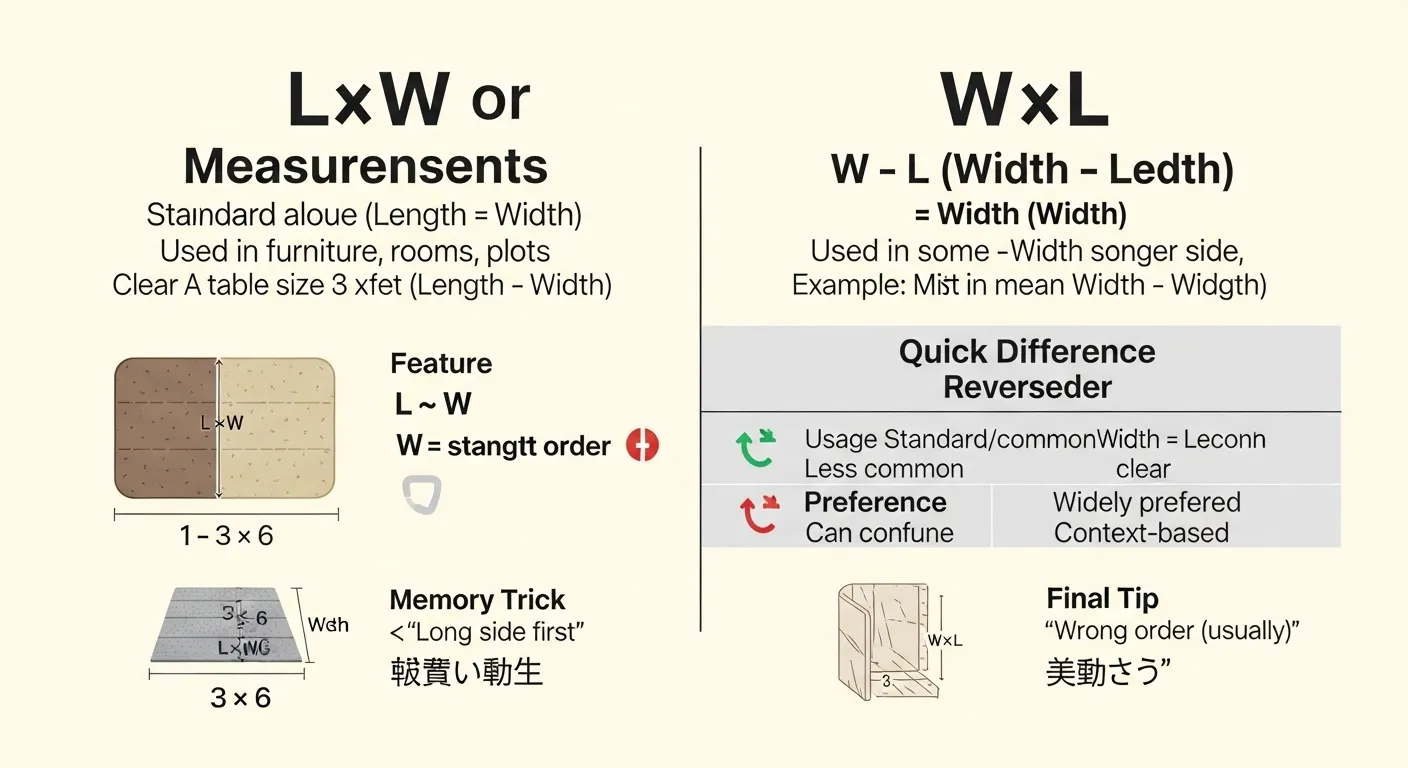
LxW means Length × Width, and WxL means Width × Length; both show the same measurement, but LxW is the standard order.
I remember checking product sizes online and getting confused when one site used LxW and another used WxL.
The numbers were the same, but the order made me pause. Many people search “lxw or wxl” because dimension order can feel unclear.
The good news is simple: both formats describe size, but one is more commonly accepted in writing and labeling.
LxW or WxL : Quick Answer
LxW = Length × Width (standard way to write dimensions)
WxL = Width × Length (less common, but still correct)
If you’re wondering “is LxW or WxL correct?”, the answer is: both are correct, but LxW is preferred.
Examples:
- Table size: 120 × 60 cm (LxW)
- Same table: 60 × 120 cm (WxL)
Simple rule:
LxW → preferred and standard
WxL → acceptable but uncommon
Meaning of LxW and WxL
Both LxW and WxL describe the size of an object using two measurements.When people ask “measurements LxW or WxL” or “dimensions LxW or WxL,” they are really asking about the order
Length (L)
- The longest side of an object
- Usually measured first
Width (W)
- The shorter side
- Measured after length
So:
- LxW = first length, then width
- WxL = first width, then length
The values stay the same. Only the order changes.
LxW or WxL for Pants
This is where many people get confused and search:
- “pants LxW or WxL”
- “are pants LxW or WxL”
- “are men’s pants LxW or WxL”
- “is it LxW or WxL for pants”
Answer (Simple):
Pants are usually written as Waist × Length (WxL)
Example:
- 32 × 34 → Waist 32, Length 34
👉 So for clothing, especially jeans and trousers, WxL is standard—not LxW.
Why?
Because waist is more important for fit, so it comes first.
Origin of LxW or WxL
The format L × W comes from basic measurement rules used in math, design, and construction.People often ask “is it LxW or WxL in general use?”
Why LxW became standard:
- Logical order: longer side first
- Easy to read and compare
- Used in engineering and product design
Over time, this order became widely accepted across industries.
LxW vs WxL : Key Differences
| Feature | LxW | WxL |
| Order | Length first | Width first |
| Usage | Standard | Less common |
| Meaning | Same | Same |
| Clarity | High | Can confuse |
LxW or WxL : Standard Usage
| Context | Preferred Format | Example |
| Furniture | LxW | 200 × 150 cm |
| Real estate | LxW | Room size 12 × 10 ft |
| Packaging | LxW | Box 30 × 20 cm |
| Informal use | Both | Depends on writer |
👉 Key insight:
Most industries follow LxW for clarity and consistency.
- General dimensions → LxW
- Pants sizing → WxL
Which Format Should You Use?
Choose based on clarity and audience:If you’re still thinking “LxW or WxL which is correct?”, follow this:
- Use LxW for most measurements
- Use WxL for pants and clothing
- Use LxW in most cases
- Use WxL only if context is clear
- Stay consistent in one document
Best advice:
Always use LxW for professional and clear communication.Use LxW unless the industry (like clothing) follows WxL
Common Mistakes with LxW or WxL
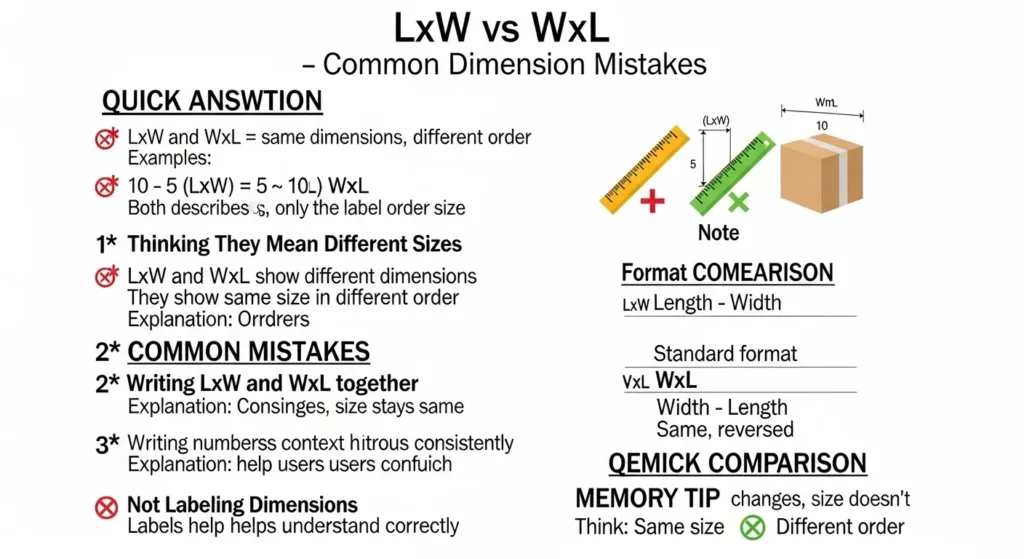
1. Thinking They Mean Different Sizes
❌ LxW and WxL show different dimensions
✅ They show the same size in different order
2. Mixing Orders
❌ Writing LxW and WxL together
✅ Use one format consistently
3. Not Labeling Dimensions
❌ Writing numbers without context
✅ Clearly mention length and width
LxW or WxL in Everyday Examples
In Shopping
- Product size: 100 × 50 cm (LxW)
In Home Design
- Room: 15 × 12 ft (LxW)
Packaging
- Box: 40 × 30 cm
In Online Listings
- Dimensions often shown in LxW format
LxW vs WxL : Side by Side Comparison
| Feature | LxW | WxL |
| Standard | Yes | No |
| Readability | Easy | Medium |
| Use | Professional | Casual |
| Confusion | Low | Higher |
LxW or WxL : Usage Insight
Why people get confused:
- Same numbers, different order
- No clear labels sometimes
- Different formats on websites
General pattern:
- LxW → most common worldwide
- WxL → occasional use
Important note:
Clarity matters more than format, but LxW is safer and clearer.
Frequently Asked Questions
1. What does LxW mean?
It means Length × Width, the standard way to show size.
2. Is WxL wrong?
No, it is correct but less common.
3. Which one is standard?
LxW is the standard format.
4. Do both show the same size?
Yes, both represent the same dimensions.
5. Why is LxW preferred?
It follows logical order and is widely used.
6. Can I use WxL?
Yes, but only when the context is clear.
7. What should I use in professional writing?
Always use LxW.
8. LxW or WxL which is correct?
Both are correct, but LxW is standard
9. Are pants LxW or WxL?
WxL (Waist × Length)
10. Are men’s pants LxW or WxL?
WxL
11. Is it LxW or WxL for pants?
WxL is correct
Conclusion
Understanding the difference between LxW and WxL is simple once you focus on order. Both formats describe the same dimensions, but LxW (Length × Width) is the standard and most widely accepted way to write measurements.
It follows a logical structure, starting with the longer side, which makes it easier to read and compare.
On the other hand, WxL is still correct but less common and can sometimes create confusion. In professional settings like design, construction, or product listings, using LxW helps maintain clarity and consistency. The key is not just knowing the difference but using one format consistently.
By choosing LxW as your default, you ensure your measurements are clear, professional, and easy to understand for everyone.

I am Bryan A. Garner, an American writer and editor focused on English usage, grammar, and word choice.
I am best known for Garner’s Modern English Usage, a reference book widely used by writers, editors, and legal professionals.
My work centers on clarity, precision, and resolving confusing word comparisons in modern English.