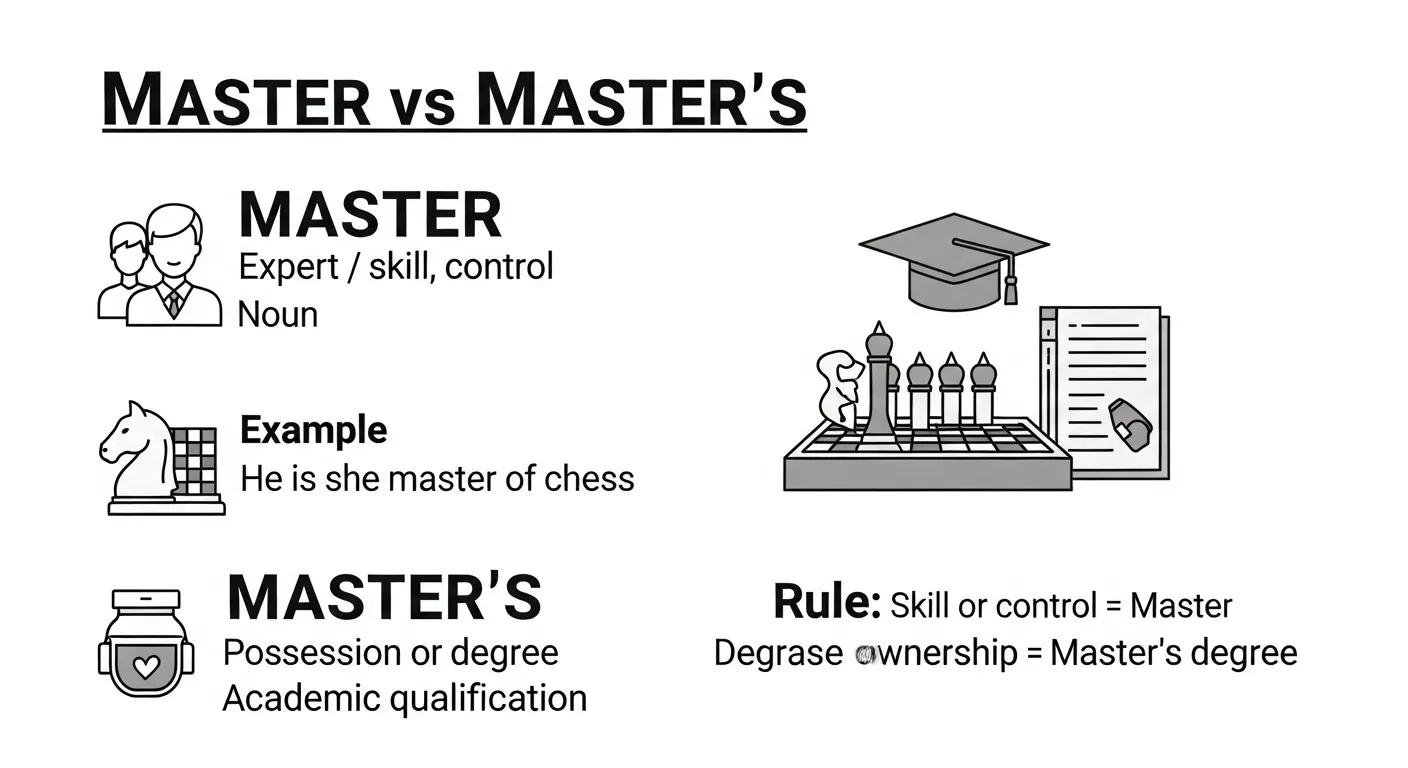
Master or Master’s? → The short answer is: use Master for a title or skill, and Master’s to refer to a postgraduate degree.
Many people search for master or master’s because the difference is subtle but important, especially in academic, professional, and everyday contexts. Confusing them can make your writing unclear or incorrect.
- Master can be a noun, verb, or adjective, depending on context. It refers to someone skilled, a degree, or controlling something.
- Master’s is a possessive form or short for a Master’s degree, showing ownership or a specific academic qualification.
For example, saying “I am pursuing a master in biology” is technically incorrect in modern academic usage—it should be “I am pursuing a Master’s in Biology.” This article explains the differences, origins, usage, common mistakes, and examples so you can confidently use master or master’s.
Master or Master’s: Quick Answer
- Master → Noun or verb; can mean expert, teacher, or something to control.
- Master’s → Possessive form; commonly refers to a Master’s degree.
Examples:
- He is a master of chess. ✅
- I am studying for a Master’s in engineering. ✅
- The ship’s master’s cabin is at the front. ✅
Tip:
- Master = expert, skill, or control
- Master’s = possession or degree
The Origin of Master and Master’s
- Master comes from Old English mægester, from Latin magister, meaning teacher, chief, or ruler.
- Master’s is simply the possessive form of master, showing ownership or relation, e.g., “Master’s degree = degree of a master.”
Key takeaway: Understanding whether you mean skill/expertise or possession/academic degree is critical.
British English vs American English Usage
| Aspect | Master | Master’s |
| Meaning | Expert, teacher, controlling authority | Possession, Master’s degree |
| Part of speech | Noun, verb, adjective | Possessive noun |
| Common usage UK | Academic titles, skills | Academic degrees, possessions |
| Common usage US | Academic titles, skills | Academic degrees, possessions |
| Example | “She is a master pianist.” | “He earned a Master’s in Economics.” |
Tip: Both spellings are the same in UK and US English; the distinction is grammatical and contextual.
Which One Should You Use?
- Use Master when referring to skill, authority, or teaching:
Example: “He is a master in martial arts.” - Use Master’s when referring to ownership or a Master’s degree:
Example: “She is pursuing a Master’s in Computer Science.”
Professional tip: If you’re talking about an academic degree, always use Master’s.
Common Mistakes with Master and Master’s
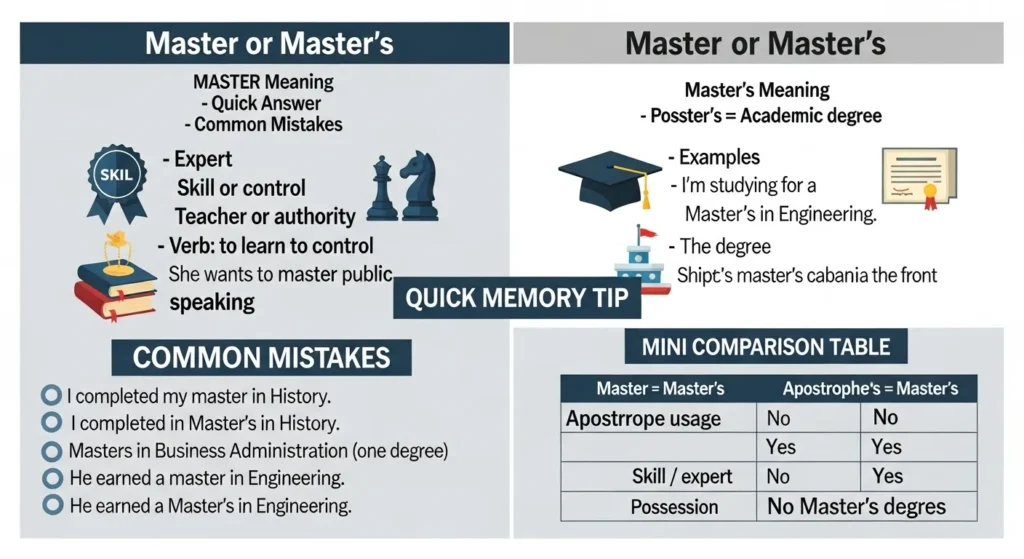
- Using master instead of master’s for degrees
- ❌ “I completed my master in history.”
- ✅ “I completed my Master’s in History.”
- Misplacing the apostrophe
- ❌ “Masters in Business Administration” (if talking about one degree)
- ✅ “Master’s in Business Administration”
- Using master for skill when degree is meant
- ❌ “He earned a master in engineering.”
- ✅ “He earned a Master’s in Engineering.”
- Confusing plural forms
- Multiple degrees → “Master’s degrees” ✅
Master or Master’s in Everyday Examples
Academic Context
- “I’m applying for a Master’s in Economics.”
- “She has a Master’s in Literature from Oxford.”
Skills and Expertise
- “He is a master at painting landscapes.”
- “The chef is a master of French cuisine.”
Formal Titles
- “The ship master’s cabin is luxurious.”
- “He addressed the master of the ceremony respectfully.”
Emails or Reports
- “Our team includes a master in data analytics.”
- “She will start her Master’s in Biotechnology next month.”
Master or Master’s: Google Trends & Usage Data
Search trends show Master’s dominates in academic contexts, while master is used in broader skill or authority contexts.
| Keyword | Popularity | Common Context |
| Master | Medium | Skills, authority, teaching |
| Master’s | High | Academic degrees, education |
| Master’s degree | High | Universities, admissions |
| Master class | Medium | Skill development, workshops |
FAQs: Master or Master’s
1. Are master and master’s the same?
No. Master = expert or authority, Master’s = possessive or academic degree.
2. Can master be used for degrees?
No, always use Master’s for academic qualifications.
3. How do you spell Master’s degree correctly?
With an apostrophe: Master’s degree ✅
4. Can master be a verb?
Yes, it can mean to become skilled at something: “She mastered the piano.”
5. Can master refer to a person?
Yes, “master” can mean teacher, expert, or someone in authority.
6. Is Master’s used worldwide?
Yes, in both UK and US English, Master’s refers to postgraduate degrees.
7. Can you pluralize Master’s degree?
Yes, Master’s degrees refers to multiple postgraduate qualifications.
Conclusion
The words master or master’s have distinct uses. Master refers to skill, authority, or teaching, while Master’s shows possession or refers to an academic degree.
Using the correct form is crucial in education, professional writing, and formal communication. Remember:
- Master = expert, skill, authority
- Master’s = academic degree, possession
By understanding this distinction, you can write clearly, accurately, and professionally in any context.

I am Mignon Fogarty, an American author and language expert also known as “Grammar Girl.”
I focus on explaining grammar rules, spelling mistakes, and confusing words in a simple and friendly way.
My goal is to make correct English easy and approachable for everyday readers.