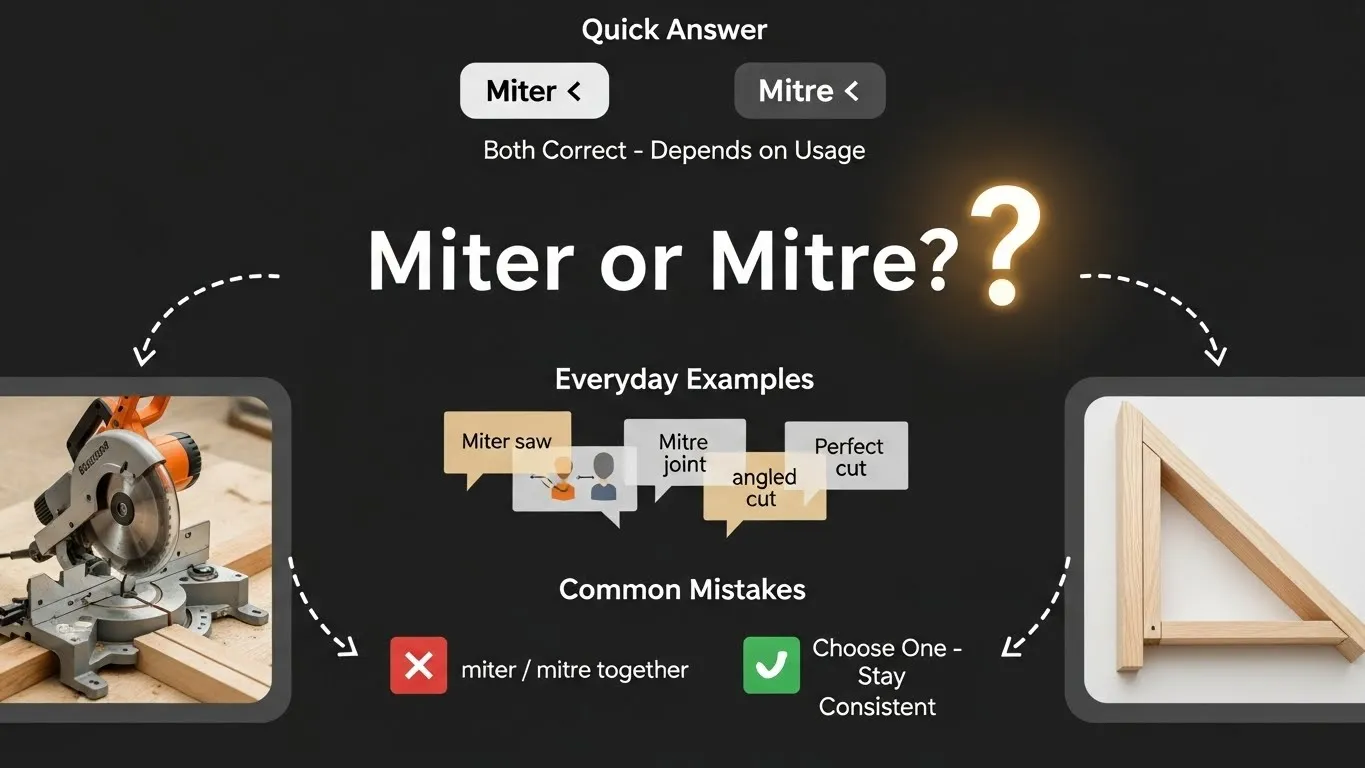
Miter is American English; mitre is British English. Both spellings are correct and have the same meaning.
Many people search for “miter or mitre” because both spellings appear correct at first glance. You may see miter in carpentry tools, dictionaries, or American articles, while mitre often appears in British books, architecture, or religious writing.
The confusion exists because both spellings are actually correct, but they are used in different varieties of English. If you use the wrong spelling for your audience, your writing can look inconsistent or unprofessional.
This article solves the confusion clearly and simply. You’ll get a quick answer, learn the origin of the word, understand British vs American spelling rules, see real-life examples, and get clear advice on which spelling you should use.
By the end, you’ll know exactly when to use miter and when to use mitre.
Miter or Mitre : Quick Answer
Both spellings are correct, but usage depends on English variety.
- Miter → American English
- Mitre → British English
The word refers to:
- A joint formed by cutting two pieces at an angle
- A cutting tool used to make angled cuts
- A ceremonial headdress worn by bishops
Examples:
- ✅ He used a miter saw to cut the wood. (US)
- ✅ The frame has perfect mitre joints. (UK)
The Origin of Miter or Mitre
The word comes from the Greek mitra, meaning headband or turban. It passed into Latin and then into Old French as mitre. From French, English adopted the word with the spelling mitre.
When American English developed its simplified spelling system, many words ending in -re were changed to -er. This is how mitre became miter in American English.
So, both spellings share the same origin. The difference exists because of spelling reforms, not meaning.
British English vs American English Spelling
This is a classic British vs American spelling difference.
Comparison Table
| English Variety | Preferred Spelling | Example |
| American English | Miter | Miter saw |
| British English | Mitre | Mitre joint |
| Canadian English | Mitre (mostly) | Mitre angle |
| Australian English | Mitre | Mitre cut |
The meaning stays the same in all cases.
Which Spelling Should You Use?
Use miter if your audience is:
- American
- Writing for US-based websites
- Using US exams or textbooks
Use mitre if your audience is:
- British or European
- Commonwealth countries
- Academic or traditional writing
If your audience is global, choose one spelling and stay consistent throughout the text.
Common Mistakes with Miter or Mitre
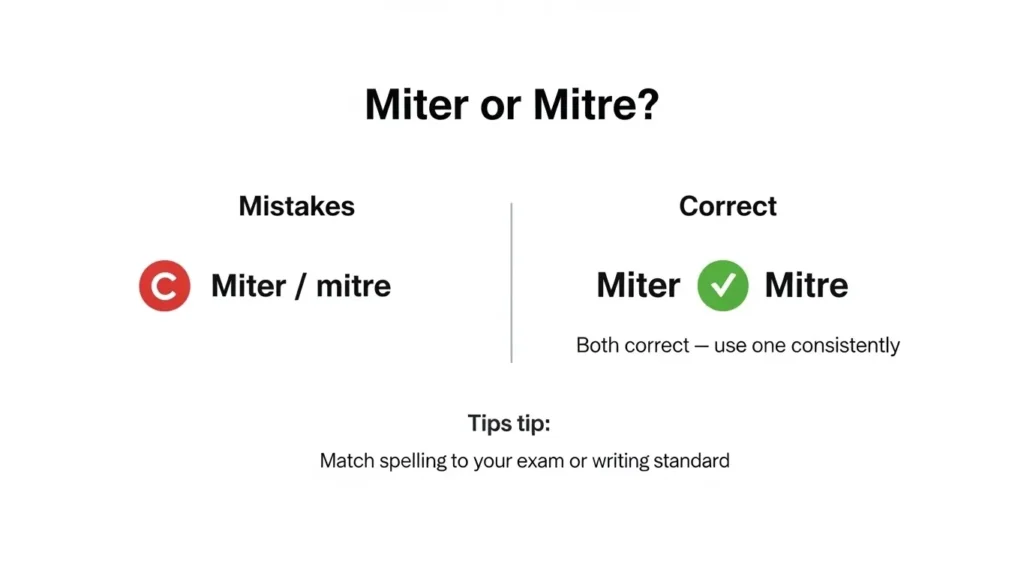
- ❌ Mixing spellings in the same document
✅ Choose one spelling and use it consistently - ❌ Assuming one spelling is wrong
✅ Both are correct, depending on region - ❌ Using US spelling in UK exams
✅ Match spelling to exam standards
Tip:
Check whether your writing follows American or British English rules.
Learn More : Copywrite or Copyright: Which Term Is Correct and Why It Matters
Miter or Mitre in Everyday Examples
Emails
- “Please cut the wood using a miter saw.” (US)
News
- “The cathedral displays a golden mitre.” (UK)
Social Media
- “Perfect mitre joints every time!”
Formal Writing
- “The bishop wore a traditional mitre during the ceremony.”
Construction & Carpentry
- “A miter joint improves the corner finish.”
Miter or Mitre : Google Trends & Usage Data
Search trends show that:
- Miter is searched more in the United States
- Mitre is more popular in the UK, Australia, and Europe
The term appears most often in:
- Carpentry and woodworking searches
- Architecture and construction
- Religious and historical contexts
Both spellings are widely accepted in their regions, and search interest depends mainly on location.
Comparison Table: Miter vs Mitre
| Word | English Type | Meaning |
| Miter | American English | Angled joint, tool, or bishop’s hat |
| Mitre | British English | Same meaning |
FAQs: Miter or Mitre
1. Are miter and mitre the same word?
Yes. They have the same meaning.
2. Is miter American English?
Yes, it is the American spelling.
3. Is mitre British English?
Yes, it is the British spelling.
4. Which spelling should I use in exams?
Use the spelling required by your exam board.
5. Is miter used for the bishop’s hat in the US?
Yes, Americans use miter for all meanings.
6. Can I mix both spellings?
No. Consistency is important.
7. Is one spelling more correct than the other?
No. Both are correct in their regions.
Conclusion
The difference between miter or mitre is not about meaning but about regional spelling. Miter is used in American English, while mitre is used in British and Commonwealth English. Both refer to the same joint, tool, or ceremonial headwear.
The key rule is simple: match your spelling to your audience. If you are writing for the US, use miter. If you are writing for the UK or international academic contexts, use mitre. Never mix the two in the same piece of writing.
Understanding this difference improves clarity, consistency, and professionalism in your English writing, especially in technical, academic, or formal contexts.

I am Lynne Truss, a British writer and journalist who is best known for my work on English grammar. I have always been interested in language and punctuation, especially how small mistakes can change meaning. Through my books, I try to make grammar easy, interesting, and enjoyable for readers.