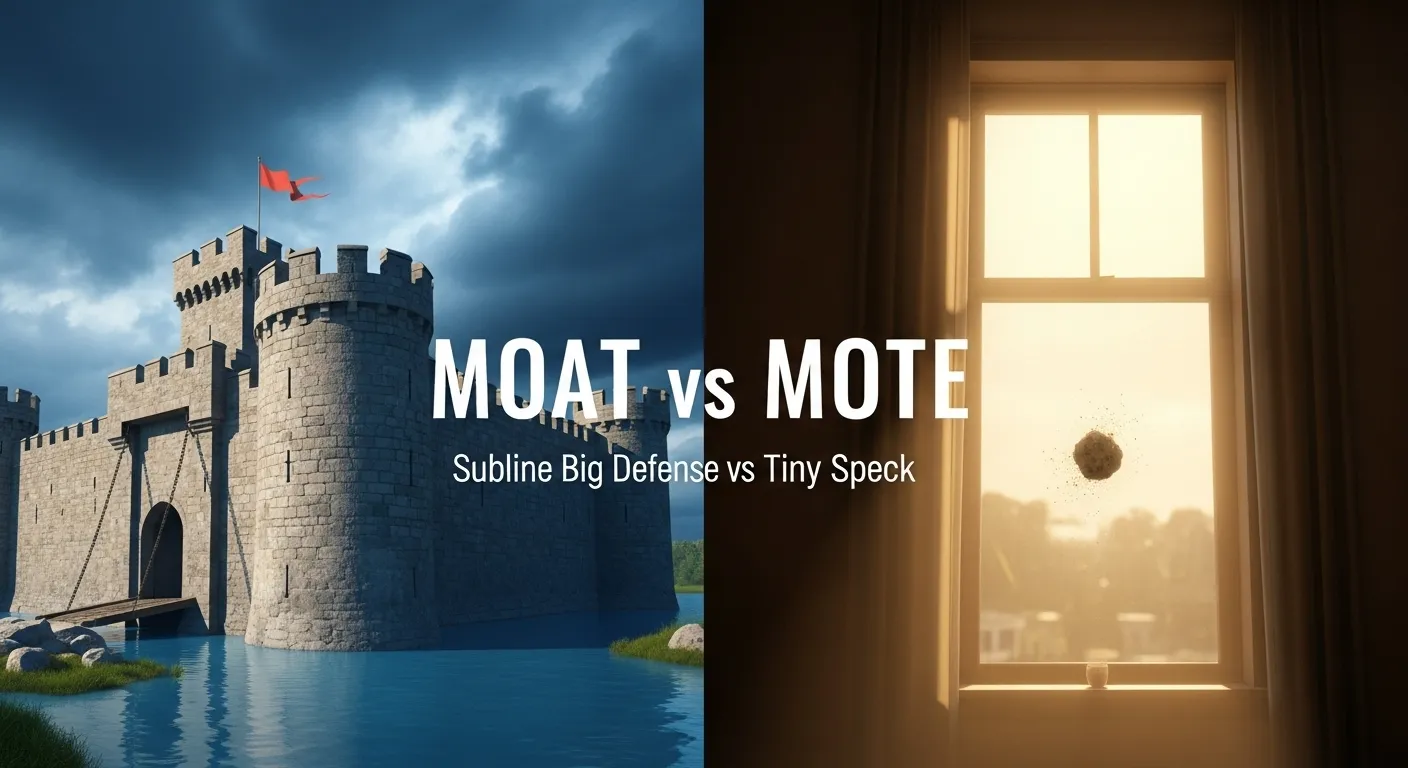
The answer is simple:moat is a deep ditch around a castle, while mote means a tiny speck of dust.
I still remember reading a sentence that said, “A single mote protected the castle,” and I knew something was wrong. But for a second, I doubted myself. That’s exactly why people search “moat or mote.” T
hese words look similar, sound close in fast speech, and appear in very different contexts. The confusion usually starts with spelling and ends with meaning.
Once I understood what each word truly stands for, the mix-up vanished. In this article, I’ll break everything down clearly so you can choose the right word with confidence every time.
Moat or Mote: Quick Answer
Moat means a deep ditch, usually filled with water, built around a castle or fort for protection.
Mote means a very small particle, such as dust or a tiny speck.
Examples:
- ✔ The castle was surrounded by a wide moat.
- ✔ A mote of dust floated in the sunlight.
👉 Defense or structure? → Moat
👉 Tiny particle? → Mote
The Origin of Moat or Mote
Looking at word origins makes the difference clearer.
Moat comes from Old French motte, meaning a mound or fortified structure. Over time, it came to describe the ditch dug around castles as a defensive barrier. That’s why moat is closely linked to medieval forts and protection.
Mote comes from Old English mot, meaning a small particle or speck. This meaning has stayed almost unchanged for centuries. You’ll often see mote used in poetic, religious, or descriptive writing.
The confusion exists because:
- Both words are short
- Both contain “mo”
- Both are nouns
- Pronunciation can sound similar in some accents
But historically and logically, they have nothing in common.
British English vs American English Spelling
This is not a British vs American spelling issue.
Both moat and mote are spelled the same in:
- British English
- American English
- Canadian English
- Australian English
The difference is entirely about meaning, not spelling rules.
Examples:
- UK: The ancient castle still has its moat.
- US: Not a single mote of evidence was found.
Comparison Table
| Word | Meaning | UK English | US English |
| Moat | Defensive ditch | Same | Same |
| Mote | Tiny particle | Same | Same |
Which Spelling Should You Use?
Your choice depends only on context, not audience.
- Writing about history, castles, or defense → Moat
- Writing about dust, tiny particles, or figurative smallness → Mote
Audience-based advice:
- US audience → Same rule
- UK/Commonwealth audience → Same rule
- Global audience → Focus on meaning
Easy memory trick:
- Moat has “a” like around → around a castle
- Mote has “e” like extremely small
Common Mistakes with Moat or Mote
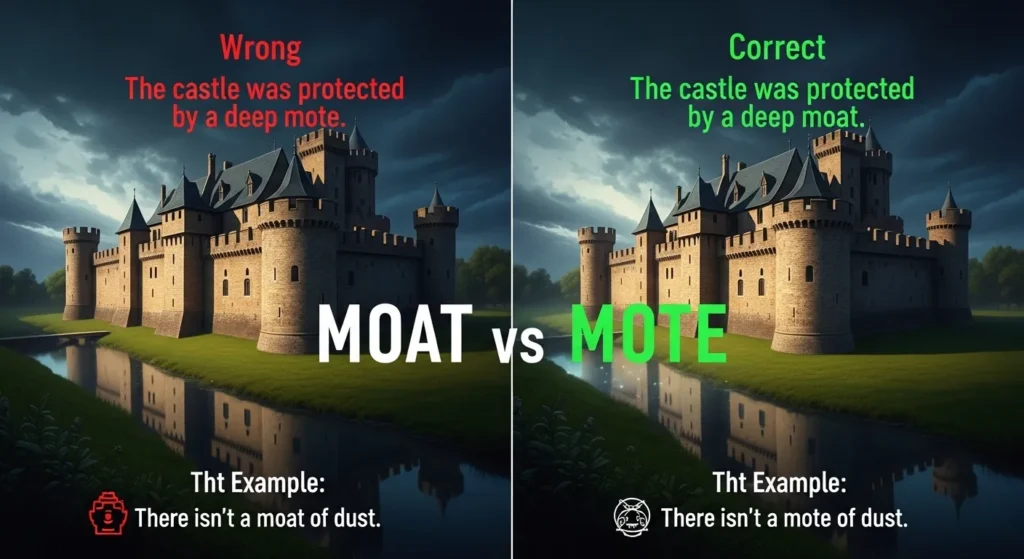
Here are mistakes I often see.
❌ The castle was protected by a deep mote.
✅ The castle was protected by a deep moat.
❌ There isn’t a moat of dust on the table.
✅ There isn’t a mote of dust on the table.
❌ Using moat metaphorically for “small amount”
✅ Use mote for smallness or insignificance
Moat or Mote in Everyday Examples
Emails
- “The museum still has its original moat.”
- “There isn’t a mote of doubt about the decision.”
News Writing
- “The historic moat was restored last year.”
- “Not a mote of evidence supported the claim.”
Social Media
- “Love castles with real moats.”
- “Couldn’t find a mote of motivation today.”
Formal Writing
- “The moat served as a primary defensive feature.”
- “The theory lacks even a mote of scientific support.”
Moat or Mote: Google Trends & Usage Data
Search data shows “moat or mote” is commonly searched by:
- Students
- ESL learners
- Readers of historical or religious texts
Usage patterns:
- Moat appears mostly in:
- History
- Architecture
- Tourism content
- Mote appears in:
- Literature
- Religious texts (e.g., mote and beam)
- Figurative expressions
Regional interest:
- United States
- United Kingdom
- India
- Pakistan
- Australia
The confusion is global and meaning-based.
Comparison Table: Moat vs Mote
| Feature | Moat | Mote |
| Meaning | Defensive ditch | Tiny particle |
| Size | Large | Extremely small |
| Common context | Castles, forts | Dust, evidence |
| Figurative use | Rare | Common |
| Common confusion | Mixed with mote | Mixed with moat |
FAQs: Moat or Mote
1. Is “mote and beam” a real phrase?
Yes. It refers to noticing small faults in others.
2. Can moat be used metaphorically?
Sometimes, in business (economic moat), but rarely otherwise.
3. Which word refers to dust?
Mote.
4. Is this a US vs UK spelling issue?
No. Both spellings are the same worldwide.
5. Can mote mean something figuratively small?
Yes. It often means a tiny amount.
6. Is moat always related to castles?
Mostly, but it can also refer to modern defenses.
7. Which word is more common in daily speech?
Moat is more common than mote.
Conclusion
Once you understand the difference between moat and mote, the confusion disappears instantly. Moat is large, visible, and protective.
Mote is tiny, almost invisible, and often symbolic. The words may look similar, but their meanings sit at opposite ends of size and function. Paying attention to context is the key.
If you’re writing history, literature, casual messages, or formal content, choosing the correct word improves clarity and professionalism.
Small spelling choices create big differences in meaning. Now that you know the rule, you’ll never hesitate again when choosing between moat and mote.

I am Lynne Truss, a British writer and journalist who is best known for my work on English grammar. I have always been interested in language and punctuation, especially how small mistakes can change meaning. Through my books, I try to make grammar easy, interesting, and enjoyable for readers.