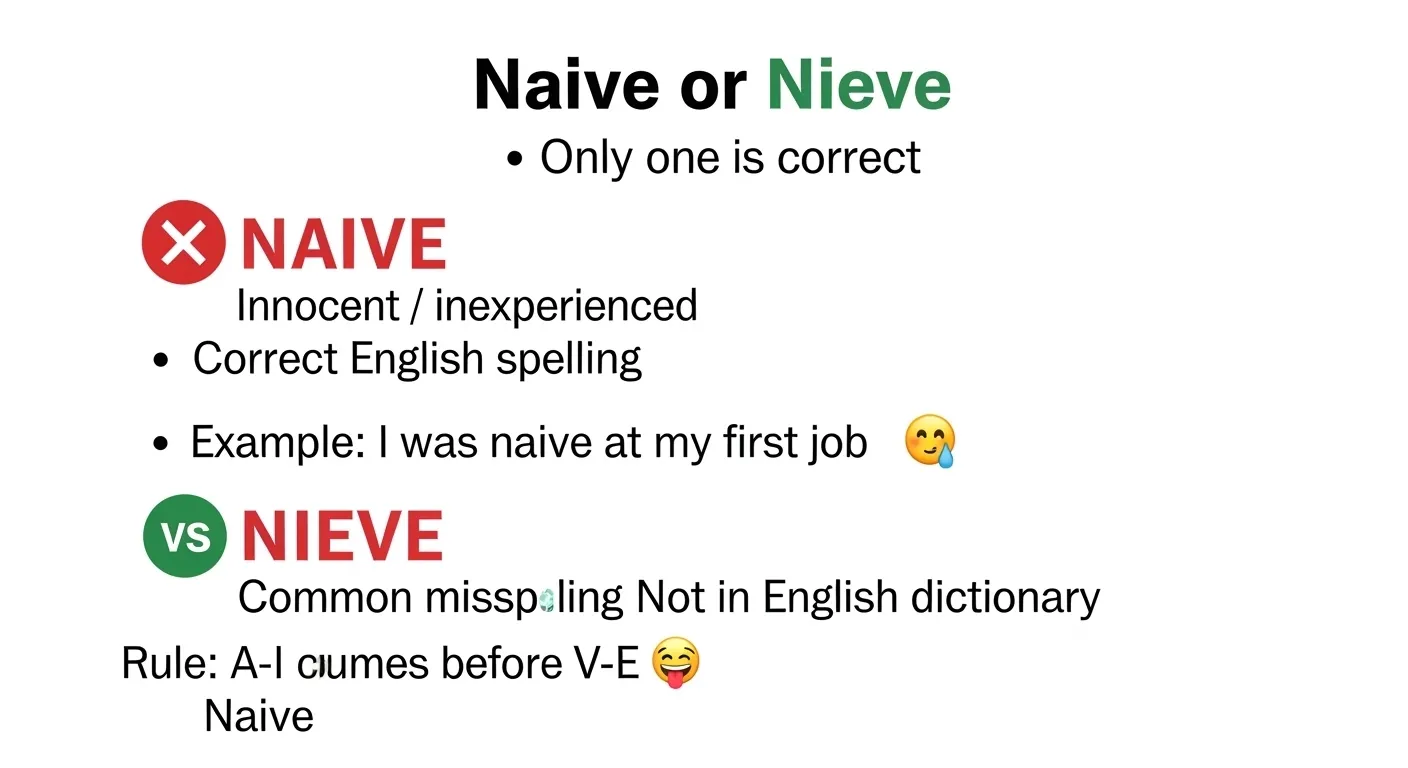
The short answer: naive is correct, while nieve is incorrect.
Naive or nieve confused me the first time I wrote a character description in an article. I typed, “He was young and nieve,” and something felt wrong. The word looked almost correct, but not quite. I checked it, and yes I had misspelled it. Later, I realized many people search naive or nieve because the spelling feels tricky.
The vowel order can easily get mixed up. Writers, students, bloggers, and professionals want to avoid simple spelling mistakes that can hurt credibility. This guide explains clearly why naive is correct and why nieve is not a real English word.
Naive or Nieve : Quick Answer
- naive → Correct spelling
- nieve → Incorrect spelling
Examples:
✅ She was too naive to believe the rumor.
❌ She was too nieve to believe the rumor.
Simple Rule:
👉 The correct order is a-i, not i-e.
The Origin of Naive and Nieve
The word naive comes from the French word naïf, meaning natural, innocent, or simple. English adopted the word in the 1600s.
Originally, it included two dots over the “i” (naïve). These dots are called a diaeresis, and they show that the vowels are pronounced separately.
Over time, English simplified the spelling by removing the dots in most cases. So today, both naive and naïve are accepted, but nieve is never correct.
The confusion exists because:
- English has many “ie” and “ei” patterns
- People apply the “i before e” rule incorrectly
- Fast typing swaps letters
Understanding the French origin helps you remember the correct order of letters.
British English vs American English Spelling
There is no major spelling difference between British and American English for this word.
Both use:
- naive (without dots)
- naïve (with dots, more formal or traditional)
Comparison Table
| Spelling | Status | UK English | US English |
| naive | correct | ✅ Common | ✅ Common |
| naïve | correct | ✅ Formal | ✅ Formal |
| nieve | incorrect | ❌ No | ❌ No |
Important:
The confusion is about spelling accuracy, not regional variation.
Which Spelling Should You Use?
In most everyday writing, use naive.
When to use naïve
- Academic writing
- Formal essays
- When preserving original French spelling
When to use naive
- Blogs
- Emails
- Business writing
- Social media
Never use
- ❌ nieve
Quick Tip:
If spell-check underlines it, it is probably wrong.
Common Mistakes with Naive or Nieve
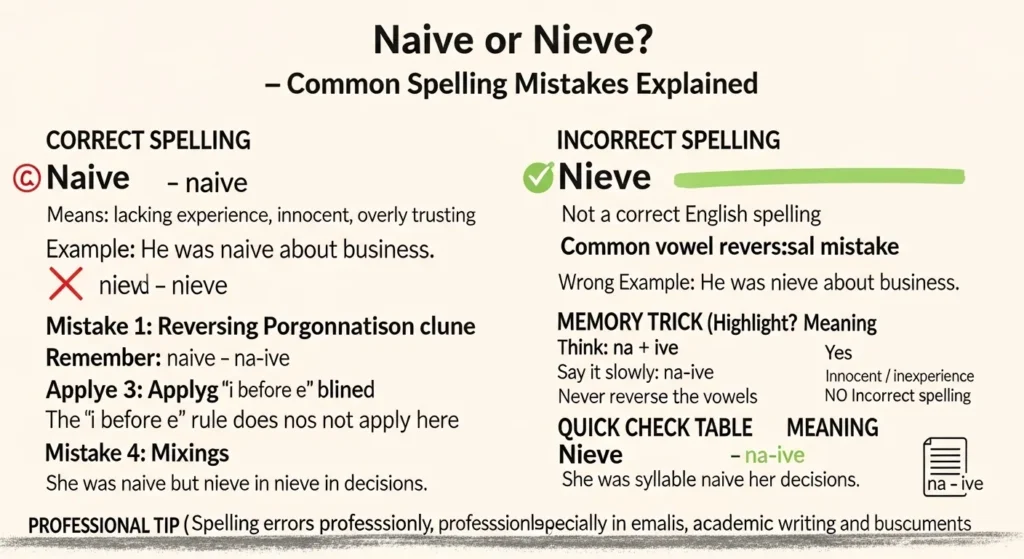
Mistake 1: Reversing vowels
❌ He was nieve about business.
✅ He was naive about business.
Mistake 2: Forgetting pronunciation clue
People forget that both vowels are pronounced separately: na-ive.
Mistake 3: Applying the “i before e” rule blindly
The rule does not apply here.
Mistake 4: Mixing forms in one document
❌ She was naive but nieve in decisions.
✅ She was naive in her decisions.
Spelling errors reduce professionalism, especially in formal writing.
Nieve or Naive in Everyday Examples
Emails
- It would be naive to ignore the warning signs.
News
- Analysts called the policy naive.
Social Media
- I was naive to trust that offer 😅
Academic Writing
- The theory assumes a naive understanding of economics.
Using the correct spelling builds credibility.
Naive or Nieve : Google Trends & Usage Data
Search data shows naive or nieve is commonly searched in:
- United States
- United Kingdom
- Canada
- Australia
- India
Why people search this keyword:
- Confusion over vowel order
- Typing mistakes
- School assignments
- Essay writing
Usage Insight:
- Naive appears widely in news, academic, and blog writing
- Nieve appears mainly as a spelling error
The high search volume proves that many English users struggle with this word.
Naive vs Nieve : Side-by-Side Comparison
| Word | Type | Meaning | Correct? | Example |
| naive | adjective | innocent or inexperienced | ✅ Yes | She was naive |
| naïve | adjective | same meaning (formal form) | ✅ Yes | A naïve assumption |
| nieve | none | no meaning in English | ❌ No | ❌ Wrong spelling |
FAQs: Naive or Nieve
1. Is nieve ever correct?
No. It is always incorrect in English.
2. What does naive mean?
It means innocent, inexperienced, or overly trusting.
3. Is naïve different from naive?
No. The meaning is the same.
4. Why do people misspell naive?
Because vowel combinations in English can be confusing.
5. Should I use the dots over the i?
You can, but it is optional in modern writing.
6. Is naive formal or informal?
It works in both formal and informal contexts.
7. Is naive negative?
It can be neutral or slightly negative depending on context.
8. Is naive commonly used in essays?
Yes, especially in analysis and opinion writing.
Conclusion
The confusion between naive or nieve comes from simple letter order mistakes. The correct spelling is naive, and in formal contexts, you may also see naïve. The form nieve is always incorrect and should be avoided.
I have learned that small spelling errors can make writing look careless, even when ideas are strong. Words like naive are common in essays, business writing, and news articles. Using the wrong spelling can distract readers and reduce trust. Once you remember that the correct order is a-i, not i-e, this mistake becomes easy to avoid. Clear spelling shows attention to detail, and attention to detail builds credibility.

I am Lynne Truss, a British writer and journalist who is best known for my work on English grammar. I have always been interested in language and punctuation, especially how small mistakes can change meaning. Through my books, I try to make grammar easy, interesting, and enjoyable for readers.