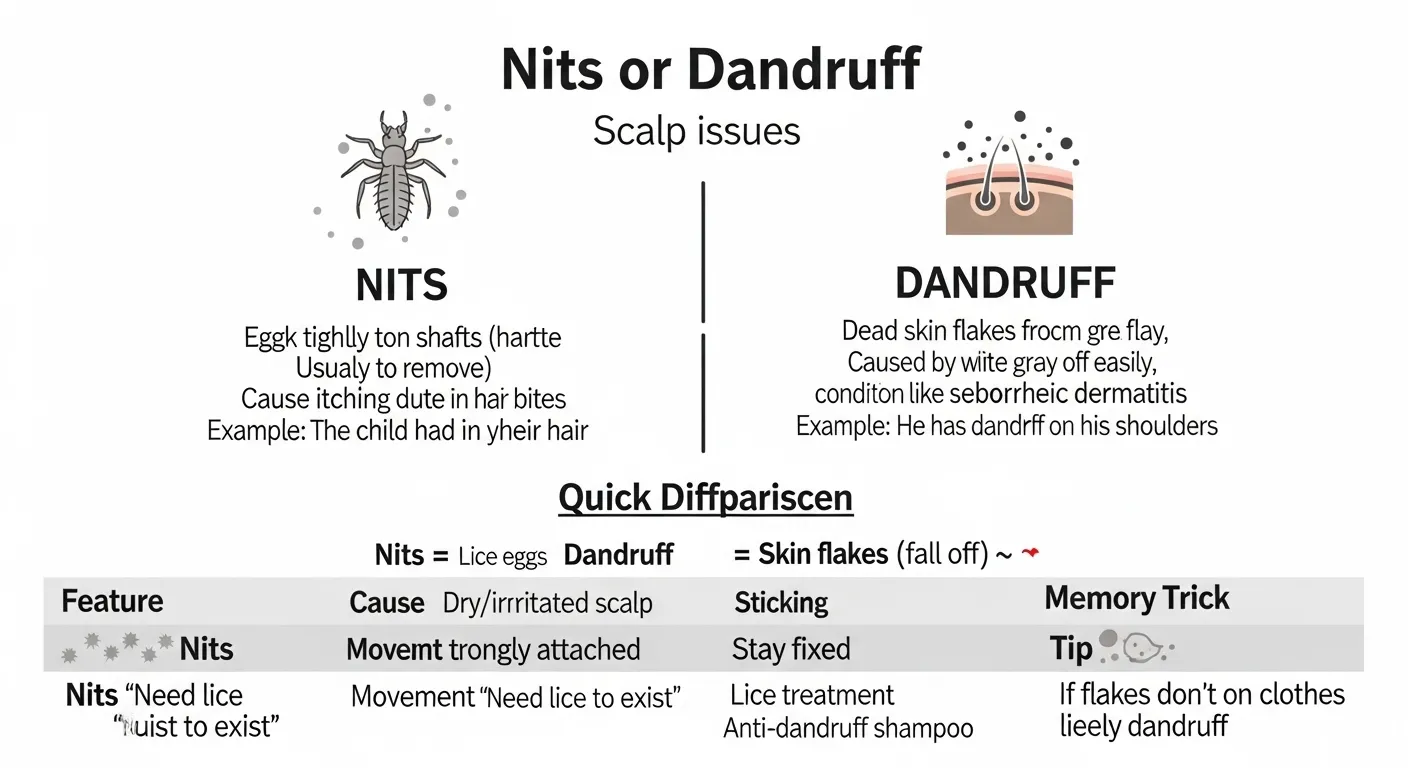
Nits are lice eggs attached to hair strands, while dandruff is loose white flakes caused by scalp conditions.
I remember once noticing small white particles in my hair and feeling unsure if it was dandruff or something more serious. That confusion made me look closer, and I realized how easy it is to mix up these two.
Many people search “nits or dandruff” because both appear as white flakes on the scalp. The difference matters a lot because their causes and treatments are completely different.
Understanding this helps you identify the issue correctly and take the right steps.
Nits or Dandruff : Quick Answer
Nits = tiny lice eggs stuck firmly to hair strands.
Dandruff = loose white flakes of dead skin from the scalp.
Examples:
- Nits stay attached to hair and do not fall easily.
- Dandruff flakes fall off when you scratch or shake your hair.
Simple rule:
Nits → stick to hair (lice eggs)
Dandruff → fall off easily (dead skin flakes)
Meaning of Nits and Dandruff
The difference between nits and dandruff comes from their cause, appearance, and behavior.
Nits (Lice Eggs)
Nits are small eggs laid by head lice on hair shafts.
Key features:
- Firmly attached to hair
- Oval shaped and tiny
- Hard to remove
- Usually close to the scalp
Examples:
- The child had nits near the roots of the hair.
- Nits remained stuck even after washing.
Nits indicate a lice infestation and need proper treatment.
Dandruff (Scalp Condition)
Dandruff is a common scalp condition that causes flakes of dead skin.
Key features:
- White or yellow flakes
- Fall off easily
- Often linked with dryness or oily scalp
- May cause itching
Examples:
- He noticed dandruff on his shoulders.
- Anti dandruff shampoo helped reduce flakes.
Dandruff is not contagious.
Origin of Dandruff and Nits
The word nit comes from Old English and refers to the egg of a louse.
The word dandruff has uncertain origins but has been used for centuries to describe flaky scalp conditions.
These origins reflect their meanings and explain why the terms are different.
Nits or Dandruff : Key Differences
| Feature | Nits | Dandruff |
| Cause | Head lice | Scalp condition |
| Appearance | Tiny eggs | White flakes |
| Attachment | Stuck to hair | Loose |
| Removal | Hard to remove | Easy to remove |
| Contagious | Yes (lice spread) | No |
Dandruff or Nits in Everyday Situations
At Home
- Nits require special lice treatment.
- Dandruff can be managed with shampoo.
In Daily Life
- Nits do not fall off easily.
- Dandruff flakes appear on clothes.
In Personal Care
- Fine combs help remove nits.
- Regular washing helps control dandruff.
Common Mistakes with Nits or Dandruff
1. Thinking They Are the Same
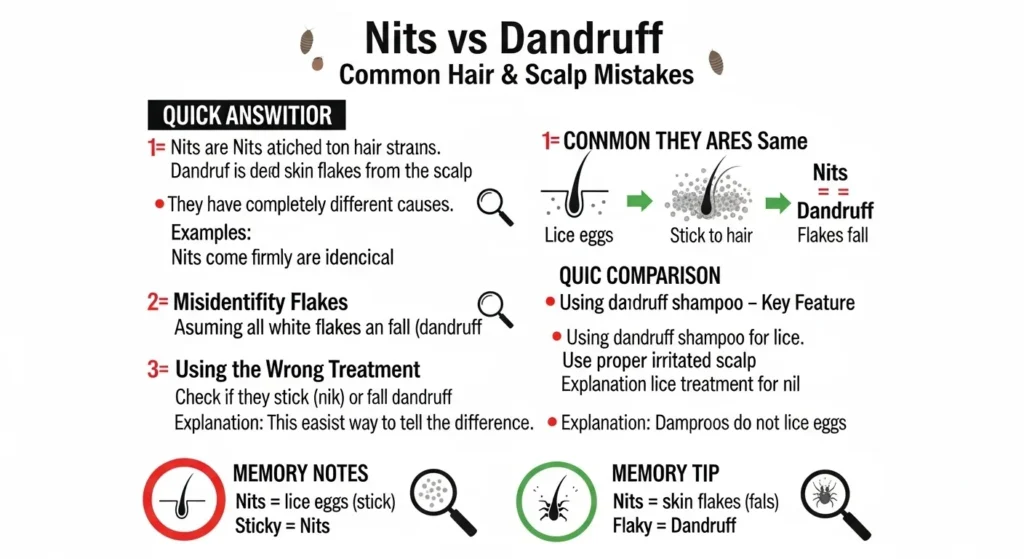
❌ Nits and dandruff are identical.
✅ They have completely different causes.
2. Misidentifying Flakes
❌ Assuming all white flakes are dandruff.
✅ Check if they stick (nits) or fall (dandruff).
3. Using the Wrong Treatment
❌ Using dandruff shampoo for lice.
✅ Use proper lice treatment for nits.
Nits vs Dandruff : Side by Side Comparison
| Feature | Nits | Dandruff |
| Type | Lice eggs | Skin flakes |
| Cause | Parasite | Skin condition |
| Spread | Contagious | Not contagious |
| Texture | Hard | Soft |
| Location | Hair shafts | Scalp |
Frequently Asked Questions
1. What is the difference between nits and dandruff?
Nits are lice eggs attached to hair, while dandruff is loose scalp flakes.
2. Are nits contagious?
Yes. Nits come from lice, which can spread between people.
3. Does dandruff spread?
No. Dandruff is not contagious.
4. How can I tell if I have nits or dandruff?
- Stuck to hair → nits
- Falls easily → dandruff
5. Can I treat nits with shampoo?
Regular shampoo does not remove nits. Special lice treatment is needed.
6. Is dandruff serious?
Dandruff is usually mild and manageable with proper care.
Conclusion
Understanding the difference between nits and dandruff is important for proper treatment and care. Although both may appear as white particles in the hair, their causes and behavior are completely different.
Nits are lice eggs that stick firmly to hair strands and indicate an infestation that requires specific treatment. Dandruff, on the other hand, is a common scalp condition that produces loose flakes of dead skin and can often be managed with regular hair care products. The key difference lies in how they behave: nits stay attached, while dandruff falls off easily.
By paying attention to these signs, you can quickly identify the problem and avoid using the wrong treatment. This simple understanding saves time, reduces stress, and helps maintain better scalp health.

I am Lynne Truss, a British writer and journalist who is best known for my work on English grammar. I have always been interested in language and punctuation, especially how small mistakes can change meaning. Through my books, I try to make grammar easy, interesting, and enjoyable for readers.