The short answer is simple: nominal names things, while ordinal shows order or position.
I remember the first time I searched nominal or ordinal. I was filling out a form and saw options like “nominal data” and “ordinal data.”Both sounded technical, both looked similar, and honestly, I felt stuck. If you’re here, you’ve probably felt the same confusion.
People search this keyword because these terms appear in exams, statistics, surveys, research papers, and data analysis tools but no one explains them in plain English. At first, I thought it was just academic jargon.
Then I realized something important: these words describe how data works, not just how it looks. Once that clicked, everything became clear. In this article, I’ll explain the difference step by step, simply and clearly.
Nominal or Ordinal: Quick Answer
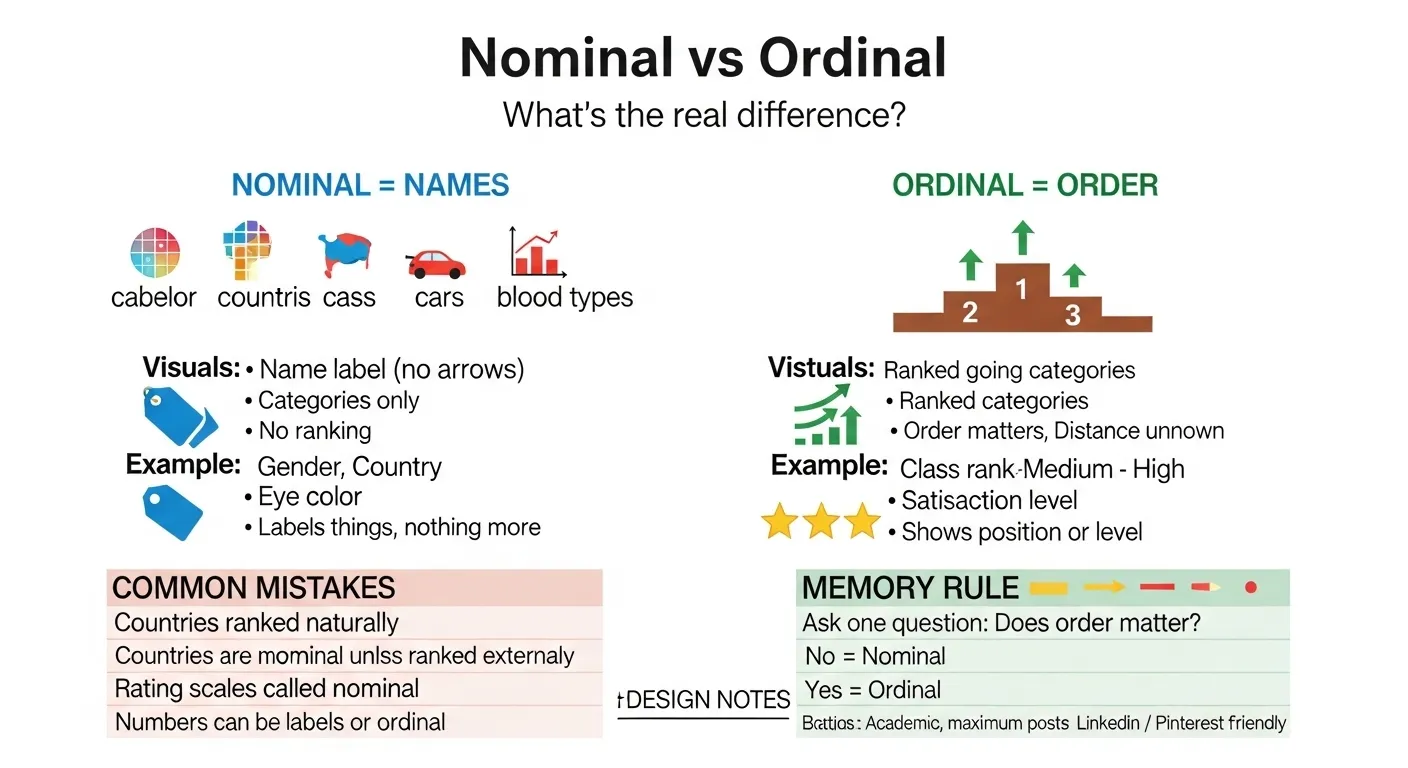
Nominal data labels or names categories, while ordinal data shows order or ranking.
Simple examples:
- Nominal: Gender, blood type, country
- Ordinal: Rank, class position, satisfaction level
If your data has no order, it is nominal.
If your data has a clear order, it is ordinal.
That’s the core difference and everything else builds on this rule.
The Origin of Nominal or Ordinal
Understanding the origin makes these terms easier to remember.
- Nominal comes from the Latin word nomen, meaning name.
So nominal data simply names or labels something. - Ordinal comes from the Latin word ordinalis, meaning order or sequence.
Ordinal data tells us position or rank.
The spelling differences exist because they describe different ideas, not because of British or American English rules. These words were adopted into English through academic and mathematical writing and have kept their original meanings.
British English vs American English Spelling
Here’s an important clarification:
👉 There is no British vs American spelling difference for nominal or ordinal.
Both spellings are:
- Identical in UK English
- Identical in US English
- Identical worldwide
Comparison Table
| Term | Meaning | UK Spelling | US Spelling |
| Nominal | Naming categories | Nominal | Nominal |
| Ordinal | Showing order | Ordinal | Ordinal |
If you see confusion online, it’s about meaning, not spelling.
Which One Should You Use?
Choosing between nominal and ordinal depends on what your data represents, not who your audience is.
Use nominal when:
- Categories have no natural order
- You are labeling or classifying data
Examples:
- Eye color
- Nationality
- Type of car
- Religion
You cannot rank these logically.
Use ordinal when:
- Categories can be ranked
- Order matters, even if differences are unclear
Examples:
- Satisfaction levels (low, medium, high)
- Education level
- Class rank
- Star ratings
You know the order, but not the exact distance between values.
For global and professional audiences:
- Academic writing → Use terms precisely
- Surveys and research → Choose based on data structure
- Business reports → Misusing them can lead to wrong analysis
Common Mistakes with Nominal or Ordinal
Let’s clear up the most common errors.
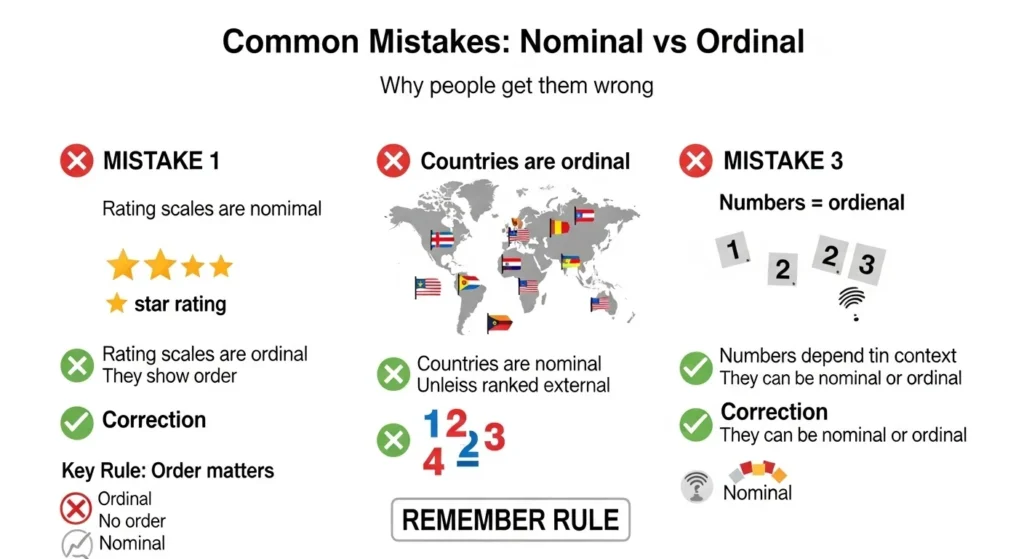
❌ Mistake 1:
Rating scales are nominal data.
✅ Correction:
Rating scales are ordinal because they show order.
❌ Mistake 2:
Countries can be ranked, so they are ordinal.
✅ Correction:
Countries are nominal unless you apply an external ranking.
❌ Mistake 3:
Numbers always mean ordinal data.
✅ Correction:
Numbers can represent nominal, ordinal, or other data types. Context matters.
Ordinal or Nominal in Everyday Examples
Emails
- Please select your department (nominal data).
- Rate your experience from poor to excellent (ordinal data).
News
- Voters were grouped by age category (nominal).
- Schools were ranked based on performance (ordinal).
Social Media
- Favorite color poll (nominal).
- Top 5 movies list (ordinal).
Formal Writing
- Participants were classified by gender and nationality (nominal).
- Responses were measured using a five-point Likert scale (ordinal).
Ordinal vs Nominal: Google Trends & Usage Data
Search behavior shows two clear patterns:
- Nominal is mostly searched in:
- Statistics courses
- Survey design
- Data analysis
- Research methods
- Ordinal spikes during:
- Exam seasons
- Academic assignments
- Research paper submissions
By region:
- Searches are strong in the US, UK, India, Pakistan, and Australia.
- Most searches come from students, researchers, and professionals.
This confirms that people aren’t confused about spelling they’re confused about classification.
Nominal vs Ordinal: Comparison Table
| Feature | Nominal | Ordinal |
| Meaning | Names categories | Shows order |
| Order matters | ❌ No | ✔ Yes |
| Can be ranked | ❌ No | ✔ Yes |
| Examples | Gender, color | Rank, rating |
| Common use | Classification | Comparison |
FAQs: Nominal or Ordinal
1. Is nominal data qualitative?
Yes. Nominal data is qualitative and categorical.
2. Is ordinal data quantitative?
It is mostly qualitative but has an order.
3. Are survey ratings nominal or ordinal?
They are ordinal because they follow a sequence.
4. Can numbers be nominal?
Yes. Numbers can be labels, like jersey numbers.
5. Which is more advanced, nominal or ordinal?
Neither. They serve different purposes.
6. Can ordinal data be converted to nominal?
Yes, by ignoring the order.
7. Why is ordinal data important?
It allows comparison and ranking without exact values.
Conclusion
The difference between nominal or ordinal becomes easy once you stop overthinking it. Nominal data is about naming and labeling. It tells us what something is, not where it stands. Ordinal data adds one key feature: order.
It shows position, rank, or level, even if the distance between values is unknown. I used to mix these up too, especially when dealing with surveys and reports. But once I focused on one question does order matter? everything made sense.
Using the correct term improves clarity, accuracy, and credibility in academic and professional writing. Whether you are a student, researcher, or analyst, mastering this distinction will help you design better surveys and interpret data correctly.
Remember: no order means nominal; clear order means ordinal. That single rule will guide you every time.

I am Lynne Truss, a British writer and journalist who is best known for my work on English grammar. I have always been interested in language and punctuation, especially how small mistakes can change meaning. Through my books, I try to make grammar easy, interesting, and enjoyable for readers.