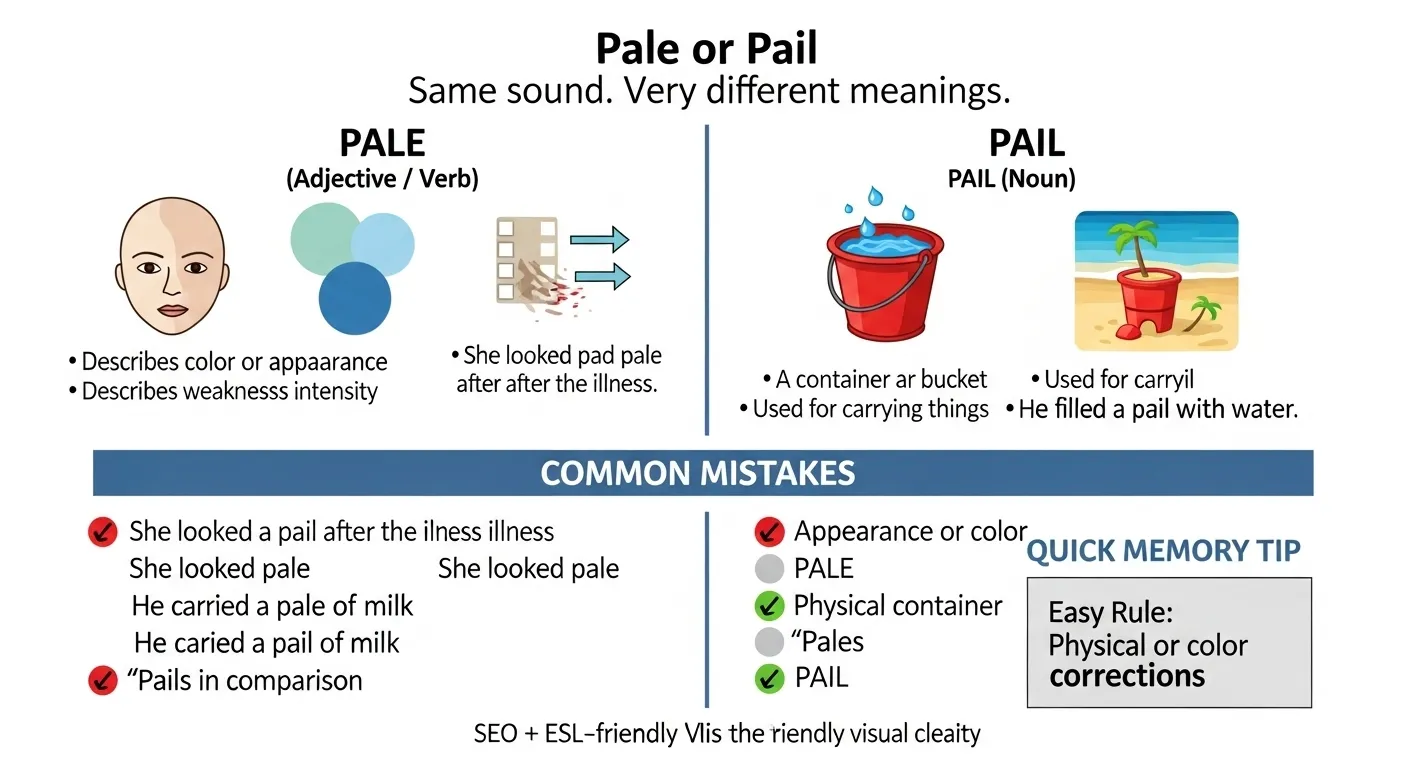
The Short answer is this: Pale describes color or appearance, while Pail is a container, like a bucket.
I still remember the first time I typed pale or pail into a search bar. I was writing a sentence about carrying water, but my spellcheck didn’t help much. Pail or Pale words looked right, both sounded the same, and both appeared in dictionaries. That’s exactly why so many people search this keyword.
These words are homophones they sound identical but mean completely different things. At first, I thought it was just a spelling issue. Then I realized the real problem: using the wrong word can change the entire meaning of a sentence.
Once you understand their roles, the confusion disappears. This guide clears it up clearly, simply, and permanently.
Pale or Pail: Quick Answer
Pale is an adjective that describes light color, weakness, or lack of intensity.
Pail is a noun that means a bucket or container.
Simple examples:
- Her face turned pale after the news.
- He filled a pail with water.
If you are describing appearance, use pale.
If you are naming an object, use pail.
They sound the same, but they are never interchangeable.
The Origin of Pale or Pail
Understanding where these words come from makes them easier to remember.
- Pale comes from the Latin word pallidus, meaning pale or colorless.
Over time, English adopted it to describe light shades, weak emotions, or dull intensity. - Pail comes from Old French paele and Latin patella, meaning pan or container.
It later evolved into the English word for a bucket-like object.
The spelling difference exists because these words come from different languages and meanings, even though pronunciation merged over time.
British English vs American English Spelling
This is another area where people get confused—but here’s the truth:
👉 There is no British vs American spelling difference for pale or pail.
Both British and American English:
- Spell pale the same way
- Spell pail the same way
- Use them with the same meanings
Comparison Table
| Word | Meaning | UK Spelling | US Spelling |
| Pale | Light color or weak | Pale | Pale |
| Pail | Bucket or container | Pail | Pail |
So if you see mistakes, they are due to sound confusion, not regional spelling rules.
Which Spelling Should You Use?
The correct choice depends entirely on context.
Use pale when:
- Talking about color or shade
- Describing health or emotion
- Comparing strength or intensity
Examples:
- She wore a pale blue dress.
- His face looked pale.
- This idea pales in comparison.
Use pail when:
- Referring to a container
- Talking about carrying liquids or items
- Describing farm, cleaning, or outdoor work
Examples:
- The child carried a pail of sand.
- Fill the pail with water.
For professional and global writing:
- Descriptive writing → pale
- Practical or physical objects → pail
Mixing them up can confuse readers instantly.
Common Mistakes with Pale or Pail
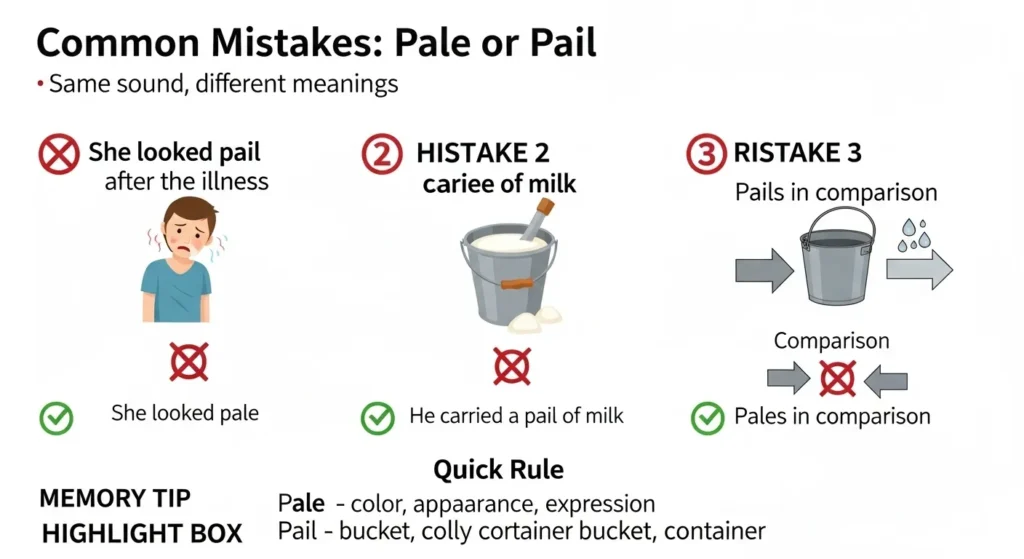
Let’s fix the most frequent errors.
❌ Mistake 1:
She looked pail after the illness.
✅ Correction:
She looked pale after the illness.
❌ Mistake 2:
He carried a pale of milk.
✅ Correction:
He carried a pail of milk.
❌ Mistake 3:
Using pail in expressions like “pails in comparison.”
✅ Correction:
The correct phrase is “pales in comparison.”
Pail vs Pale in Everyday Examples
Emails
- The document highlights are pale and hard to read.
- Please bring a pail for cleaning supplies.
News
- The patient appeared pale during the examination.
- Firefighters used a pail to control the small flame.
Social Media
- Feeling pale after a long night 😴
- Beach day essentials: towel, sunscreen, and a pail 🏖️
Formal Writing
- The walls were painted a pale shade of green.
- The worker filled a metal pail with tools.
Pail or Pale: Google Trends & Usage Data
Search patterns show a clear reason for confusion:
- Pale is commonly searched in:
- Health topics
- Color and design
- Literature and creative writing
- Pail appears more in:
- School-level vocabulary searches
- Homophone confusion queries
- DIY and cleaning contexts
By country:
- Searches are consistent in the US, UK, Canada, Australia, and South Asia.
- Most searches come from students, ESL learners, and writers.
This confirms that people struggle with sound-based confusion, not meaning once explained.
Pale vs Pail: Comparison Table
| Feature | Pale | Pail |
| Part of speech | Adjective / Verb | Noun |
| Meaning | Light color or weak | Bucket or container |
| Used to describe | Appearance, intensity | Physical object |
| Sounds like | Pail | Pale |
| Interchangeable | ❌ No | ❌ No |
FAQs: Pale or Pail
1. Is pale an adjective?
Yes. It mainly describes color, health, or intensity.
2. Is pail ever a verb?
Rarely, but it is mostly used as a noun.
3. Why do pale and pail sound the same?
English pronunciation merged over time, creating homophones.
4. Can pale be used metaphorically?
Yes. “His fear paled beside her courage.”
5. Is pail the same as bucket?
Yes. A pail is a type of bucket.
6. Which one is more common?
Pale is more common in writing, while pail is more situational.
7. How can I remember the difference?
Pale = appearance. Pail = physical container.
Conclusion
The difference between pale or pail becomes simple once you focus on meaning instead of sound. Pale helps you describe how something looks, feels, or compares.
It’s about color, weakness, or subtlety. Pail, on the other hand, is solid and practical. It names a real object you can carry, fill, and use.
I used to pause every time I typed these words, worried about choosing the wrong one. But once I learned this distinction, my writing became faster and clearer.
Remembering one rule is enough: if it’s a description, choose pale; if it’s a container, choose pail. With that clarity, you’ll never second-guess yourself again.

I am Bryan A. Garner, an American writer and editor focused on English usage, grammar, and word choice.
I am best known for Garner’s Modern English Usage, a reference book widely used by writers, editors, and legal professionals.
My work centers on clarity, precision, and resolving confusing word comparisons in modern English.