The Short answer is : Parenthesis is singular, and parentheses is plural.
I remember writing an academic paragraph and typing, “Add this inside the parenthesis.” My teacher corrected it to “parentheses,” and I felt confused. Why did the whole word change instead of just adding an -s?
Many people search “parentheses or parenthesis” because the spelling shift looks unusual. Unlike regular plurals, this word comes from Greek and follows a different pattern.
In this guide, I’ll clearly explain the meaning, grammar rule, correct usage, and how to avoid common mistakes in writing.
Parentheses or Parenthesis : Quick Answer
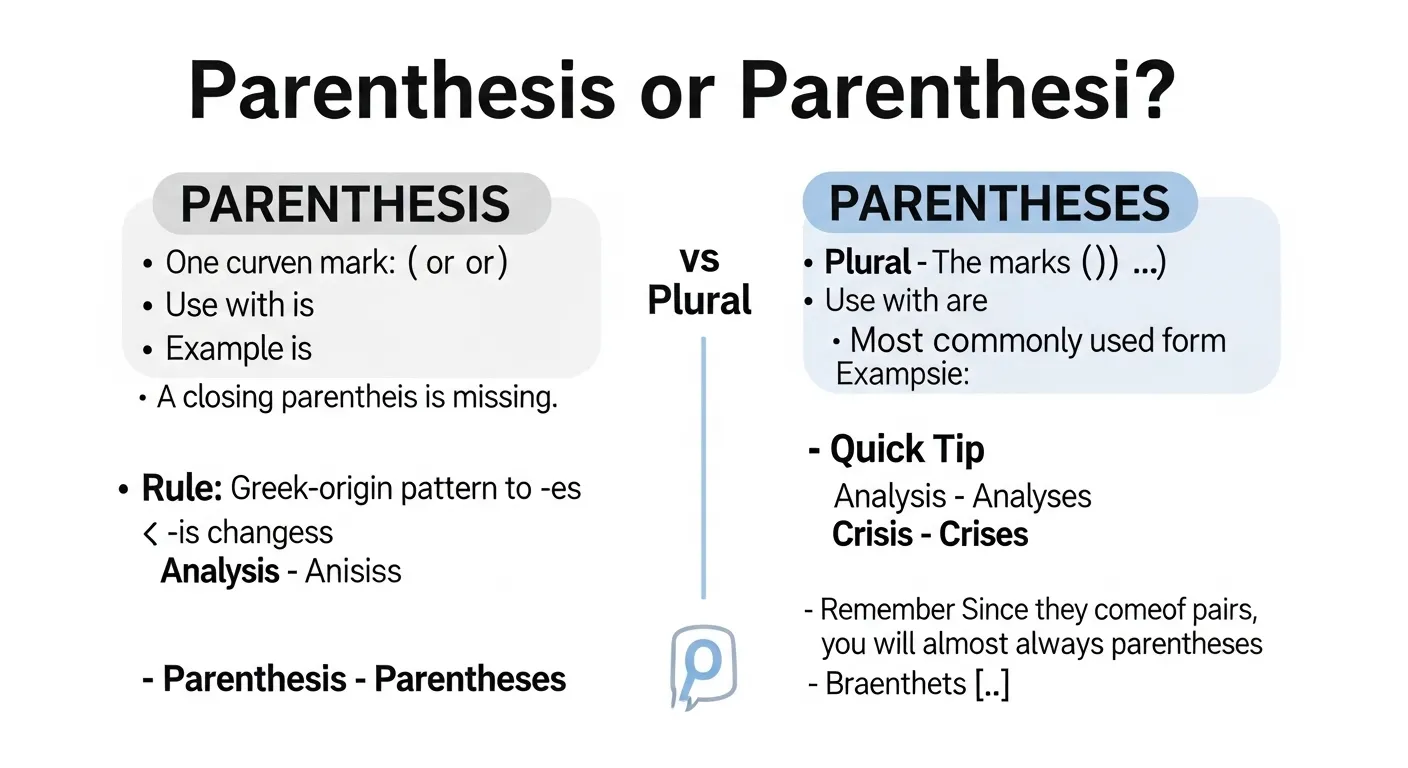
Parenthesis = one curved punctuation mark used to add extra information ( )
Parentheses = two curved punctuation marks used together
Meaning: These marks are used to include additional or clarifying information in a sentence.
Examples:
- Add the note inside the parenthesis. (referring to one mark)
- Put the extra details in parentheses. (referring to the pair)
In most cases, you will use parentheses because the marks normally come in pairs.
The Origin of Parentheses and Parenthesis
The word comes from Greek parentithenai, meaning “to place beside.”
Many Greek-origin words change in special ways when plural:
- analysis → analyses
- crisis → crises
- thesis → theses
- parenthesis → parentheses
Instead of adding -s, the ending changes from -is to -es.
So:
- parenthesis (singular)
- parentheses (plural)
This is a grammar pattern, not a spelling mistake.
What Do Parentheses Mean in Writing?
Parentheses are punctuation marks used to:
- Add extra information
- Include explanations
- Give examples
- Insert dates or references
Example:
- Ali was born in Lahore (Pakistan).
- She finally answered the question (after five minutes of silence).
The information inside parentheses is usually not essential to the main sentence.
British English vs American English Usage
There is no spelling difference between British and American English for these words.
Both use:
- parenthesis (singular)
- parentheses (plural)
Here is a quick comparison:
| Form | American English | British English |
| Singular | parenthesis | parenthesis |
| Plural | parentheses | parentheses |
| Meaning | Punctuation mark | Punctuation marks |
Unlike words such as defense/defence, there is no regional spelling change here.
Which Word Should You Use?
In normal writing, you will almost always use parentheses, because punctuation marks come in pairs.
Use parenthesis only when:
- Talking about one single curved mark
- Referring to the grammatical concept in technical discussion
Examples:
- The sentence contains a misplaced parenthesis.
- Remove the extra parenthesis at the end.
But in general writing:
- Add the explanation in parentheses.
- The details appear in parentheses.
If you are unsure, ask yourself:
Are you talking about one mark or a pair?
Common Mistakes with Parentheses or Parenthesis
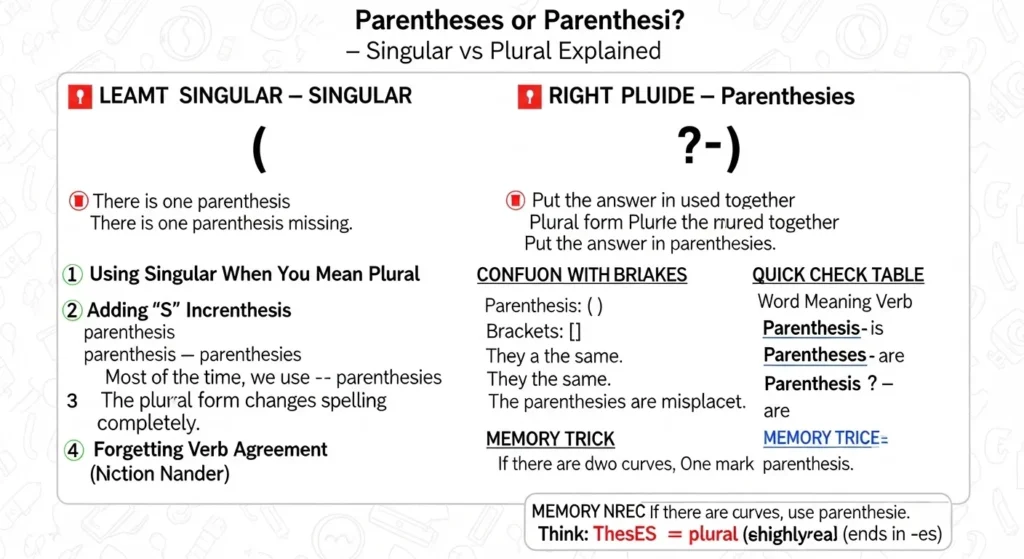
1. Using Singular When You Mean Plural
❌ Put the answer in parenthesis.
✅ Put the answer in parentheses.
2. Adding “s” Incorrectly
❌ parenthesiss
❌ parenthesises
✅ parentheses
3. Confusing With Brackets
Parentheses: ( )
Brackets: [ ]
They are not the same punctuation marks.
4. Forgetting Verb Agreement
❌ The parentheses is misplaced.
✅ The parentheses are misplaced.
Remember:
- Parenthesis → is
- Parentheses → are
Parenthesis or Parentheses in Everyday Examples
In Academic Writing
- The formula is explained in parentheses.
- A closing parenthesis is missing.
Emails
- Please include your phone number in parentheses.
- There is an extra parenthesis in this sentence.
In Books
- The author added a comment in parentheses.
- The editor corrected the misplaced parenthesis.
On Social Media
- Just kidding (obviously).
- The joke was explained in parentheses.
Most of the time, you will see parentheses used.
Parentheses in Grammar and Mathematics
In mathematics, parentheses group numbers:
- (5 + 3) × 2
Grammar, parentheses add extra information:
- The meeting (which lasted two hours) was productive.
In both cases, the plural parentheses is commonly used because they appear as a pair.
Comparison Table: Parenthesis vs Parentheses
| Feature | Parenthesis | Parentheses |
| Number | Singular | Plural |
| Meaning | One curved mark | A pair of curved marks |
| Verb Used | is | are |
| Common Usage | Rare | Very common |
| Region Difference | None | None |
The main difference is singular versus plural.
Frequently Asked Questions (FAQs)
1. What is the difference between parenthesis and parentheses?
Parenthesis is singular. Parentheses is plural.
2. Which one is more commonly used?
Parentheses is more commonly used because punctuation marks come in pairs.
3. Is parentheses singular?
No. Parentheses is plural.
4. Why does parenthesis change to parentheses?
It follows a Greek-origin plural rule where -is changes to -es.
5. Can I say “in parenthesis”?
Grammatically, yes, if referring to one mark. But normally you say “in parentheses.”
6. Is there a spelling difference between US and UK?
No. Both use the same spelling.
7. What verb should I use with parentheses?
Use “are” because it is plural.
Conclusion
The difference between parenthesis and parentheses is about number. Parenthesis refers to one curved punctuation mark. Parentheses refers to the pair used in writing. Because these marks normally appear together, the plural form is much more common. The unusual spelling change happens because the word comes from Greek and follows a special plural pattern where -is becomes -es.
There is no regional spelling difference between American and British English. The only thing you need to remember is singular versus plural and matching the correct verb. If you are writing general sentences, you will almost always use parentheses. Understanding this pattern will also help you with other similar words like analysis/analyses and crisis/crises.

I am Emily Carter, a British writer and linguistics enthusiast from London.
I specialize in studying the differences between British and American English.
I enjoy exploring how language changes across cultures and regions.
Through my writing, I aim to make English learning simple and interesting for students.