The short answer: planning is correct in most cases, while planing is usually incorrect unless referring to smoothing wood.
Planing or planning confused me the first time I wrote a project update. I typed, “We are planing the event,” and it looked slightly strange. I paused and wondered if I had dropped a letter. After checking, I realized the correct spelling was planning with double “n.”
Later, I noticed many people search planing or planning because English double-letter rules can feel inconsistent. Writers, students, and professionals often hesitate when adding -ing to verbs.
This article explains the rule clearly, shows when each spelling is correct, and helps you avoid common mistakes.
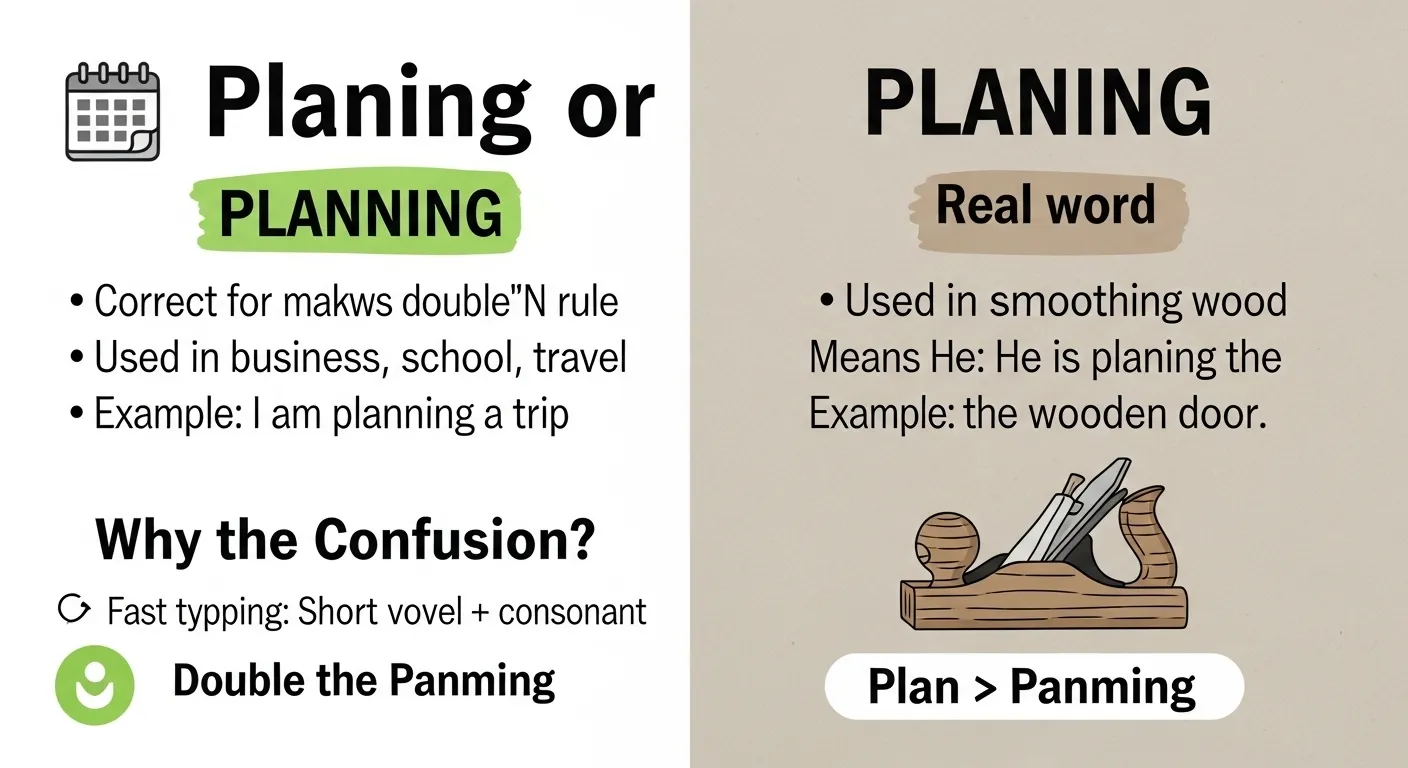
Planing or Planning : Quick Answer
- planning → Correct spelling for preparing or organizing something
- planing → Correct only when referring to smoothing or shaping wood
Examples:
✅ We are planning a meeting.
❌ We are planing a meeting.
✅ He is planing the wooden board.
❌ He is planning the wooden board.
Simple Rule:
👉 If you mean organizing or preparing, use planning.
👉 If you mean smoothing wood, use planing.
The Origin of Planing and Planning
The verb plan comes from the Latin word planum, meaning “flat surface.” Over time, English adopted “plan” to mean organizing or designing something in advance.
When adding -ing to short verbs that end in a single vowel + single consonant, English usually doubles the final consonant. That is why:
- plan → planning
- run → running
- sit → sitting
This rule exists to keep pronunciation consistent. Without doubling the “n,” the word would change sound.
However, planing is also a real word but it comes from a different meaning. It relates to the noun plane, a woodworking tool used to smooth surfaces.
That is why confusion happens. Both spellings exist, but they have different meanings.
British English vs American English Spelling
There is no difference between British and American English in this case. The spelling rule for doubling consonants applies in both.
Comparison Table
| Word | Meaning | UK English | US English |
| planning | organizing | ✅ Same | ✅ Same |
| planing | smoothing wood | ✅ Same | ✅ Same |
This confusion is about grammar rules, not regional spelling.
Which Spelling Should You Use?
Choose based on context.
Use planning when:
- Talking about organizing events
- Referring to business strategy
- Discussing preparation or future actions
- Writing academic or professional content
Use planing when:
- Referring to woodworking
- Talking about smoothing surfaces
- Describing shaping materials
Audience Advice
- Business writing → planning
- Academic writing → planning
- Construction or carpentry context → planing
Quick Tip:
If the sentence involves meetings, goals, or preparation, always use planning.
Common Mistakes with Planing or Planning
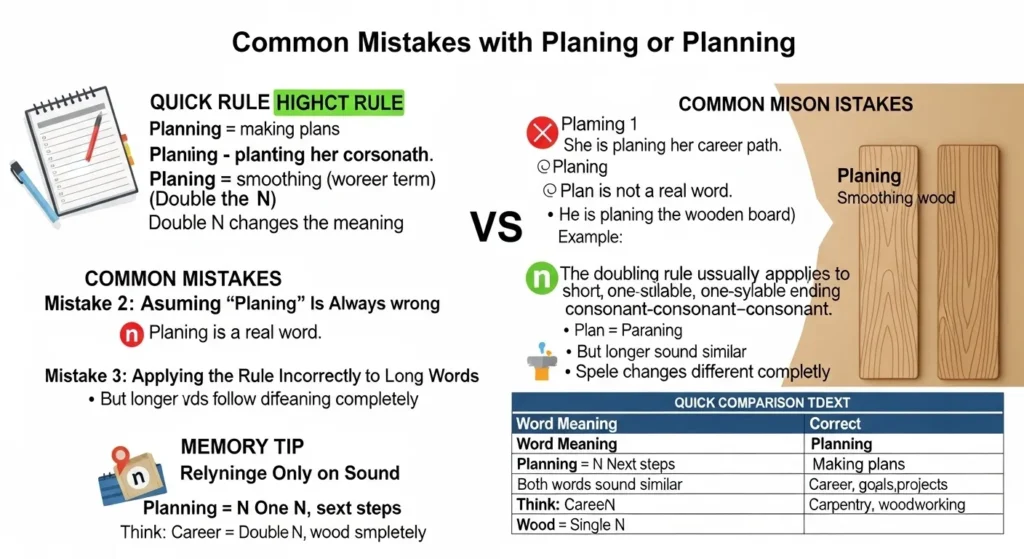
Forgetting to double the consonant
❌ She is planing her career path.
✅ She is planning her career path.
Assuming planing is always wrong
❌ Planing is not a real word.
✅ Planing is correct in woodworking contexts.
Applying the rule incorrectly to long words
The doubling rule usually applies to short words with one syllable.
Relying only on sound
Both words sound similar, but spelling changes meaning.
Planning or Planing in Everyday Examples
Emails
- We are planning a team meeting next week.
News
- The government is planning new policies.
Social Media
- Planning my next vacation ✈️
Technical Writing
- The carpenter is planing the door to make it fit.
Using the correct spelling improves clarity and professionalism.
Planing or Planning : Google Trends & Usage Data
Search trends show planning is far more common than planing globally.
Planning is heavily searched in:
- United States
- United Kingdom
- Canada
- Australia
- India
This is because planning relates to:
- Business strategies
- Event preparation
- Personal development
- Project management
Planing, however, appears mainly in:
- Carpentry tutorials
- DIY woodworking content
- Technical manuals
Important Insight:
Most people searching “planing or planning” accidentally misspell planning.
Planing vs Planning : Side-by-Side Comparison
| Word | Part of Speech | Meaning | Example |
| plan | verb | to organize | I plan my week |
| planning | verb (continuous) | organizing | She is planning |
| plane | noun/tool | smoothing tool | Use a plane |
| planing | verb | smoothing wood | He is planing wood |
This table shows the two words come from slightly different roots.
FAQs: Planing or Planning
1. Is planing ever correct?
Yes, in woodworking or technical contexts.
2. Why does plan become planning?
Because short verbs double the final consonant before adding -ing.
3. Is this rule the same in British and American English?
Yes, both follow the same doubling rule.
4. Does pronunciation change?
No, both words sound similar in casual speech.
5. Can spell-check detect this mistake?
Sometimes, but not always, because planing is a real word.
6. What is the easiest way to remember?
Meetings and goals = planning. Wood and tools = planing.
7. Is planning more common?
Yes, much more common in daily writing.
8. Should I worry about this mistake in formal writing?
Yes, because it can change meaning completely.
Conclusion
The difference between planing or planning is small but important. Planning refers to organizing, preparing, or designing something in advance.
It follows the English rule of doubling the final consonant before adding -ing. Planing, on the other hand, relates to smoothing wood or shaping materials with a tool.
I have learned that small spelling details can change meaning and affect professionalism. Writing “planing a meeting” instead of “planning a meeting” may confuse readers or make your writing look careless. The key is remembering the double-letter rule for short verbs. If your context involves preparation or organization, always use planning.
Once you understand the rule, this confusion becomes easy to avoid. Paying attention to these small differences helps your writing look clear, confident, and polished.

I am Mignon Fogarty, an American author and language expert also known as “Grammar Girl.”
I focus on explaining grammar rules, spelling mistakes, and confusing words in a simple and friendly way.
My goal is to make correct English easy and approachable for everyday readers.