Prokaryotic cells lack a nucleus, while eukaryotic cells have a true nucleus and complex structures.
I remember the first time I studied cells and got confused between these two terms. Both sounded scientific and similar, but they described very different types of life. That confusion is common among students and learners.
Many people search “prokaryotic or eukaryotic” because they want a clear and simple explanation.
Once you understand their structure and functions, the difference becomes easy to remember and apply.
Prokaryotic or Eukaryotic : Quick Answer
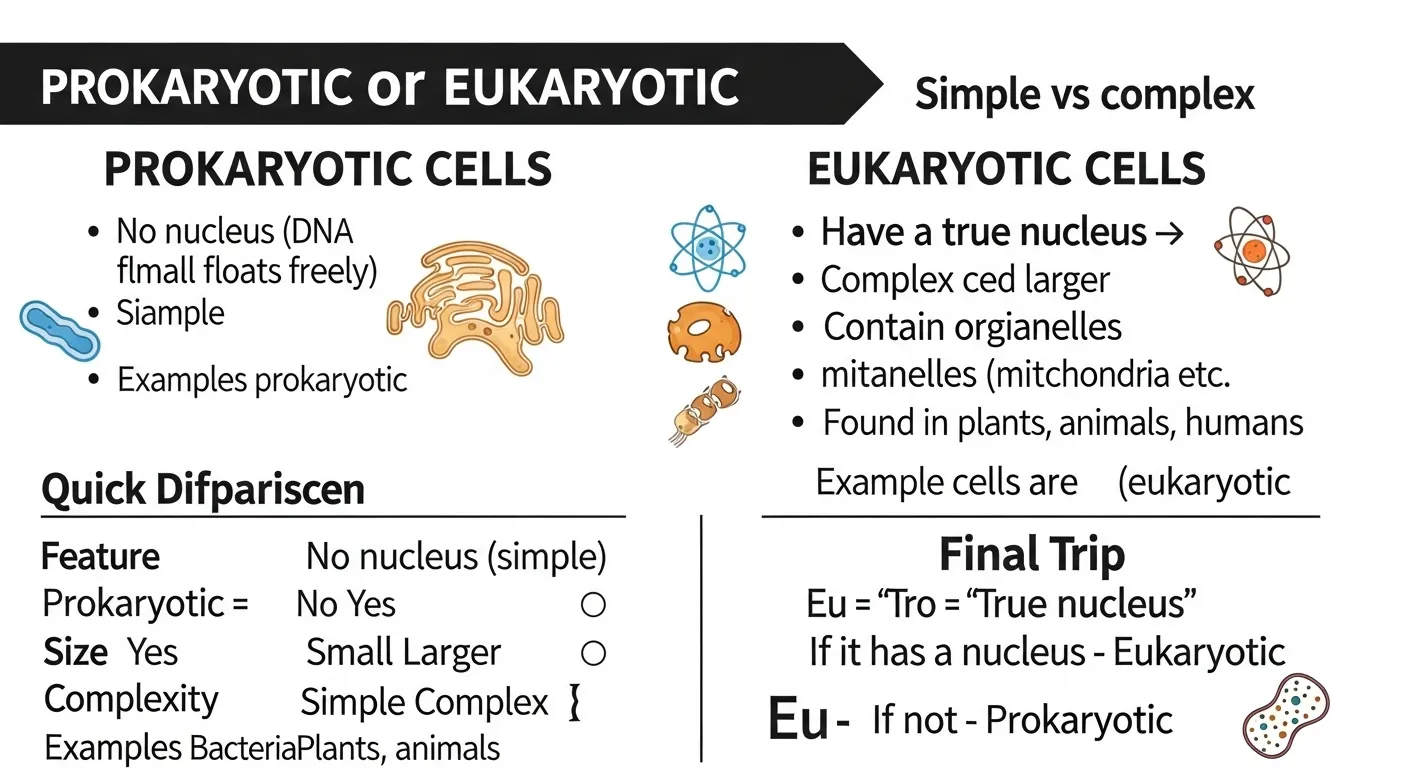
Prokaryotic = cells without a nucleus or membrane bound organelles (simple cells)
Eukaryotic = cells with a nucleus and complex internal structures
Examples:
- Bacteria are prokaryotic organisms.
- Humans and plants are eukaryotic organisms.
Simple rule:
Prokaryotic → simple, no nucleus
Eukaryotic → complex, has nucleus
Meaning of Prokaryotic and Eukaryotic
The difference between prokaryotic and eukaryotic is based on cell structure and complexity.
Prokaryotic (Simple Cells)
Prokaryotic cells are small and simple cells without a nucleus.
Key features:
- No nucleus
- No membrane bound organelles
- DNA floats freely in the cell
- Usually single celled organisms
Examples:
- Bacteria
- Archaea
Sentence examples:
- Most bacteria are prokaryotic.
- A prokaryotic cell is simple in structure.
Eukaryotic (Complex Cells)
Eukaryotic cells are larger and more complex, with a nucleus and organelles.
Key features:
- True nucleus
- Membrane bound organelles
- Organized structure
- Can be single celled or multicellular
Examples:
- Humans
- Animals
- Plants
- Fungi
Sentence examples:
- Human cells are eukaryotic.
- A eukaryotic cell has a nucleus.
Origin of Prokaryotic or Eukaryotic
Both terms come from Greek roots:
- Prokaryotic = pro (before) + karyon (nucleus) → “before nucleus”
- Eukaryotic = eu (true) + karyon (nucleus) → “true nucleus”
This origin clearly explains their meanings.
Eukaryotic vs Prokaryotic : Key Differences
| Feature | Prokaryotic | Eukaryotic |
| Nucleus | No | Yes |
| Complexity | Simple | Complex |
| Size | Small | Larger |
| Organelles | Absent | Present |
| Examples | Bacteria | Humans, plants |
Which One Should You Use?
Use the correct term based on the organism:
- Talking about bacteria → Prokaryotic
- Talking about animals, plants, humans → Eukaryotic
Quick tip:
Ask yourself:
- Does it have a nucleus?
→ Yes → Eukaryotic
→ No → Prokaryotic
Common Mistakes with Prokaryotic or Eukaryotic
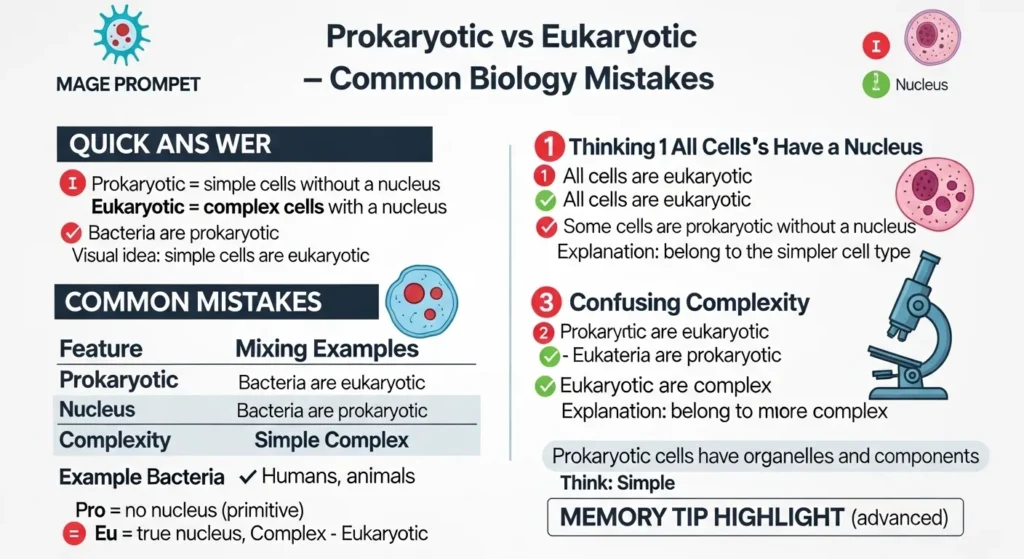
1. Thinking All Cells Have a Nucleus
❌ All cells are eukaryotic.
✅ Some cells are prokaryotic without a nucleus.
2. Mixing Examples
❌ Bacteria are eukaryotic.
✅ Bacteria are prokaryotic.
3. Confusing Complexity
❌ Prokaryotic cells are complex.
✅ Eukaryotic cells are more complex.
Prokaryotic and Eukaryotic in Everyday Learning
In Biology Class
- Students learn that bacteria are prokaryotic.
- Human cells are eukaryotic.
Science Exams
- Questions often compare both cell types.
- Understanding differences helps answer correctly.
In Research
- Scientists study prokaryotic cells for simplicity.
- Eukaryotic cells are studied for complexity.
Prokaryotic vs Eukaryotic : Side by Side Comparison
| Feature | Prokaryotic | Eukaryotic |
| Type | Simple cell | Complex cell |
| DNA | Free floating | Inside nucleus |
| Organism | Usually single celled | Single or multicellular |
| Structure | Basic | Advanced |
Eukaryotic or Prokaryotic : Usage Insight
These terms are widely used in:
- Biology education
- Science textbooks
- Research papers
Why people search this topic:
- Scientific terms sound similar
- Easy to confuse in exams
- Need for simple explanation
General pattern:
- Prokaryotic appears more in microbiology
- Eukaryotic appears more in general biology
Frequently Asked Questions
1. What is the difference between prokaryotic and eukaryotic?
Prokaryotic cells have no nucleus, while eukaryotic cells have a true nucleus.
2. Are humans prokaryotic or eukaryotic?
Humans are eukaryotic.
3. Are bacteria prokaryotic?
Yes. Bacteria are prokaryotic organisms.
4. Which is more complex?
Eukaryotic cells are more complex.
5. Do prokaryotic cells have DNA?
Yes, but it is not inside a nucleus.
6. Why are these terms confusing?
Because both are scientific and sound similar.
7. Which one is smaller?
Prokaryotic cells are smaller.
Conclusion
Understanding the difference between prokaryotic and eukaryotic cells is a basic but important part of biology. Prokaryotic cells are simple, small, and do not have a nucleus. They are usually found in single celled organisms like bacteria.
Eukaryotic cells, on the other hand, are larger, more complex, and contain a true nucleus along with many specialized structures. These cells form animals, plants, fungi, and humans.
The key difference lies in structure and complexity. By remembering that prokaryotic means “before nucleus” and eukaryotic means “true nucleus,” you can easily identify and understand them. This clear distinction helps in learning biology, preparing for exams, and understanding how life is organized at the cellular level.

I am Lynne Truss, a British writer and journalist who is best known for my work on English grammar. I have always been interested in language and punctuation, especially how small mistakes can change meaning. Through my books, I try to make grammar easy, interesting, and enjoyable for readers.