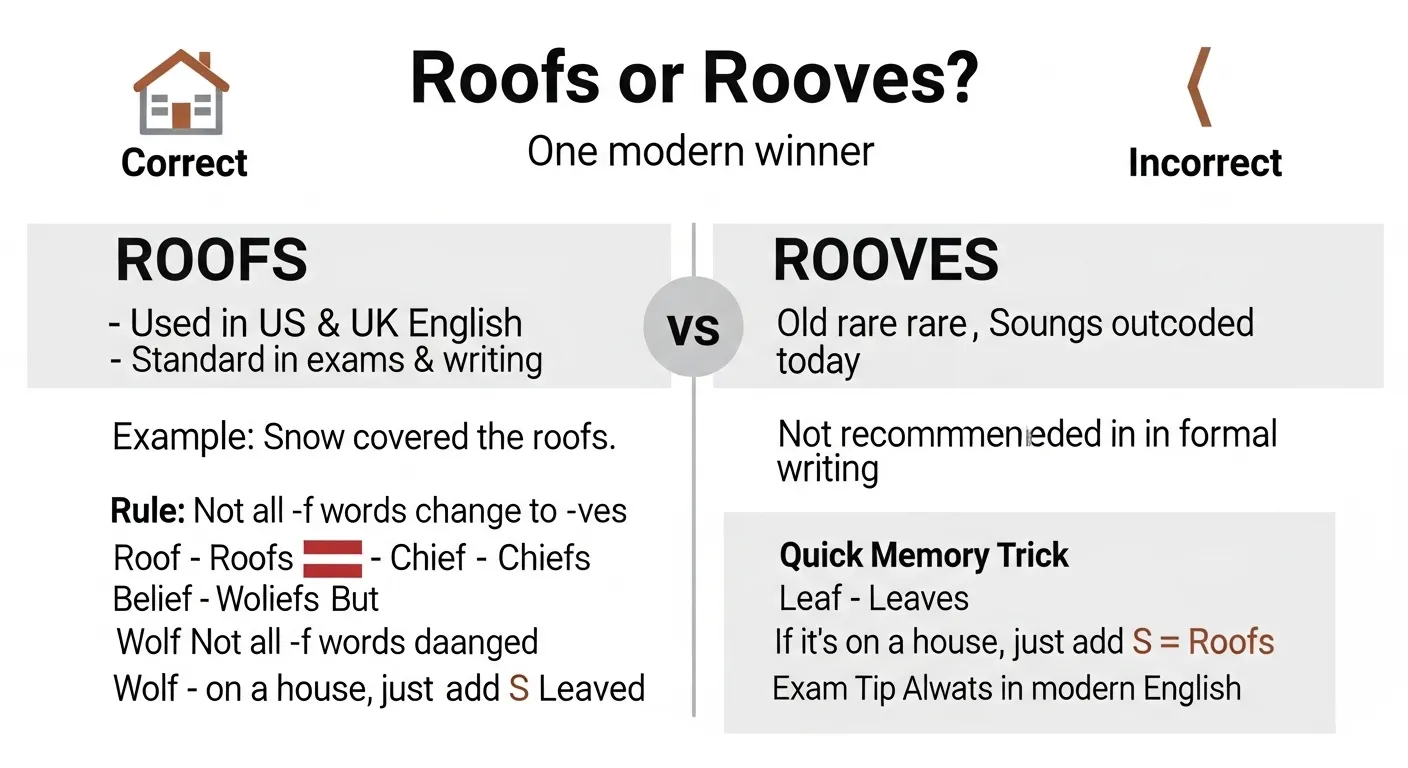
The Short answer is: Roofs is the correct and standard plural of roof, while rooves is a rare older form.
I remember writing “two rooves were damaged in the storm” in a school essay. My teacher circled it and wrote, “Use roofs.” That small correction stayed with me.
I saw “rooves” in an old novel and felt confused again. Many people search this question because English plurals can be tricky, especially with words ending in -f. Should it change to -ves like “wolves”? Or just add -s?
In this guide, I’ll explain the rule clearly and help you choose the right form with confidence.
Roofs or Rooves : Quick Answer
Roof means the top covering of a building.
Roofs = the correct and modern plural of roof
Rooves = an old or rare plural form, almost never used today
Both mean “more than one roof,” but roofs is the standard spelling.
Examples:
- The houses have red roofs.
- Snow covered the roofs of the buildings.
You should almost always use roofs.
The Origin of Roofs and Rooves
The word roof comes from Old English hrōf, meaning covering or shelter.
In English, some nouns ending in -f change to -ves in the plural:
- wolf → wolves
- leaf → leaves
- knife → knives
Because of this pattern, some people once used rooves.
However, not all -f words follow that rule:
- roof → roofs
- chief → chiefs
- belief → beliefs
Over time, English settled on roofs as the correct standard plural. Today, dictionaries list roofs as the main form. Rooves is marked as rare or outdated.
British English vs American English Spelling
Unlike many spelling differences, this is not mainly about region.
Both American and British English prefer roofs.
Here is a simple comparison:
| Region | Standard Form | Rare Form |
| United States | roofs | rooves (very rare) |
| United Kingdom | roofs | rooves (old usage) |
| Australia | roofs | rooves (rare) |
| Canada | roofs | rooves (rare) |
In modern writing, newspapers, books, and academic texts almost always use roofs.
So this is not like favorite/favourite. It is about modern standard usage.
Which Spelling Should You Use?
You should use roofs in almost every situation.
Use roofs when writing:
- School essays
- Business reports
- News articles
- Emails
- Social media posts
Avoid rooves unless:
- You are quoting an old text
- You are writing historical fiction
- You want an old-fashioned tone
For modern English, roofs is the safe and correct choice.
Common Mistakes with Roofs or Rooves
Here are frequent errors:
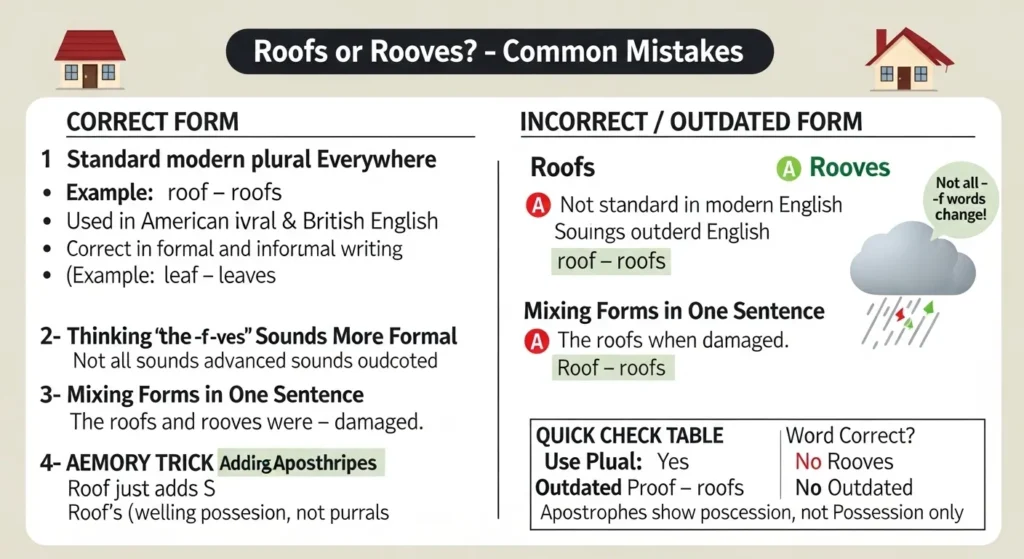
1. Copying the -f to -ves Rule Everywhere
❌ roof → rooves
✅ roof → roofs
Not all -f words change to -ves.
2. Thinking Rooves Is More “Formal”
Some people think rooves sounds more advanced.
It does not. It sounds outdated.
3. Mixing Forms in One Sentence
❌ The roofs and rooves were damaged.
✅ The roofs were damaged.
4. Adding Apostrophes
❌ roof’s (when plural)
✅ roofs
Remember: apostrophes show possession, not plurals.
Rooves or Roofs in Everyday Examples
In Emails
- Several roofs need repair after the storm.
- The contractor inspected the roofs yesterday.
In News Articles
- High winds damaged dozens of roofs.
- Snow collapsed the roofs of older homes.
On Social Media
- The city looks beautiful with white roofs!
- Solar panels now cover many roofs.
In Formal Writing
- The roofs were constructed using steel beams.
- Engineers examined the structural safety of the roofs.
In almost every modern example, you will see roofs.
Roofs or Rooves : Google Trends & Usage Data
Search patterns show that roofs is far more common than rooves.
Why?
- Schools teach roofs as the correct plural.
- Dictionaries list roofs as standard.
- Media and construction industries use roofs.
Rooves appears rarely and mostly in:
- Older literature
- Historical texts
- Searches asking if it is correct
In modern English usage, roofs clearly dominates.
Comparison Table: Roofs vs Rooves
| Feature | Roofs | Rooves |
| Meaning | Plural of roof | Plural of roof |
| Modern Usage | Standard | Rare |
| Accepted in US? | Yes | Rarely |
| Accepted in UK? | Yes | Rarely |
| Formal Writing | Preferred | Not recommended |
| Sounds Modern? | Yes | No |
The meaning is the same, but the usage level is very different.
Frequently Asked Questions (FAQs)
1. Is rooves correct?
It is technically correct but very rare and outdated.
2. What is the correct plural of roof?
Roofs is the correct and standard plural.
3. Why doesn’t roof become rooves?
Not all -f words change to -ves. Roof keeps the simple -s ending.
4. Is rooves used in British English?
It existed in older British English but is rarely used today.
5. Which form should I use in school writing?
Always use roofs.
6. Do dictionaries accept rooves?
Some list it as rare or old-fashioned, but roofs is the main form.
7. Is rooves wrong?
It is not completely wrong, but it is outdated and not recommended.
Conclusion
The difference between roofs and rooves is mainly about modern usage. Both words mean the plural of roof, which is the top covering of a building.
If English has chosen roofs as the standard form. While some -f words change to -ves, roof is not one of them in modern English.
Rooves may appear in older texts, but it sounds outdated today. In school, business, journalism, and daily writing, roofs is the correct and preferred spelling. If you want clear and professional English, use roofs and stay consistent.
Once you understand that not every -f word follows the same rule, many other plural forms will become easier to manage.

I am Mignon Fogarty, an American author and language expert also known as “Grammar Girl.”
I focus on explaining grammar rules, spelling mistakes, and confusing words in a simple and friendly way.
My goal is to make correct English easy and approachable for everyday readers.