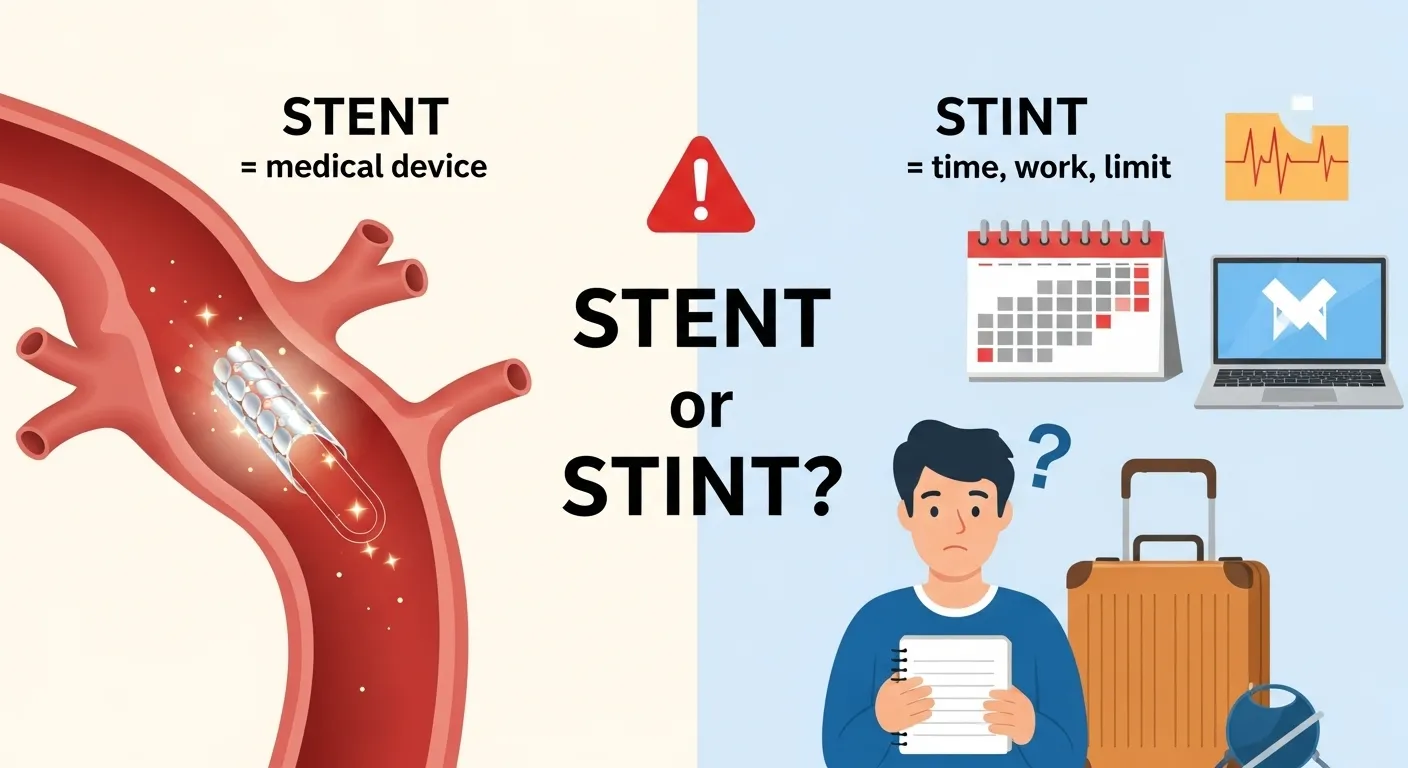
The correct word depends on meaning: stent is a medical device, while stint means a period of time or to limit something.
I still remember pausing mid-sentence while writing an article and wondering, “Is it stent or stint?”
I had heard both words spoken the same way, and honestly, they looked interchangeable. If you’re searching this keyword, you’re likely facing the same confusion.
Many people mix these words up because they sound identical but belong to very different contexts.
At first, I assumed it was just a spelling mistake. Then I realized it’s actually a meaning problem. This article clears that confusion completely by explaining what stent and stint really mean, where they come from, and how to use them correctly in everyday and professional writing.
Stent or Stint: Quick Answer
Stent is a noun used in medicine.
Stint is a noun or verb related to time, work, or limits.
Examples:
- ✅ The doctor inserted a stent to keep the artery open.
- ❌ The doctor inserted a stint to keep the artery open.
- ✅ She worked a six-month stint at the company.
- ❌ She worked a six-month stent at the company.
If the sentence is about health or surgery, use stent.
If it’s about time, work, or restriction, use stint.
The Origin of Stent or Stint
The word stent comes from the name of Charles Stent, a 19th-century English dentist. He created a compound used to support tissues, and later the term stent became associated with medical support structures, especially in blood vessels.
The word stint comes from Old English styntan, meaning “to stop” or “limit.” Over time, it evolved to describe:
- A fixed period of work
- A stretch of time
- The act of limiting resources or effort
Because these words come from completely different origins, they are not interchangeable, even though they sound the same.
British English vs American English Spelling
This confusion is not about British vs American English.
Both words are spelled the same way in all major English varieties.
Key point:
- British English: stent, stint
- American English: stent, stint
The difference is meaning and context, not region.
Comparison Table
| Word | British English | American English |
| stent | Same spelling | Same spelling |
| stint | Same spelling | Same spelling |
| Meaning difference | Yes | Yes |
| Regional variation | No | No |
Which Spelling Should You Use?
Choose based on context, not sound.
Audience-based advice:
- Medical or healthcare audience: Always use stent
- General or professional writing: Use stint for time or work
- Global audience: Be precise to avoid serious misunderstandings
Simple rule:
- If it relates to arteries, surgery, or medicine, use stent
- If it relates to time, effort, or limits, use stint
Common Mistakes with Stent or Stint
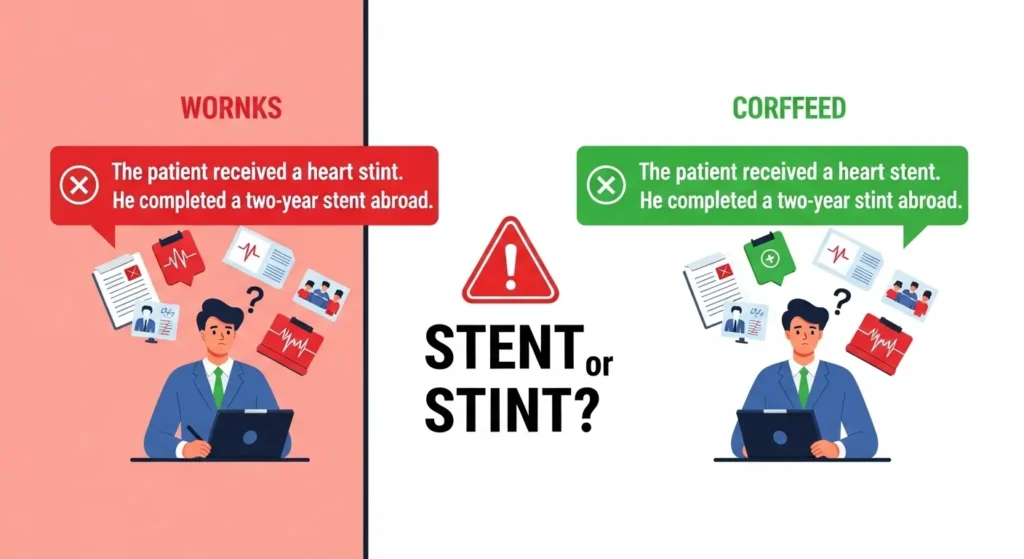
Here are the most frequent errors:
❌ Mistake 1: Using stint in medical contexts
✅ The patient received a heart stent.
❌ Mistake 2: Using stent for time periods
✅ He completed a two-year stint abroad.
❌ Mistake 3: Assuming spelling doesn’t matter
✅ In this case, spelling changes meaning completely.
❌ Mistake 4: Relying only on pronunciation
✅ Always check the context.
Stent or Stint in Everyday Examples
Emails
- I’ll be on a short stint with the marketing team.
- The cardiologist recommended a stent procedure.
News
- The athlete returned after a stint on the bench.
- Doctors successfully placed a coronary stent.
Social Media
- My gym stint starts today wish me luck!
- Medical science has saved so many lives with the stent.
Formal Writing
- The subject underwent angioplasty with stent placement.
- Her research stint lasted three years.
Stent or Stint: Google Trends & Usage Data
Search trends show that “stent or stint” is commonly searched by:
- Students
- Medical learners
- Content writers
- ESL users
Usage patterns:
- Stent is most common in:
- Medical articles
- Health news
- Scientific journals
- Stint is common in:
- Career writing
- Sports journalism
- Everyday conversation
Most confusion comes from pronunciation, not spelling rules.
Comparison Table: Stent vs Stint
| Feature | Stent | Stint |
| Part of speech | Noun | Noun / Verb |
| Main meaning | Medical support device | Period of time / limit |
| Field | Medicine | General language |
| Common contexts | Surgery, cardiology | Work, sports, effort |
| Interchangeable | No | No |
FAQs: Stent or Stint
1. Is stent only used in medicine?
Yes, in modern English it is almost exclusively medical.
2. Can stint be a verb?
Yes. Don’t stint on quality.
3. Why do people confuse stent and stint?
They sound the same when spoken.
4. Is this a British vs American issue?
No. Both regions use the same spellings.
5. Can using the wrong word be serious?
Yes, especially in medical writing.
6. Which word is more common?
Stint is more common in daily language; stent in medical contexts.
7. Can stent mean time?
No. That meaning belongs only to stint.
Conclusion
The difference between stent or stint is a perfect example of how English words can sound identical but mean completely different things.
Stent belongs strictly to the medical world and refers to a life-saving device used to keep arteries open. Stint, on the other hand, lives in everyday language and talks about time, effort, or limits.
The solution is simple: focus on context. Health equals stent. Time or work equals stint. Once you lock this rule in your mind, you’ll never confuse these two words again, and your writing will instantly become clearer and more confident.

I am Lynne Truss, a British writer and journalist who is best known for my work on English grammar. I have always been interested in language and punctuation, especially how small mistakes can change meaning. Through my books, I try to make grammar easy, interesting, and enjoyable for readers.