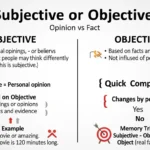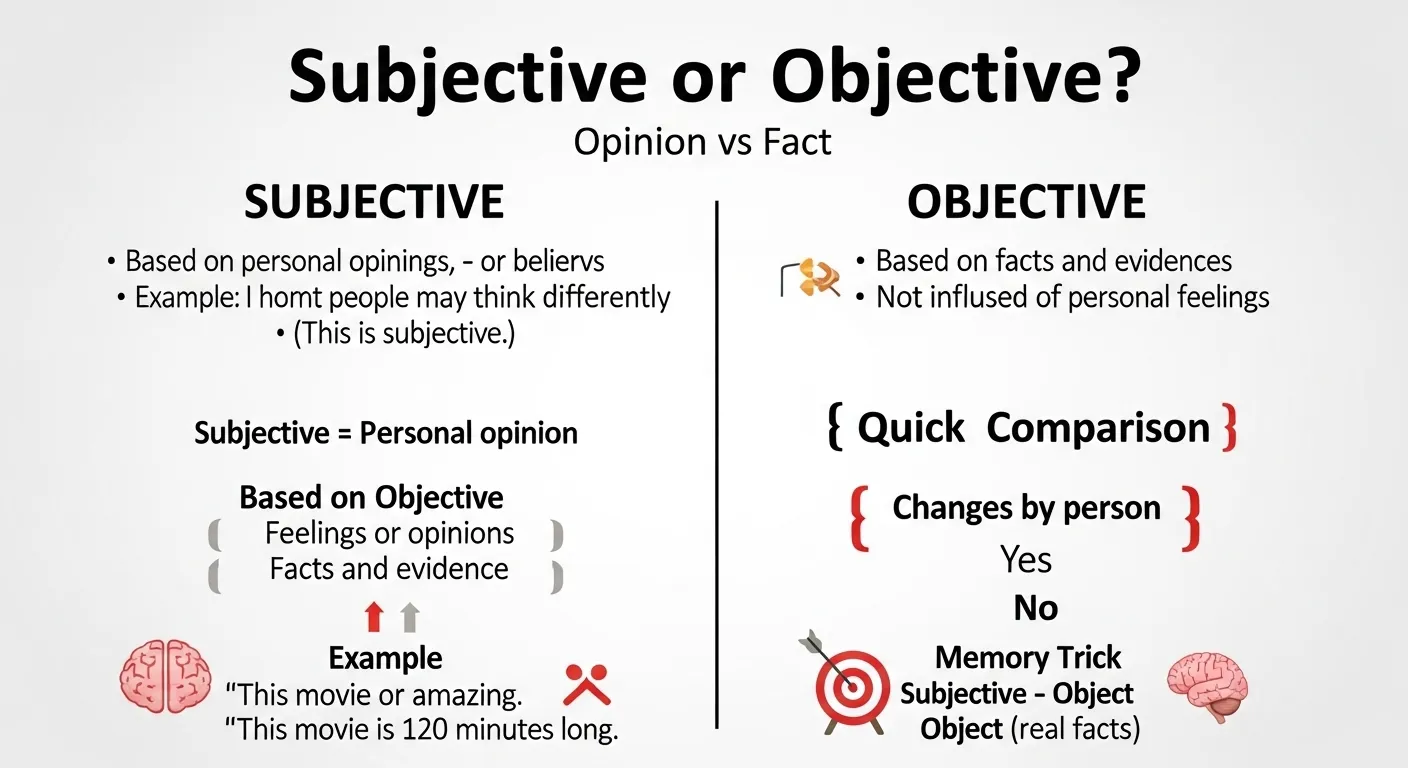
Subjective describes opinions based on personal feelings, while objective refers to facts that are not influenced by personal opinions.
I remember reading two movie reviews about the same film. One review praised the movie, while another criticized it heavily. That made me realize how writing can be either subjective or objective.
Many people search “subjective or objective” because these words are often used in writing, journalism, education, and research. The confusion usually happens when writers are unsure if they are expressing a personal opinion or presenting a factual statement.
Once you understand the difference between opinion and fact, choosing the correct word becomes much easier.
Subjective or Objective : Quick Answer
Subjective = an adjective meaning based on personal opinions, feelings, or beliefs.
Objective = an adjective meaning based on facts, evidence, and unbiased information.
Examples:
- Movie reviews are often subjective.
- Scientific research should be objective.
Simple rule:
Subjective → opinion or personal view
Objective → facts or evidence
Meaning of Subjective and Objective
The difference between subjective and objective depends on if information is influenced by personal feelings.
Subjective (Adjective)
Subjective refers to opinions, feelings, or personal interpretations.
Examples:
- Music taste is highly subjective.
- His opinion about the book was subjective.
- Art criticism is often subjective.
Because subjective ideas depend on personal feelings, different people may have different opinions.
Objective (Adjective)
Objective refers to information based on facts and evidence rather than personal feelings.
Examples:
- Scientists try to remain objective in their research.
- The report provided objective data.
- Good journalism aims to be objective.
Objective statements can usually be tested or proven.
Origin of Objective or Subjective
The words subjective and objective come from Latin roots.
- Subjective comes from a Latin word meaning related to the mind or personal experience.
- Objective comes from a Latin word meaning relating to external objects or reality.
Over time, English adopted these terms to describe the difference between personal opinions and independent facts.
Subjective or Objective Grammar Rule
The easiest way to choose between subjective and objective is to determine If the statement expresses an opinion or a fact.
| Word | Part of Speech | Meaning | Example |
| Subjective | Adjective | Based on personal feelings | Movie reviews are subjective. |
| Objective | Adjective | Based on facts | Scientific studies should be objective. |
Examples:
- His review of the restaurant was subjective.
- The research paper presented objective results.
If the statement shows personal opinion, use subjective.
If it presents verifiable facts, use objective.
Subjective and Objective in Everyday Examples
In Education
- Essay grading can sometimes be subjective.
- Multiple choice tests are more objective.
Journalism
- Opinion columns are often subjective.
- News reports try to remain objective.
In Conversations
- Favorite foods are subjective.
- The temperature today is an objective fact.
In Reviews
- Movie ratings are often subjective.
- Sales numbers provide objective data.
Common Mistakes with Subjective or Objective
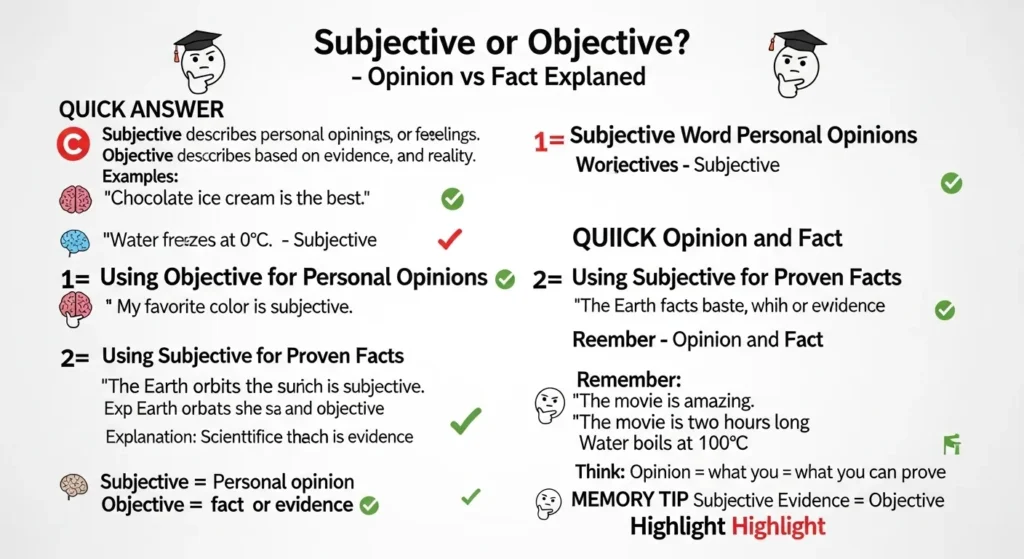
1. Using Objective for Personal Opinions
❌ My favorite color is objective.
✅ My favorite color is subjective.
2. Using Subjective for Proven Facts
❌ The Earth orbits the sun, which is subjective.
✅ The Earth orbits the sun, which is objective.
3. Mixing Opinion and Fact
Remember:
- Subjective = personal opinion
- Objective = fact or evidence
Subjective vs Objective : Side by Side Comparison
| Feature | Subjective | Objective |
| Meaning | Based on personal opinion | Based on facts |
| Influence | Feelings or beliefs | Evidence and data |
| Example sentence | Taste in music is subjective. | Scientific facts are objective. |
| Context | Opinions or experiences | Research and information |
Frequently Asked Questions
1. What is the difference between subjective and objective?
Subjective refers to personal opinions, while objective refers to facts or evidence.
Example:
- Movie opinions are subjective.
- Scientific data is objective.
2. Is subjective always an opinion?
Yes. Subjective statements depend on personal feelings or experiences, which means they can vary from person to person.
Example:
- Art appreciation is subjective.
3. Is objective always a fact?
Generally, yes. Objective statements rely on measurable facts or evidence.
Example:
- Water freezes at 0°C, which is an objective fact.
4. Why do people confuse subjective and objective?
They are opposite concepts, and many writers struggle to decide If a statement expresses an opinion or a fact.
5. How can I remember the difference between subjective and objective?
Use this simple trick:
- Subjective → subject (personal feelings)
- Objective → object (facts outside personal opinion)
Example:
- Favorite movies are subjective.
- Scientific results should be objective.
Conclusion
Understanding the difference between subjective and objective is important for clear communication and accurate writing.
Subjective refers to opinions, feelings, or personal interpretations that can vary from one person to another. Objective, on the other hand, refers to facts and information that can be verified independently of personal beliefs.
Many discussions, reviews, and creative works naturally involve subjective perspectives, while fields like science, journalism, and research aim to present objective information.
Recognizing if a statement expresses an opinion or a fact helps writers choose the correct word and communicate their ideas more clearly.
By remembering that subjective relates to personal views and objective relates to factual evidence, you can easily avoid confusion and use these terms correctly in everyday writing.

I am Bryan A. Garner, an American writer and editor focused on English usage, grammar, and word choice.
I am best known for Garner’s Modern English Usage, a reference book widely used by writers, editors, and legal professionals.
My work centers on clarity, precision, and resolving confusing word comparisons in modern English.