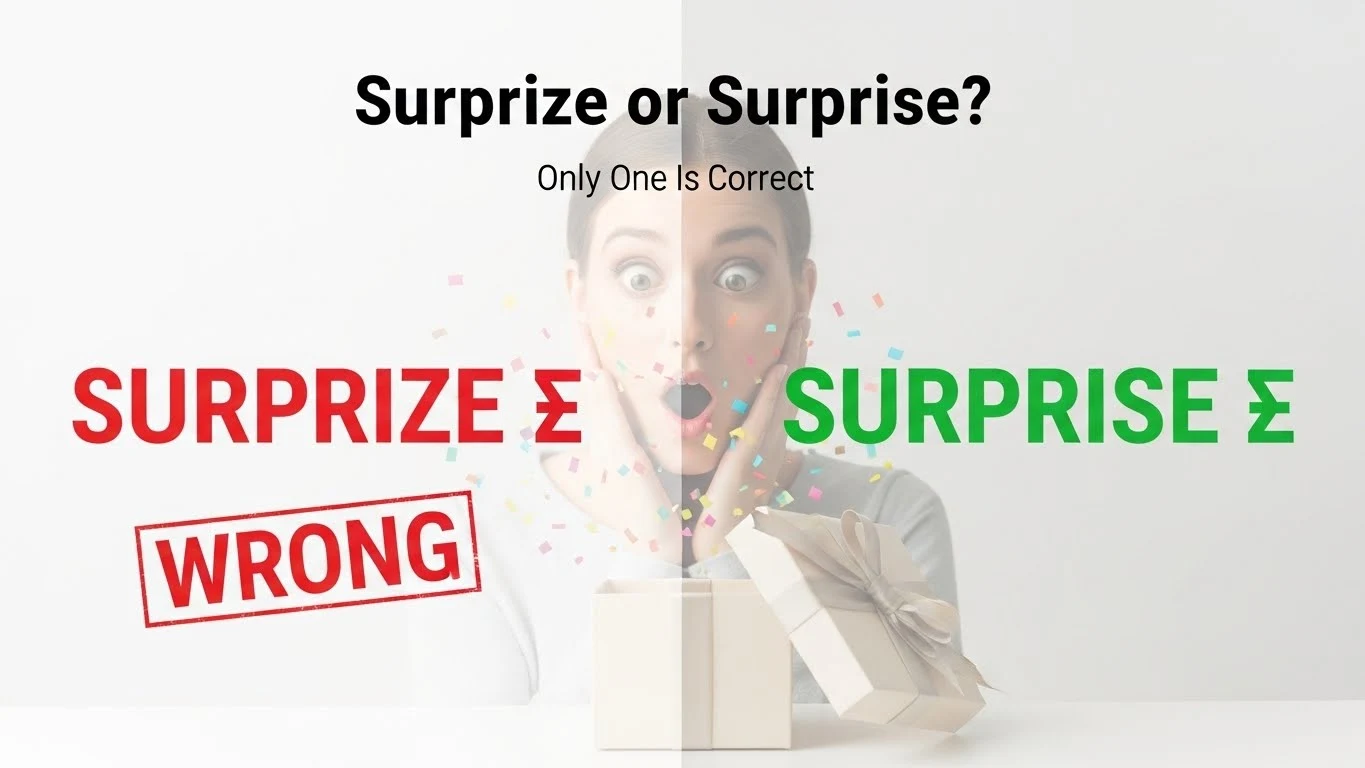
Surprise is the correct spelling in modern English; surprize is incorrect and outdated.
Many people search for “surprize or surprise” because both spellings look believable, yet only one is correct in modern English.
English has many words where -ise and -ize spellings vary, it’s easy to assume surprize might be an alternative form.You may have seen sentences like “I was surprized by the news” or “It was a big surprize” and wondered whether this spelling is acceptable.
The problem usually comes from pronunciation, older spelling patterns, and confusion with words like realize or organize.
This article clears up the confusion completely. You’ll get a quick answer, learn the word’s origin, understand why the spelling mistake happens, see correct usage in everyday examples, and get clear advice on which spelling you should use in all types of writing.
Surprize or Surprise : Quick Answer
Surprise is the correct spelling.
Surprize is incorrect in modern standard English.
Surprise means something unexpected or the feeling caused by it.
Examples:
- ✅ I was surprised by the gift.
- ❌ I was surprized by the gift.
- ✅ The news came as a surprise.
Read More : Steem or Steam: Which Spelling Is Correct and Why It Matters
The Origin of Surprize or Surprise
The word surprise comes from the Old French word surprise, meaning an unexpected event. It entered English in the 15th century and has always been closely tied to the idea of something sudden or unforeseen.
In very old English texts, surprize sometimes appeared as a variant spelling. If this form became outdated long ago. Modern English standardized the spelling as surprise, and dictionaries no longer accept surprize as correct.
The confusion remains because:
- The word sounds like it could end in -ize
- English has many -ize / -ise spelling patterns
- Learners assume consistency where English has exceptions
British English vs American English Spelling
This is not a British vs American spelling difference.
Both varieties agree:
- Surprise → correct
- Surprize → incorrect
Comparison Table
| English Variety | Correct Spelling | Incorrect Spelling |
| American English | Surprise | Surprize |
| British English | Surprise | Surprize |
| Australian English | Surprise | Surprize |
| Global English | Surprise | Surprize |
Unlike words such as organize/organise, surprise never changes spelling.
Which Spelling Should You Use?
No matter your audience, the rule is the same.
- Academic writing: Surprise
- Business emails: Surprise
- Formal documents: Surprise
- Casual writing: Surprise
There is no context where surprize is acceptable in modern English.
If the word refers to something unexpected, always use surprise.
Common Mistakes with Surprize or Surprise
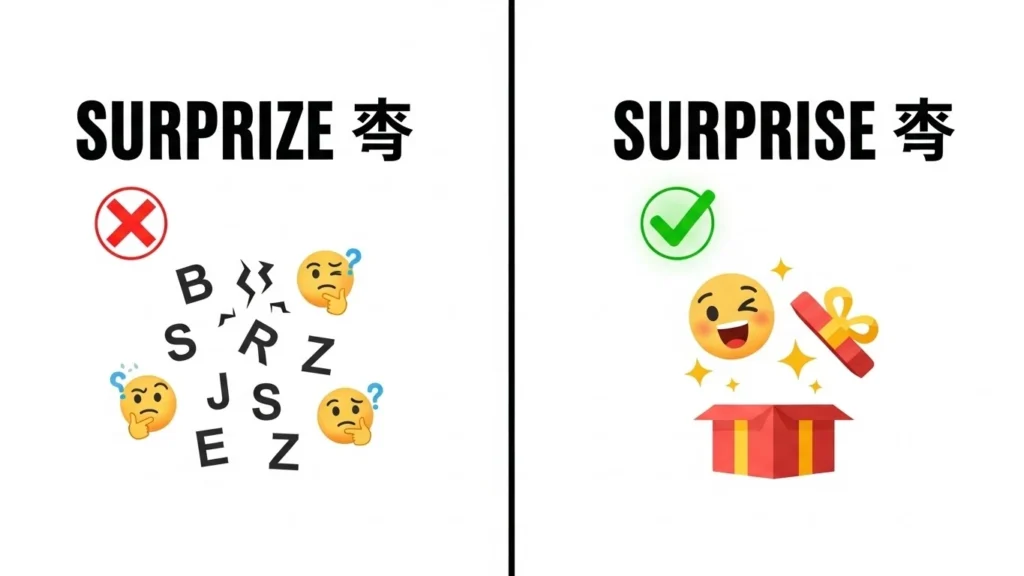
These errors appear very often:
- ❌ I was surprized to see him.
✅ I was surprised to see him. - ❌ What a pleasant surprize!
✅ What a pleasant surprise!- ❌ The ending will surprize you.
✅ The ending will surprise you.
Tip:
If the word can be replaced with unexpected event, use surprise.
Surprize or Surprise in Everyday Examples
Emails
- “We have a small surprise for you.”
News
- “The result came as a surprise to many voters.”
Social Media
- “Best birthday surprise ever 🎉”
Formal Writing
- “The findings were a surprise to researchers.”
Spoken English
- “Don’t surprise me like that!”
Surprize or Surprise : Google Trends & Usage Data
Search trends show that “surprize or surprise” is frequently searched in:
- South Asia
- Middle East
- ESL-learning regions
The confusion appears mostly in:
- Exam writing
- Creative writing
- Social media posts
Surprise dominates books, news articles, and professional writing worldwide. Surprize appears mainly in spelling mistakes and learner queries. Search interest rises around exam periods and festive seasons when people write greeting messages.
Comparison Table: Surprize vs Surprise
| Word | Meaning | Correct Usage |
| Surprise | Unexpected event or feeling | ✅ Correct |
| Surprize | Outdated / incorrect spelling | ❌ Incorrect |
FAQs: Surprize or Surprise
1. Is “surprize” ever correct?
No. It is outdated and incorrect in modern English.
2. Is surprise a noun or a verb?
It can be both.
3. Is surprise spelled differently in British English?
No. The spelling is the same everywhere.
4. Why do people write surprize?
Because of confusion with -ize spelling patterns.
5. What is the past tense of surprise?
Surprised.
6. Is surprise a formal word?
It works in both formal and informal writing.
7. Does any dictionary accept surprize?
Modern dictionaries do not accept it as correct.
Conclusion
The confusion between surprize or surprise is understandable, but the rule is simple. Surprise is the only correct spelling in modern English.
It is used consistently across American, British, and global English without variation.
Surprize is an outdated spelling that should not be used today. Using it in exams, professional writing, or online content can make your work look careless and outdated.
Even though English allows some flexibility with -ise and -ize, this word is a clear exception.
To avoid mistakes, remember this rule:
If something is unexpected, the correct word is always surprise.
Mastering small spelling differences like this helps your English sound clear, confident, and professional.

I am Lynne Truss, a British writer and journalist who is best known for my work on English grammar. I have always been interested in language and punctuation, especially how small mistakes can change meaning. Through my books, I try to make grammar easy, interesting, and enjoyable for readers.