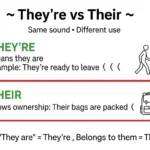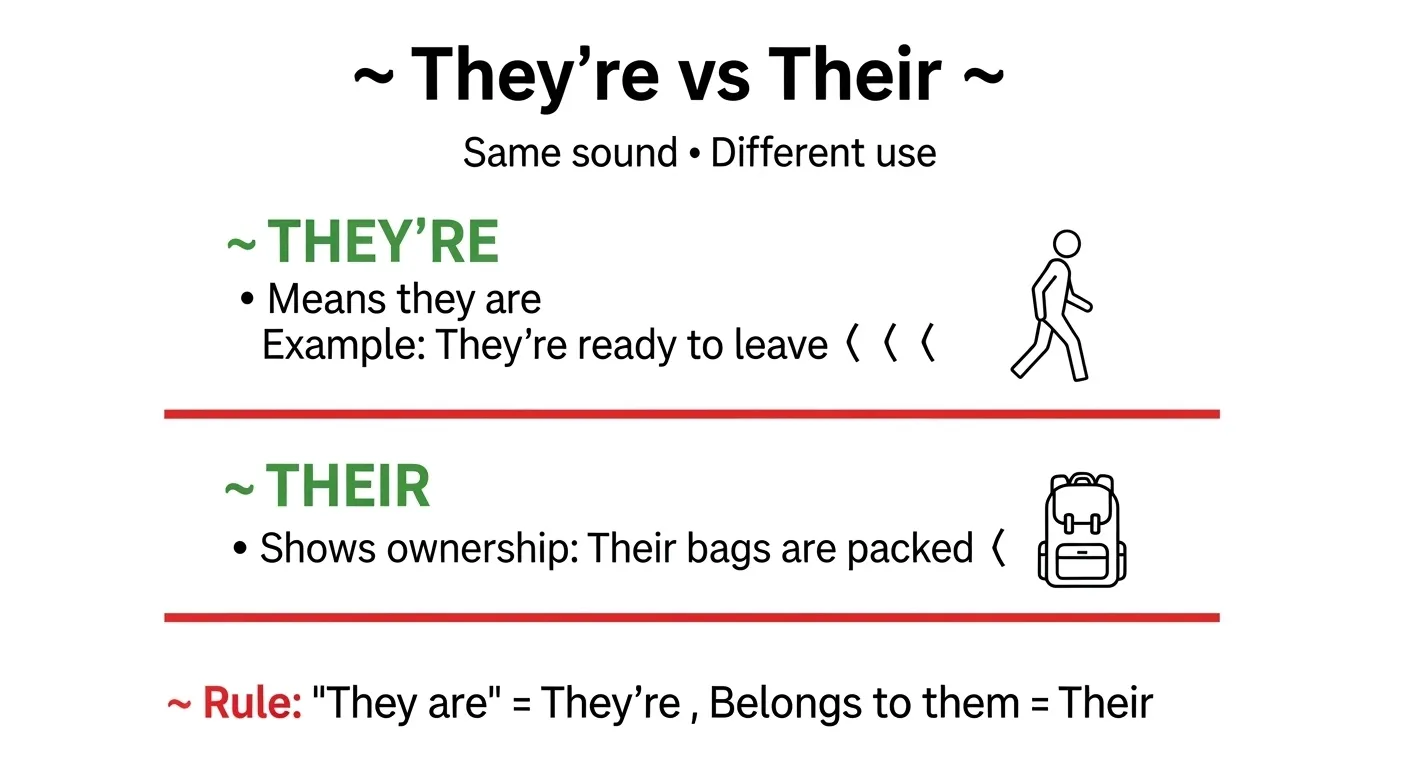
The short answer is this: They’re means they are, while Their shows ownership or possession.
I still remember stopping mid-sentence while writing an email: “They’re phone is ringing…” I knew something felt wrong, but for a second, I couldn’t tell why. That pause is exactly why people search “they’re or their.”
These two words sound the same, look similar, and show up everywhere emails, social posts, schoolwork, even news headlines. Mixing them up can change meaning and hurt clarity. This guide clears that confusion once and for all.
I’ll explain the difference simply, show real examples, and help you choose the right word every time without second-guessing.
They’re or Their: Quick Answer
They’re = they are
Their = shows ownership or possession
Simple examples:
- They’re happy today. → They are happy today.
- Their house is blue. → The house belongs to them.
Easy memory tip (I use this myself):
- If you can replace the word with “they are,” use they’re.
- If you’re talking about something belonging to them, use their.
The Origin of They’re or Their
I like understanding where words come from because it makes them easier to remember.
Their
- Comes from Old Norse þeirra, meaning “belonging to them.”
- It has been used for centuries to show possession.
- English kept this form because it clearly shows ownership.
They’re
- A contraction of they are.
- Apostrophes in English often replace missing letters.
- In they’re, the apostrophe replaces the “a” in are.
Why the confusion exists
- Both words sound exactly the same.
- English has many homophones (same sound, different meaning).
- Fast typing and autocorrect make mistakes more common today.
British English vs American English Spelling
Here’s something important I want to make clear:
👉 There is NO spelling difference between British and American English for they’re and their.
Both forms are:
- Spelled the same
- Used the same way
- Grammatically identical
What does differ is how strictly mistakes are judged in formal writing.
Comparison Table
| Aspect | British English | American English |
| Spelling of their | their | their |
| Spelling of they’re | they’re | they’re |
| Meaning | Possession vs “they are” | Same meanings |
| Tolerance for errors | Low in formal writing | Low in formal writing |
Bottom line: Geography doesn’t change the rule. Grammar does.
Which Spelling Should You Use?
I always tell writers this: your audience doesn’t change the rule your sentence does.
Use they’re if:
- You mean they are
- You can expand the sentence without breaking it
Example:
- They’re coming late. → They are coming late ✅
Use their if:
- You are showing ownership
- Something belongs to a group of people
Example:
- Their decision was final. ✅
Audience-based advice:
- US audience: Follow standard grammar (same rule)
- UK/Commonwealth audience: Same rule applies
- Global audience: Use correctly to avoid confusion
Correct usage builds trust everywhere.
Common Mistakes with They’re or Their
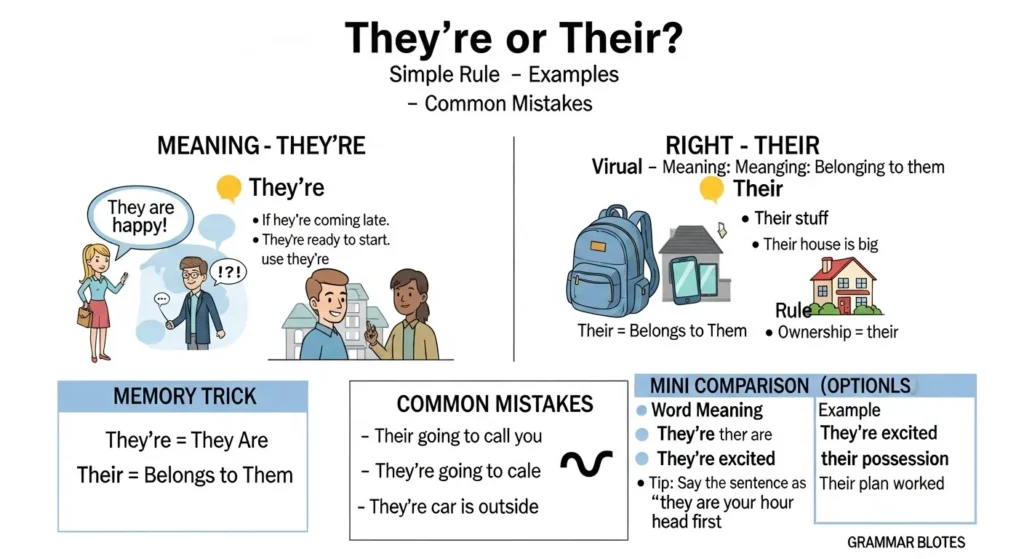
I see these errors almost daily online.
❌ Mistake 1:
“Their going to call you.”
✅ Correction: They’re going to call you.
❌ Mistake 2:
“They’re car is parked outside.”
✅ Correction: Their car is parked outside.
❌ Mistake 3:
Using they’re in formal writing without checking meaning
✅ Tip: Always expand it to they are in your head
❌ Mistake 4:
Assuming autocorrect is always right
✅ Tip: Autocorrect doesn’t understand meaning only spelling
They’re or Their in Everyday Examples
Emails
- They’re reviewing your application.
- Their response will arrive tomorrow.
News
- The players said they’re ready for the match.
- Their performance impressed the crowd.
Social Media
- They’re so excited about the launch!
- Love their new logo.
Formal Writing
- They’re expected to comply with the policy.
- Their responsibilities are clearly defined.
They’re or Their: Google Trends & Usage Data
From what I’ve seen in search behavior:
- “they’re or their” is searched millions of times yearly
- Common in:
- US
- UK
- Canada
- Australia
- India
Why people search it:
- School assignments
- Email writing
- Job applications
- Content creation
Usage trend:
- Their appears more often overall (ownership is common)
- They’re spikes during grammar-related searches
This shows one thing clearly: people want quick, clear answers.
Comparison Table: They’re vs Their
| Word | Meaning | Part of Speech | Example |
| they’re | they are | Contraction | They’re waiting outside |
| their | belonging to them | Possessive adjective | Their bags are ready |
FAQs About They’re or Their
1. Is “they’re” informal?
No. It’s correct in both casual and professional writing when used properly.
2. Can “their” refer to one person?
Yes. It’s often used as a gender-neutral singular possessive.
3. Why do people confuse they’re and their?
They sound the same and appear in similar sentences.
4. Is it okay to avoid contractions in formal writing?
Yes, but only for style not because they’re wrong.
5. Does Grammarly always catch this mistake?
Often, but not always. You still need to understand the rule.
6. Which mistake looks worse to readers?
Using they’re instead of their in formal writing is very noticeable.
7. Is “their” more common than “they’re”?
Yes, because possession is used more frequently than contractions.
Conclusion
I’ve learned that most grammar mistakes don’t come from lack of intelligence they come from speed and habit. They’re or their is a perfect example. Once you lock in the core rule they’re = they are, their = ownership the confusion disappears. I always pause for half a second and test the sentence in my head.
If “they are” works, I use they’re. If something belongs to someone, I use their. This tiny habit has saved me from countless errors in emails, articles, and messages. Mastering this difference doesn’t just fix grammar it improves clarity, credibility, and confidence in your writing.

I am Bryan A. Garner, an American writer and editor focused on English usage, grammar, and word choice.
I am best known for Garner’s Modern English Usage, a reference book widely used by writers, editors, and legal professionals.
My work centers on clarity, precision, and resolving confusing word comparisons in modern English.