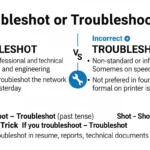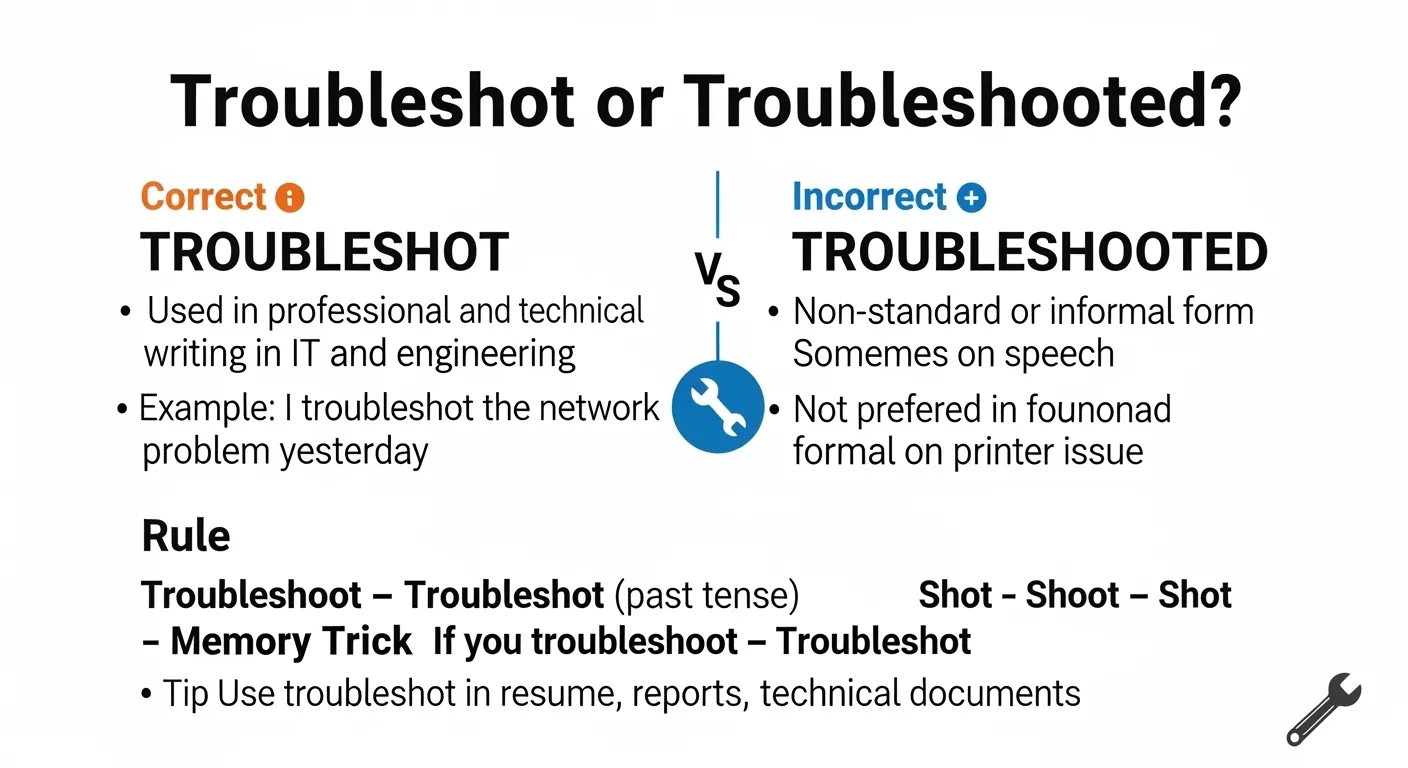
The correct past tense of “troubleshoot” is troubleshot, not troubleshooted.
I remember writing a short report about a computer problem and pausing at this exact word. Should it be “I troubleshot the issue” or “I troubleshooted the issue”?
Since many English verbs form their past tense by adding -ed, people naturally assume troubleshooted is correct. That assumption causes confusion for many writers, especially in technical or workplace communication. In reality, English treats this verb differently.
Understanding the correct form helps you write clearly when explaining how a problem was diagnosed and fixed
Troubleshot or Troubleshooted : Quick Answer
Troubleshot = the correct past tense of troubleshoot, meaning to identify and fix a technical problem.
Troubleshooted = an incorrect or nonstandard form.
Examples:
- The technician troubleshot the network issue yesterday.
- She troubleshot the software error in a few minutes.
The correct past form is troubleshot.
Meaning of Troubleshot and Troubleshooted
Troubleshot means diagnosed and fixed a problem, especially in technical systems like computers, networks, or machines.
Troubleshooted is sometimes used by mistake when people apply the regular -ed rule to the verb troubleshoot. However, it is not considered standard English.
Examples:
- Our IT team troubleshot the server problem last night.
- The engineer troubleshot the equipment failure quickly.
Origin of Troubleshooted and Troubleshot
The verb troubleshoot developed in the early twentieth century, especially in engineering and technical fields. It combines two words:
- trouble (a problem)
- shoot (to deal with quickly or directly)
Because the verb ends with shoot, English keeps the irregular past tense of that word.
shoot → shot
So the correct form becomes:
troubleshoot → troubleshot
This pattern explains why troubleshooted sounds logical but is not standard.
Troubleshot or Troubleshooted Verb Forms
Here are the main forms of the verb:
| Verb Form | Example |
| Base form | troubleshoot |
| Past tense | troubleshot |
| Past participle | troubleshot |
| Present participle | troubleshooting |
Examples:
- She is troubleshooting the software problem now.
- He troubleshot the issue yesterday.
- They have troubleshot similar problems before.
British English vs American English Usage
Unlike many spelling differences, this word does not change between British and American English.
| Feature | Troubleshot | Troubleshooted |
| Meaning | Past tense of troubleshoot | Intended same meaning |
| Grammar status | Correct | Nonstandard |
| US usage | Standard | Rare |
| UK usage | Standard | Rare |
Both British and American English prefer troubleshot.
Common Mistakes with Troubleshot or Troubleshooted
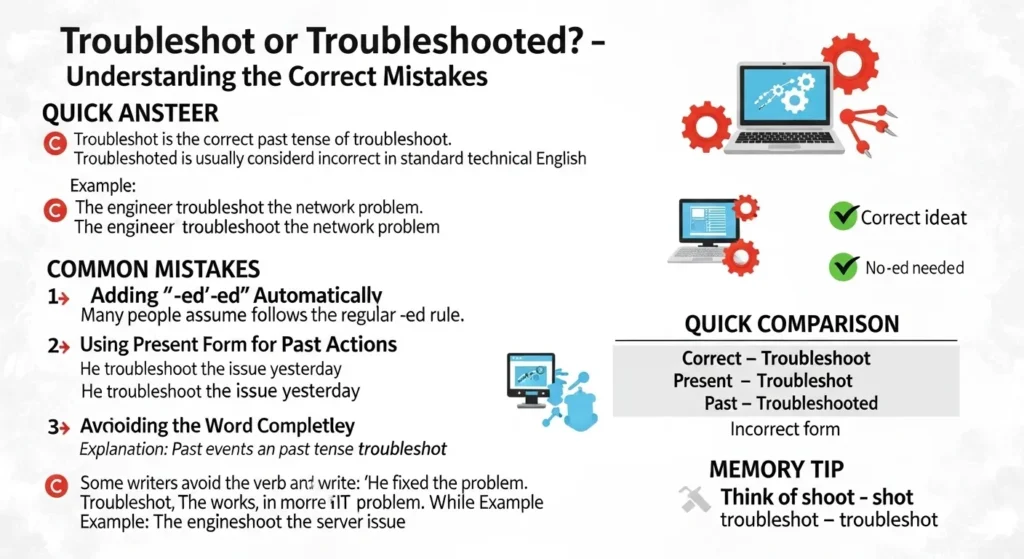
1. Adding “-ed” Automatically
Many people assume the past tense must follow the regular rule.
❌ The technician troubleshooted the system error.
✅ The technician troubleshot the system error.
2. Using Present Form for Past Actions
❌ He troubleshoot the issue yesterday.
✅ He troubleshot the issue yesterday.
3. Avoiding the Word Completely
Sometimes writers avoid the word and write:
- “He fixed the problem.”
While this works, troubleshot is more precise in technical contexts.
Troubleshooted or Troubleshot in Everyday Examples
Technical Support
- The support engineer troubleshot the connection problem.
Workplace Communication
- Our team troubleshot the database issue overnight.
IT Documentation
- The technician troubleshot the hardware malfunction.
Conversation
- I troubleshot my internet problem by resetting the router.
Comparison Table: Troubleshot vs Troubleshooted
| Feature | Troubleshot | Troubleshooted |
| Meaning | Past tense of troubleshoot | Same intended meaning |
| Grammar correctness | Correct | Nonstandard |
| Used in professional writing | Yes | Rare |
| Dictionary acceptance | Yes | Usually not |
Frequently Asked Questions
Is troubleshooted correct?
No. Most dictionaries and style guides consider it incorrect or nonstandard.
What is the correct past tense of troubleshoot?
The correct past tense is troubleshot.
Why is it troubleshot and not troubleshooted?
Because the verb includes shoot, whose past tense is shot.
What is the past participle of troubleshoot?
The past participle is also troubleshot.
Example:
- The technician has troubleshot the issue.
What is the present participle?
The present participle is troubleshooting.
Example:
- She is troubleshooting the network error.
Conclusion
The difference between troubleshot and troubleshooted comes from English verb patterns. Even though the word troubleshoot looks modern and technical, it follows the irregular pattern of the verb shoot.
Because the past tense of shoot is shot, the correct past tense becomes troubleshot. The form troubleshooted sometimes appears in informal writing, but it is not considered standard English.
For clear and accurate communication especially in technical fields such as IT, engineering, and customer support you should use troubleshot when describing a problem that has already been diagnosed and fixed.
Remembering this small grammar rule will help you avoid a common mistake and make your writing sound more professional and precise.

I am Mignon Fogarty, an American author and language expert also known as “Grammar Girl.”
I focus on explaining grammar rules, spelling mistakes, and confusing words in a simple and friendly way.
My goal is to make correct English easy and approachable for everyday readers.