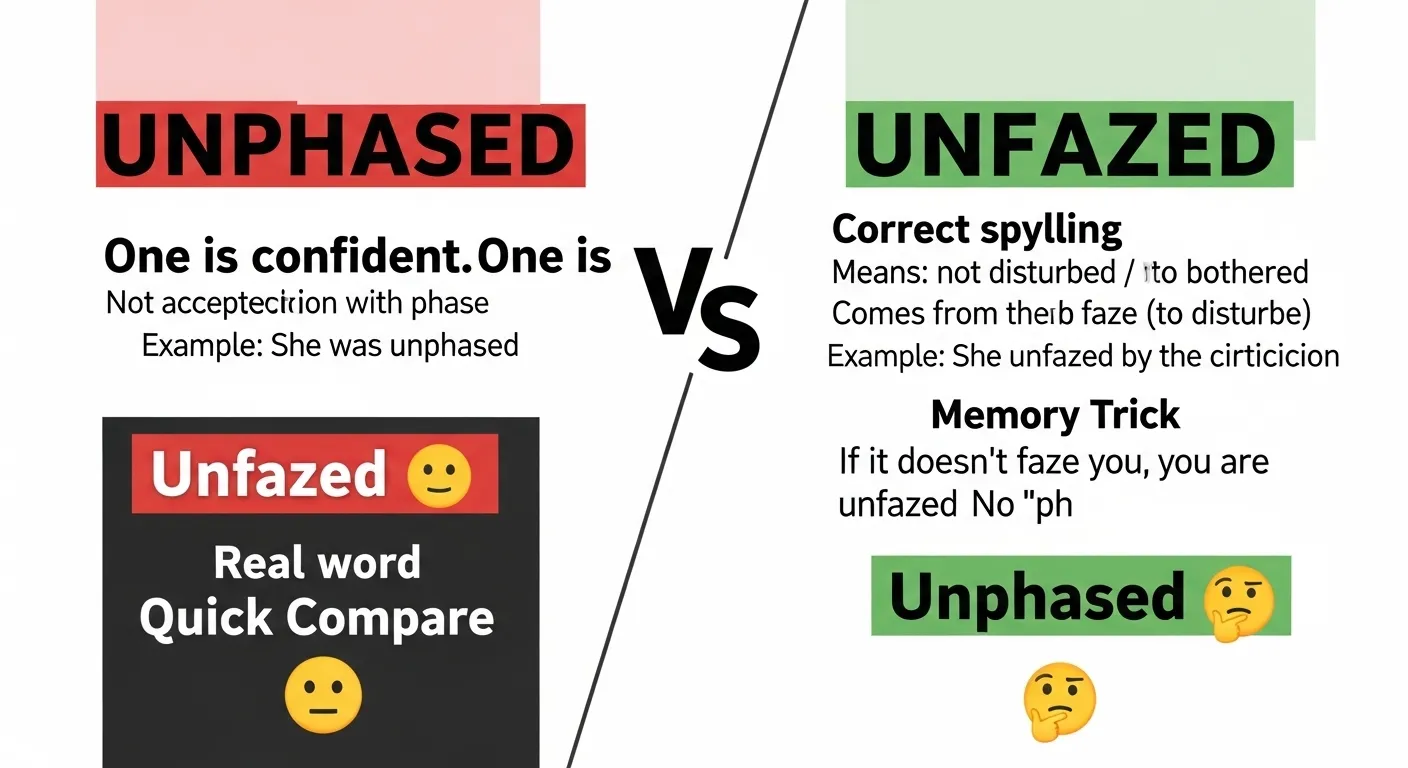
Unfazed is correct. “Unphased” is a common spelling mistake.
I still remember the first time I saw someone write “I was unphased by the criticism.” For a second, I paused. It looked right. It sounded right. But something felt off. That small doubt is why many people search for unphased or unfazed. The confusion usually comes from pronunciation. Both look similar, but only one is real English.
In this guide, I will explain the difference in simple words, show clear examples, compare spelling rules, and help you choose the right word with confidence.
Unphased or Unfazed : Quick Answer
The correct spelling is unfazed.
❌ Unphased
✅ Unfazed
Unfazed means not bothered, not disturbed, or not affected.
Examples:
- She remained unfazed during the interview.
- He was unfazed by the loud noise.
- The team stayed unfazed after losing the first match.
“Unphased” is not a standard English word. It is usually a spelling mistake.
The Origin of Unfazed
The word unfazed comes from the word faze.
What does “faze” mean?
To faze someone means to disturb or upset them.
Example:
- The bad news did not faze her.
The word “faze” appeared in American English in the 1800s. It likely came from older dialect words meaning “to frighten” or “to disturb.”
When we add the prefix “un-”, it changes the meaning:
- Faze → disturb
- Unfazed → not disturbed
Why do people write “unphased”?
The confusion comes from the word phase.
A phase is a stage or period of time.
Example:
- He is going through a difficult phase.
Since “phase” is common, people mistakenly replace “faze” with “phase.” But their meanings are different.
British English vs American English Spelling
Good news: there is no spelling difference between British and American English for this word.
Both use:
- ✅ Unfazed
There is no accepted version called “unphased” in either variety.
Comparison Table
| Version | American English | British English | Correct? |
| Unfazed | ✅ Yes | ✅ Yes | ✔ Correct |
| Unphased | ❌ No | ❌ No | ✘ Incorrect |
So whether you are writing for the US, UK, Canada, or Australia, the spelling stays the same.
Which Spelling Should You Use?
You should always use unfazed.
If your audience is American:
Use unfazed in emails, blogs, and business writing.
If your audience is British or Commonwealth:
Still use unfazed.
If your audience is global:
Use unfazed. It is the only correct spelling.
There is no situation where “unphased” is the correct formal choice.
Common Mistakes with Unphased or Unfazed
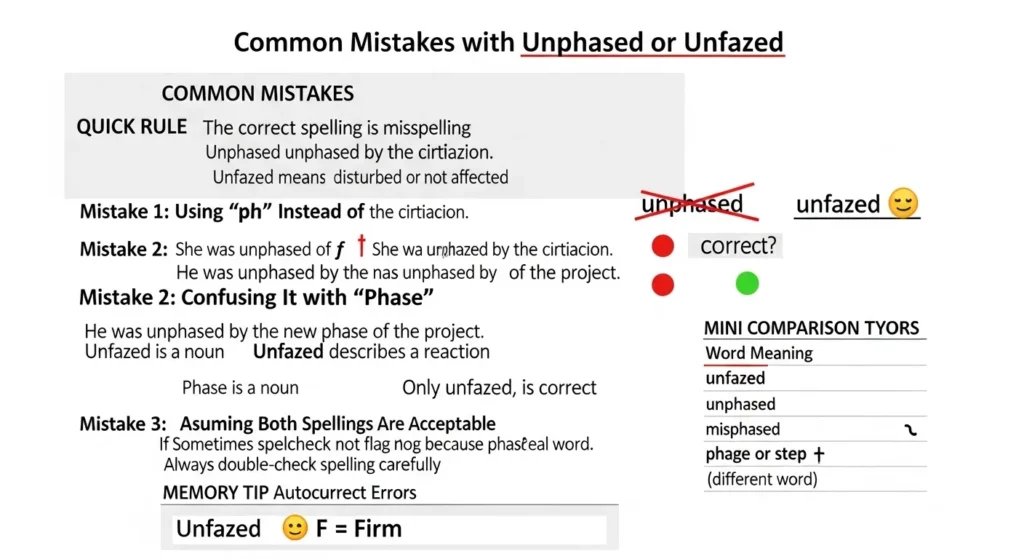
Here are frequent errors people make:
Mistake 1: Using “ph” instead of “f”
❌ She was unphased by the criticism.
✅ She was unfazed by the criticism.
Mistake 2: Confusing it with “phase”
❌ He was unphased by the new phase of the project.
✅ He was unfazed by the new phase of the project.
Mistake 3: Assuming both spellings are acceptable
❌ Both are correct spellings.
✅ Only “unfazed” is correct.
Mistake 4: Autocorrect errors
Sometimes spellcheck does not catch “unphased” because “phase” is a real word.
Always double-check.
Unphased or Unfazed in Everyday Examples
Here is how “unfazed” appears in real life:
In Emails
- “Despite the delay, our team remains unfazed and focused.”
In News Headlines
- “The player stayed unfazed under pressure.”
On Social Media
- “Haters can talk. I’m unfazed.”
In Formal Writing
- “The CEO appeared unfazed by market fluctuations.”
You will rarely see “unphased” in professional writing because it is incorrect.
Unphased or Unfazed : Google Trends & Usage Data
Search data shows that “unfazed” is far more common worldwide. Countries like the United States, United Kingdom, Canada, and Australia mainly use “unfazed.”
“Unphased” appears in search engines mostly because:
- People misspell it.
- They are unsure about the correct version.
- They confuse it with “phase.”
In professional publishing, dictionaries, and news websites, “unfazed” is the only accepted spelling.
Comparison Table: Side-by-Side View
| Word | Meaning | Correct Spelling | Example |
| Unfazed | Not disturbed | ✅ Yes | She stayed unfazed during the test. |
| Unphased | No real meaning | ❌ No | Incorrect usage |
FAQs About Unphased or Unfazed
1. Is “unphased” ever correct?
No. It is considered a spelling mistake.
2. Why do people write “unphased”?
Because it sounds similar to “phase,” which is a common word.
3. What does “unfazed” mean?
It means not bothered, not upset, or not affected.
4. Is “unfazed” American or British?
It is correct in both American and British English.
5. How can I remember the correct spelling?
Think of the word faze (to disturb). Add “un-” to make “unfazed.”
6. Is “faze” the same as “phase”?
No. “Faze” means disturb. “Phase” means stage or period.
7. Can I use “unfazed” in formal writing?
Yes. It is fully acceptable in academic, business, and formal writing.
Conclusion
The confusion between unphased and unfazed is very common, but the answer is simple. Only unfazed is correct. The mistake happens because “phase” is a familiar word, and many people assume the spelling follows that pattern. However, the correct word comes from “faze,” which means to disturb. When you add “un-,” it becomes “unfazed,” meaning not disturbed.
There is no difference between American and British English in this case. Both use “unfazed.” If you write “unphased,” it will look like a spelling error in professional settings. That can affect your credibility in emails, articles, and formal communication.
The best way to remember is this:
If you are not disturbed, you are unfazed.
Think of “faze” as “fear.” If something does not faze you, it does not scare or upset you.
From now on, you can confidently choose the right spelling every time.

I am Bryan A. Garner, an American writer and editor focused on English usage, grammar, and word choice.
I am best known for Garner’s Modern English Usage, a reference book widely used by writers, editors, and legal professionals.
My work centers on clarity, precision, and resolving confusing word comparisons in modern English.