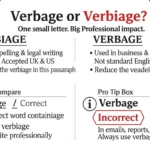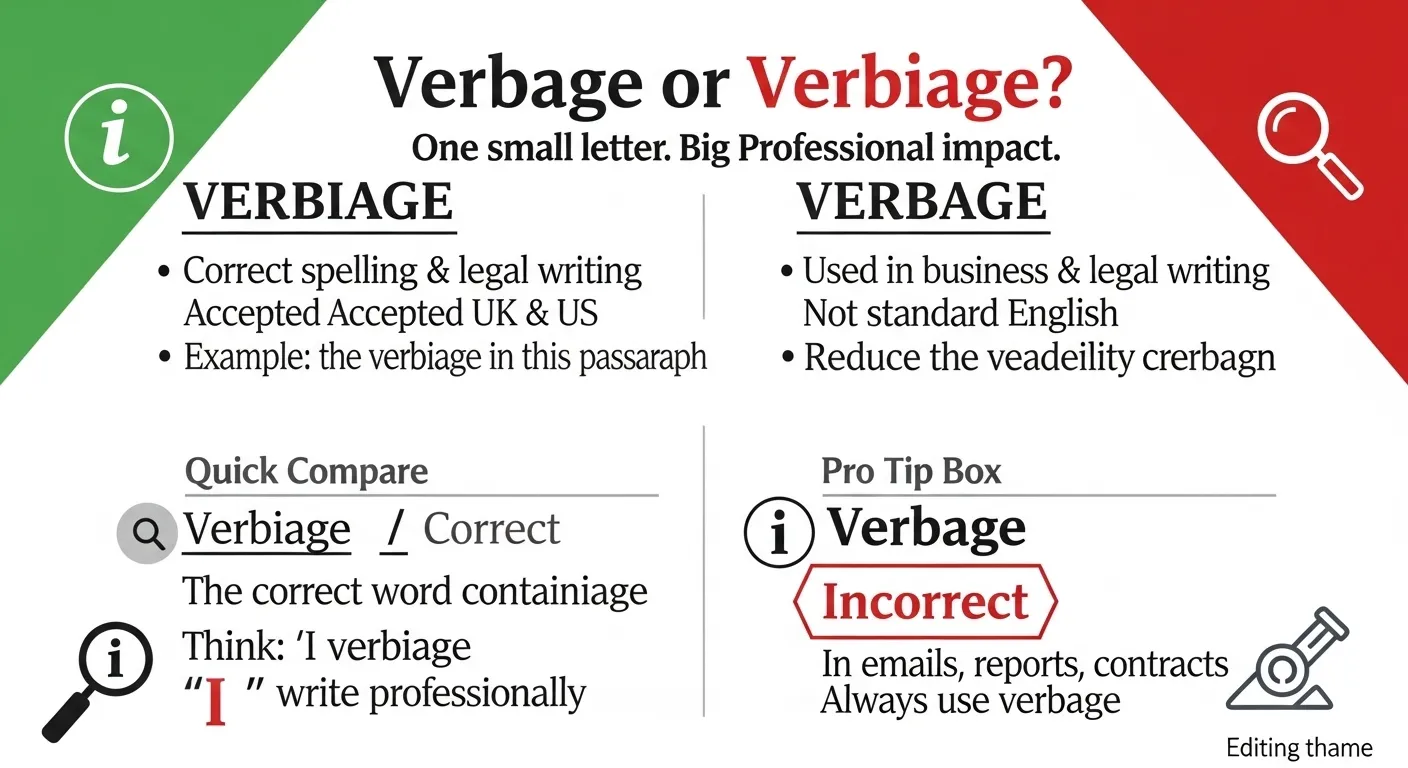
The short answer: verbiage is correct, while verbage is incorrect.
Verbage or verbiage confused me the first time I edited a business report. I read a sentence that said, “Please reduce the verbage in this paragraph.” It looked almost right, but something felt off. I checked a dictionary and realized the correct spelling was verbiage, not verbage.
Later, I saw many people searching verbage or verbiage because the words sound identical. This confusion is common in professional writing, academic essays, and office communication. A small spelling mistake like this can affect credibility.
This article explains clearly why verbiage is correct and why verbage should be avoided.
Verbage or Verbiage : Quick Answer
- verbiage → Correct spelling
- verbage → Incorrect spelling
Examples:
✅ The report contains too much verbiage.
❌ The report contains too much verbage.
Simple Rule:
👉 The correct word includes “iage” at the end.
The Origin of Verbage and Verbiage
The word verbiage comes from the French word verbier, meaning “to chatter.” It entered English in the early 18th century.
Originally, verbiage referred to excessive or unnecessary words. It had a slightly negative meaning. Over time, the meaning softened, and today it often simply refers to wording or phrasing, especially in business or legal contexts.
The spelling verbage likely developed because people pronounce verbiage as “ver-bij,” which makes it sound like it should end in “-age.” When typing quickly, writers drop the “i.”
The confusion exists because:
- The pronunciation hides the “i”
- Many English words end in “-age”
- Spell-check may not always catch informal writing
Knowing the origin helps you remember the correct spelling pattern.
British English vs American English Spelling
There is no difference between British and American English for this word. Both use verbiage as the correct spelling.
Comparison Table
| Spelling | Status | UK English | US English |
| verbiage | correct | ✅ Same | ✅ Same |
| verbage | incorrect | ❌ No | ❌ No |
This is purely a spelling accuracy issue, not a regional variation.
Which Spelling Should You Use?
Always use verbiage in formal and informal writing.
Common contexts where verbiage appears:
- Business reports
- Legal documents
- Academic essays
- Editing feedback
- Marketing materials
Example Sentences:
- The contract contains unnecessary verbiage.
- Please simplify the verbiage in this email.
Quick Tip:
If you see the word in professional writing, it will almost always be spelled verbiage.
Common Mistakes with Verbage or Verbiage
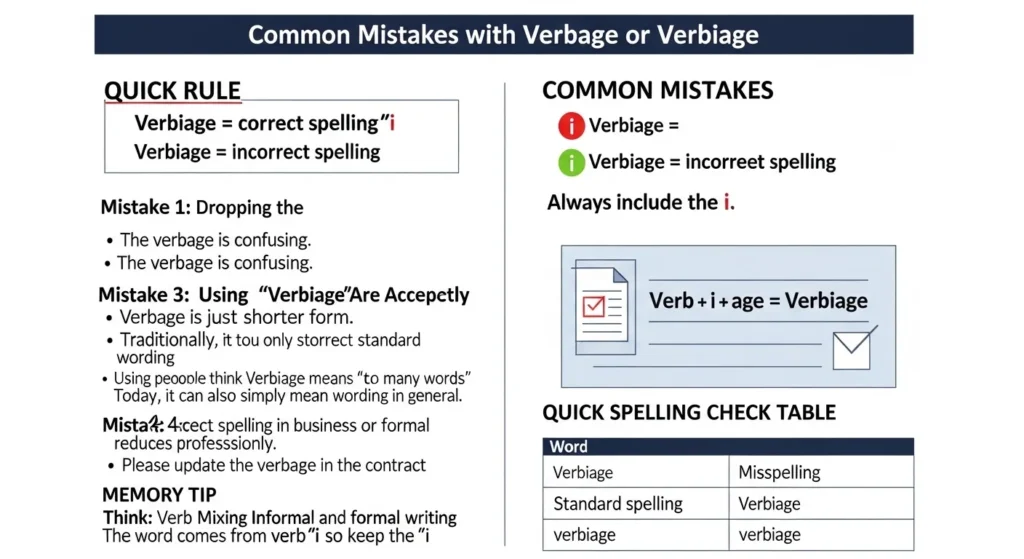
Dropping the “i”
❌ The verbage is confusing.
✅ The verbiage is confusing.
Assuming both spellings are acceptable
❌ Verbage is just a shorter form.
✅ Verbiage is the only correct spelling.
Using verbiage incorrectly
Some people think verbiage only means “too many words.” Today, it can also mean simple “wording.”
Mixing informal and formal tone
Using incorrect spelling in business writing reduces professionalism.
Verbiage or Verbage in Everyday Examples
Emails
- Please reduce the verbiage in this paragraph.
Business Reports
- The proposal contains excessive verbiage.
Legal Writing
- The contract’s verbiage must remain unchanged.
Social Media
- Sometimes less verbiage is better.
Correct spelling makes writing appear polished and credible.
Verbage or Verbiage : Google Trends & Usage Data
Search trends show that verbage or verbiage is frequently searched in:
- United States
- United Kingdom
- Canada
- Australia
- India
Why people search this keyword:
- Workplace editing
- Essay corrections
- Grammar improvement
- Spell-check confusion
Usage Insight:
- Verbiage dominates professional and academic writing
- Verbage appears mainly as a spelling error
Because the pronunciation sounds like “verb-age,” many writers accidentally remove the “i.” That is the main reason this mistake spreads online.
Verbiage : Meaning and Usage Explained
To understand this word better, it helps to break down its meaning in detail.
1. Original Meaning (Negative Tone)
Verbiage once meant excessive, unnecessary words. For example:
- The speech was full of meaningless verbiage.
2. Modern Neutral Meaning
Today, verbiage can simply mean wording or phrasing.
- The legal verbiage is difficult to understand.
3. Business Usage
In corporate settings, people often use it when editing documents.
- Let’s simplify the verbiage for clarity.
So while the spelling question is simple, the meaning has evolved over time.
Verbage vs Verbiage : Side-by-Side Comparison
| Word | Type | Meaning | Correct? | Example |
| verbiage | noun | wording or excessive words | ✅ Yes | Reduce the verbiage |
| verbage | none | not standard English | ❌ No | ❌ Incorrect spelling |
FAQs: Verbage or Verbiage
1. Is verbage ever correct?
No. It is always considered a misspelling.
2. Why do people spell it verbage?
Because it sounds like it ends in “-age.”
3. What does verbiage mean exactly?
It means wording, phrasing, or excessive words.
4. Is verbiage negative?
It can be negative, but it is often neutral today.
5. Is verbiage formal?
Yes, it is common in business and academic writing.
6. Does British English use a different spelling?
No. Both UK and US use verbiage.
7. Can I avoid using the word altogether?
Yes. You can say “wording” or “phrasing.”
8. Is verbiage common in legal writing?
Yes, especially when discussing document language.
Conclusion
The confusion between verbage or verbiage comes from pronunciation, not grammar rules. The correct spelling is verbiage, and the form verbage is always incorrect. Even though both sound identical, only one is recognized in standard English dictionaries.
I have learned that small spelling errors like this can weaken otherwise strong writing. Words such as verbiage often appear in professional, academic, and legal contexts, where accuracy matters most. Using the incorrect form can distract readers and reduce credibility.
Once you remember that verbiage contains the “i,” this mistake becomes easy to avoid. Clear, correct spelling reflects attention to detail and attention to detail builds trust in your writing.

I am Bryan A. Garner, an American writer and editor focused on English usage, grammar, and word choice.
I am best known for Garner’s Modern English Usage, a reference book widely used by writers, editors, and legal professionals.
My work centers on clarity, precision, and resolving confusing word comparisons in modern English.