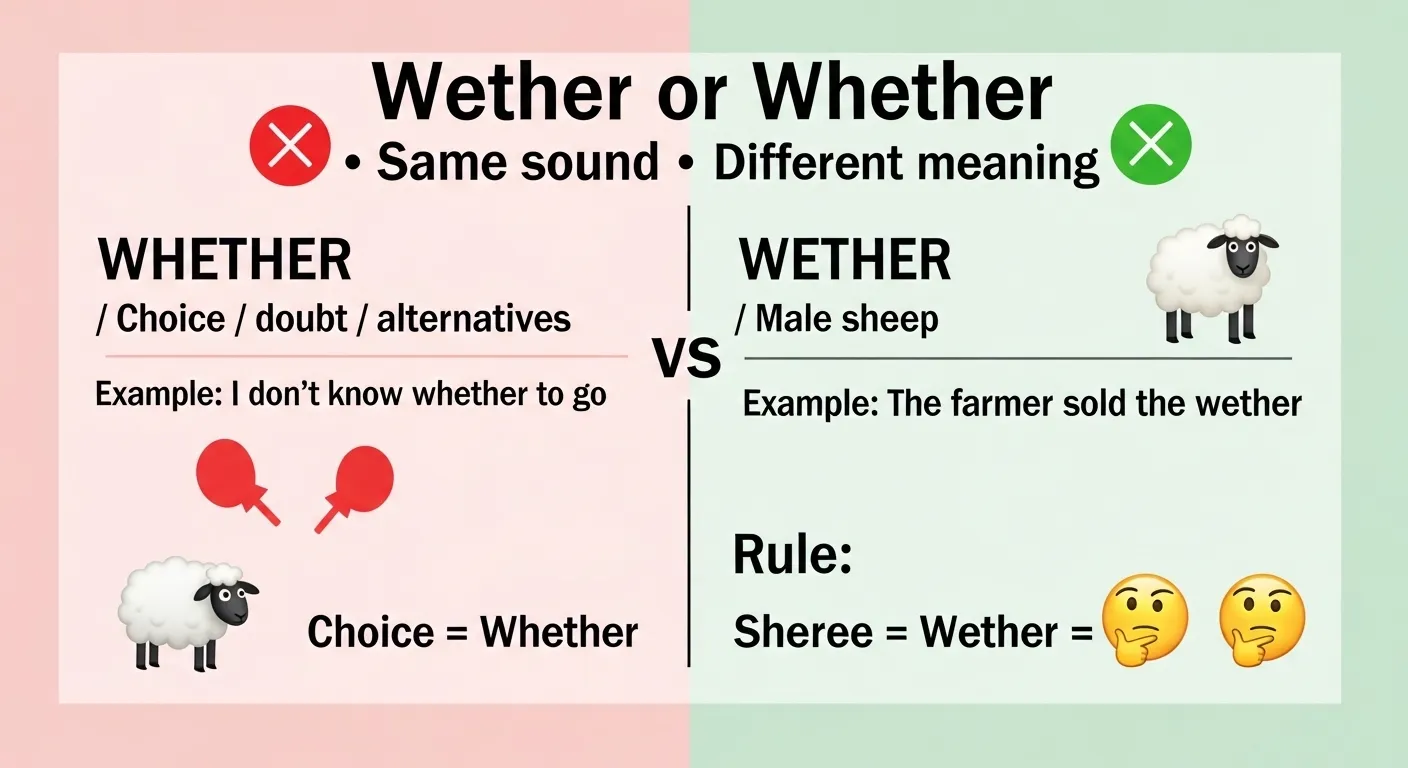
The short answer: whether is correct when making a choice or expressing doubt, while wether is a completely different word referring to a male sheep.
Wether or whether once stopped me mid-writing during a school article. I typed, “I don’t know wether to accept the challenge,” and then paused. Something looked off, but I wasn’t sure what. I searched online and found that thousands of people ask wether or whether every day.
This confusion happens because the words sound similar and are only one letter apart. Writers, students, and professionals worry that choosing the wrong word can change the meaning entirely.
This article clears that up completely, showing when to use whether and why wether is rarely used outside farming contexts.
Wether or Whether : Quick Answer
- Whether → Used to show choices, doubt, or alternatives
- Wether → A male sheep (rarely used in everyday English)
Examples:
✅ I don’t know whether I should go.
❌ I don’t know wether I should go.
✅ Farmers castrate the wether for meat production.
❌ Farmers castrate the whether for meat production.
Simple Rule:
👉 Choice/doubt = whether
👉 Sheep = wether
The Origin of Wether and Whether
Whether
The word whether comes from Old English hwæðer, meaning “which of two.” It is used to introduce alternatives or possibilities and has been part of English for over a thousand years.
Examples:
- She couldn’t decide whether to study law or medicine.
- Let me know whether you will attend the meeting.
Wether
Wether comes from Old English wether, referring to a castrated male sheep. It is mainly used in farming, agriculture, and older literature.
The confusion exists because:
- They sound almost identical
- Most people rarely encounter a wether
- Typing errors can replace whether with wether
Understanding their origin makes remembering the difference easier.
British English vs American English
There is no spelling difference between British and American English for whether or wether. Both regions use the same words with the same meanings.
Comparison Table
| Word | Meaning | UK English | US English |
| whether | choice or doubt | ✅ Same | ✅ Same |
| wether | male sheep | ✅ Same | ✅ Same |
This is a meaning-based difference, not a regional spelling issue.
Which Word Should You Use in Whether and Wether ?
Choose whether almost always.
Audience-Based Advice
- US audience → whether in writing, speech, and emails
- UK/Commonwealth audience → whether everywhere
- Global audience → whether for clarity
Use wether only when:
- Writing about sheep or farming
- Reading or quoting older texts that mention “wether”
Quick Tip:
If you are expressing a choice, doubt, or condition, you almost certainly need whether.
Common Mistakes with Wether or Whether
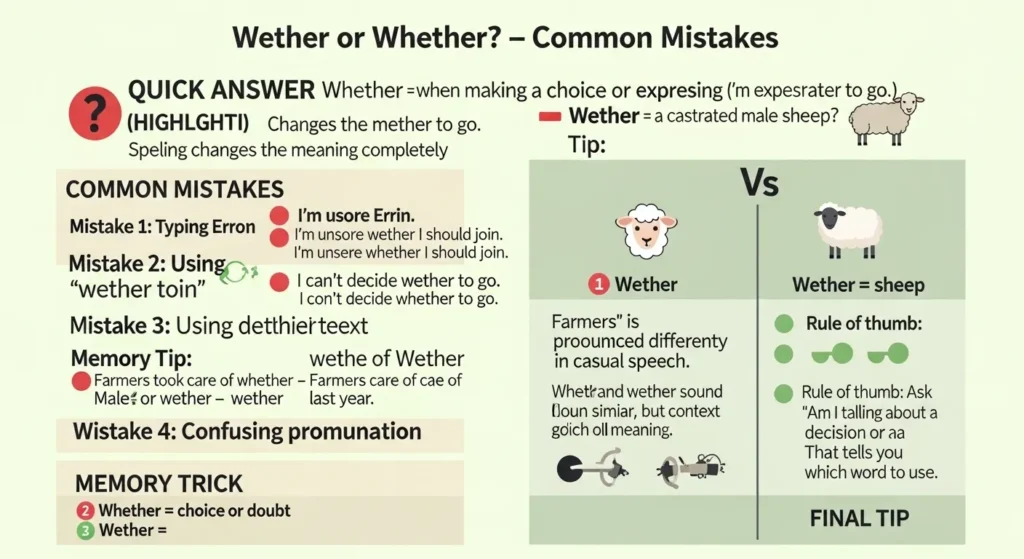
Mistake 1: Typing error
❌ I’m unsure wether I should join.
✅ I’m unsure whether I should join.
Mistake 2: Using wether incorrectly in writing
❌ I can’t decide wether to go.
✅ I can’t decide whether to go.
Mistake 3: Ignoring context
❌ Farmers took care of whether last year.
✅ Farmers took care of wether last year.
Mistake 4: Confusing pronunciation
❌ “Wether” is pronounced differently in casual speech.
✅ “Whether” and “wether” sound similar, but context changes meaning.
Whether or Wether in Everyday Examples
Emails
- Please let me know whether you will attend the meeting.
- I am unsure whether to approve the request.
News
- Experts debated whether climate change policies are effective.
- Farmers treated the wether herd carefully this year.
Social Media
- Can’t decide whether to buy this book or wait for a sale.
- A photo of a cute wether went viral today.
Formal Writing
- The committee will discuss whether the proposal is feasible.
- The farmer castrated the wether to control the flock.
Wether or Whether : Google Trends & Usage Data
Search trends show whether is far more commonly searched than wether globally.
Whether is popular in:
- United States
- United Kingdom
- Canada
- Australia
- India
Reasons:
- Used in professional writing and academic contexts
- Frequently searched by ESL learners
Wether is searched in:
- Farming and agriculture contexts
- Historical literature studies
- Veterinary content
Usage Insight:
- Whether dominates in modern writing and online searches
- Wether appears mostly in specialized or historical contexts
Wether vs Whether : Side-by-Side Comparison
| Word | Type | Meaning | Example |
| whether | conjunction | choice, doubt, alternatives | I’m not sure whether to join. |
| wether | noun | male sheep | The farmer sold the wether. |
FAQs: Wether or Whether
1. Can “wether” ever mean choice or doubt?
No. Only whether expresses choice or alternatives.
2. Is “whether” formal or informal?
It works in both formal and informal writing.
3. Why do people confuse these words?
Because they sound similar and typing errors are common.
4. Is wether used outside farming?
Almost never. It’s mainly in agriculture or older texts.
5. Can “whether” be used at the start of a sentence?
Yes. Example: Whether you agree or not, the rules apply.
6. Are there phrases that only work with “whether”?
Yes. Examples: “decide whether,” “uncertain whether,” “discuss whether.”
7. Is “wether” a spelling mistake in modern writing?
Yes, unless referring to a sheep.
8. Is there a pronunciation difference?
They sound nearly identical; context clarifies meaning.
Conclusion
The difference between wether or whether is simple but important. Whether is used to indicate a choice, doubt, or condition, If wether refers to a male sheep. Using the wrong word can confuse readers, especially in professional writing, emails, or social media.
I have learned that pausing for a second to check spelling saves embarrassment and ensures clarity. Whether is the word you will use 99% of the time, If wether is rare and specialized. Once you understand this small distinction, you will never struggle with this keyword again. Correct usage builds trust, clarity, and professionalism in all forms of communication.

I am Bryan A. Garner, an American writer and editor focused on English usage, grammar, and word choice.
I am best known for Garner’s Modern English Usage, a reference book widely used by writers, editors, and legal professionals.
My work centers on clarity, precision, and resolving confusing word comparisons in modern English.