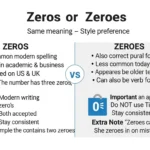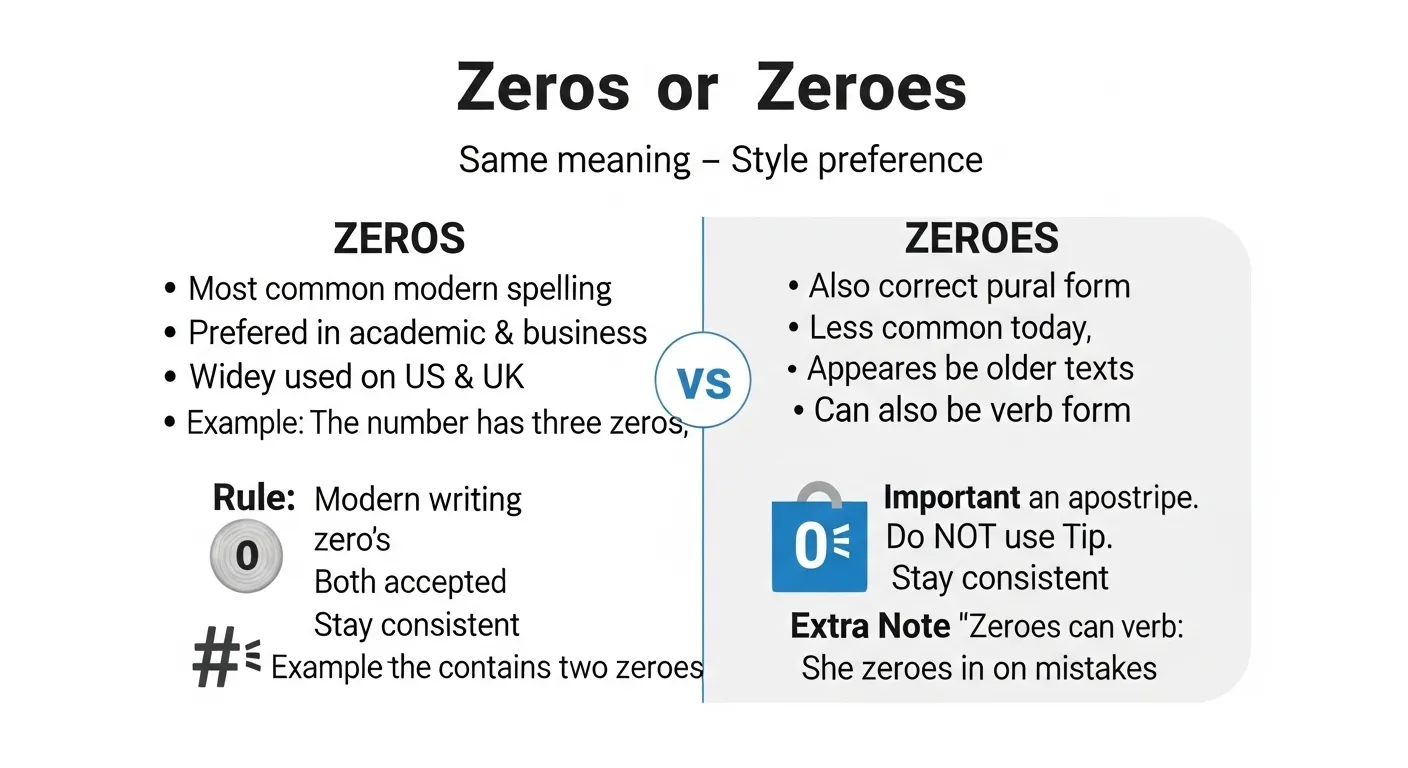
The sShort answer is : Zeros and zeroes are both correct plural forms of “zero.”
I remember typing “many zeroes” in a report and my spellchecker underlined it and changed it to “zeros,” but then I saw “zeroes” in a book. I paused. Was one wrong? Did they mean different things?
Many people search this because the word looks simple, yet the plural form creates doubt. The confusion usually comes from English spelling rules for words ending in -o.
In this guide, I will explain the difference, the spelling rules, and which form you should use.
Zeros or Zeroes : Quick Answer
Zero means the number 0. It can also mean nothing or no amount.
Zeros = a common plural form of zero
Zeroes = another correct plural form of zero
Both words mean “more than one zero.”
Examples:
- The number has three zeros at the end.
- The code contains two zeroes.
Both spellings are correct. The difference depends on style preference and region.
The Origin of Zeros and Zeroes
The word zero came into English from Italian zero, which came from Arabic ṣifr, meaning empty.
English often adds -s to make plurals:
- book → books
- car → cars
But words ending in -o can be tricky. Some add -es, and some add just -s.
For example:
- tomato → tomatoes
- hero → heroes
- piano → pianos
- photo → photos
Because of this mixed rule, both zeros and zeroes became accepted over time.
Today, zeros is more common in modern writing, but zeroes is still correct.
British English vs American English Spelling
Both American and British English accept zeros and zeroes. However, usage patterns differ slightly.
In modern American English, zeros is more common.
In British English, both forms appear, but zeros is also widely used.
Here is a simple comparison:
| Region | Preferred Form | Also Accepted |
| United States | zeros | zeroes |
| United Kingdom | zeros | zeroes |
| Academic Writing | zeros | sometimes zeroes |
| Informal Writing | zeros | zeroes |
Unlike words ending in -ize/-ise, this difference is not strongly regional. It is more about style choice.
Which Spelling Should You Use?
In most cases, you should use zeros.
Why?
- It is shorter.
- It is more common in modern writing.
- Many style guides prefer it.
However, zeroes is not wrong. It may appear in older texts or certain publications.
If you are writing:
- School assignments → Use zeros
- Business documents → Use zeros
- Creative writing → Either is fine, but stay consistent
The most important rule is consistency. Do not switch between forms in the same document.
Common Mistakes with Zeros or Zeroes
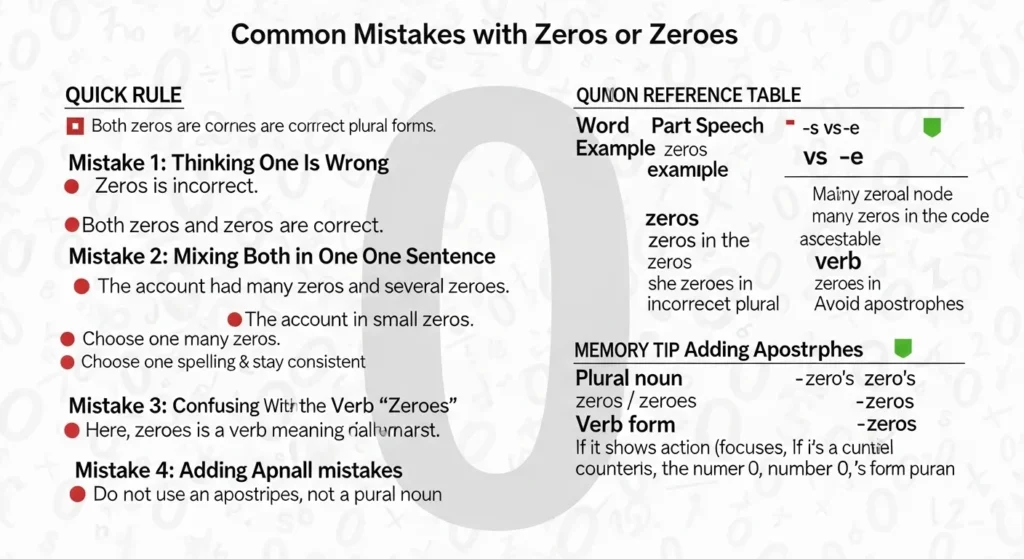
Here are common errors:
1. Thinking One Is Wrong
❌ Zeroes is incorrect.
✅ Both zeros and zeroes are correct.
2. Mixing Both in One Sentence
❌ The account had many zeros and several zeroes.
✅ The account had many zeros.
3. Confusing With the Verb “Zeroes”
Remember: zeroes can also be a verb.
Example:
- She zeroes in on small mistakes.
In this case, zeroes is not plural. It is a verb meaning “focuses.”
4. Adding Apostrophes
❌ zero’s
✅ zeros
Do not use an apostrophe to make a plural.
Zeroes or Zeros in Everyday Examples
In Emails
- Please remove the extra zeros from the invoice.
- The password has four zeros at the end.
In News Articles
- The lottery prize has many zeros.
- The company added two zeros to its revenue forecast.
On Social Media
- My bank balance has too many zeros… sadly on the wrong side!
- That price has too many zeros!
In Formal Writing
- The value contains six zeros.
- The binary sequence includes multiple zeros.
In most modern contexts, zeros appears more often.
Zeros or Zeroes : Google Trends & Usage Data
Search data shows that zeros is searched more frequently than zeroes.
Why?
- It follows the simple plural rule (add -s).
- Many schools teach it as the standard plural.
- It appears more often in math, finance, and technology content.
Zeroes still appears, especially:
- In older books
- In traditional publishing
- As a verb form (zeroes in)
In digital writing today, zeros clearly dominates.
Comparison Table: Zeros vs Zeroes
| Feature | Zeros | Zeroes |
| Meaning | Plural of zero | Plural of zero |
| Also a Verb? | No | Yes (third person verb form) |
| More Common Today? | Yes | Less common |
| Accepted in US? | Yes | Yes |
| Accepted in UK? | Yes | Yes |
| Formal Writing | Preferred | Acceptable |
Frequently Asked Questions (FAQs)
1. Is zeros correct?
Yes. It is the most common plural form of zero.
2. Is zeroes wrong?
No. It is also correct but less common.
3. Which spelling is more modern?
Zeros is more widely used in modern writing.
4. Why do some words ending in -o add -es?
English has mixed rules for -o endings. Some words add -es, others add only -s.
5. Can zeroes be a verb?
Yes. “She zeroes in on mistakes” uses zeroes as a verb.
6. Should I use zeros in academic writing?
Yes. It is usually preferred in academic and professional contexts.
7. Do British and American English differ here?
Not strongly. Both accept zeros and zeroes, but zeros is more common in both regions.
Conclusion
The difference between zeros and zeroes is small but important. Both are correct plural forms of zero. The meaning does not change. The only real difference is usage preference. In modern writing, zeros is more common and widely accepted.
It is shorter and simpler, so many writers choose it. Zeroes is still correct and appears in older texts or specific styles. It also serves as a verb form, which can create slight confusion.
If you want the safest choice, use zeros. It works in academic writing, business communication, math, and everyday writing. The key rule is consistency.
Choose one spelling and stick to it throughout your document. Once you understand this pattern, other -o ending words will become easier to manage too.

I am Lynne Truss, a British writer and journalist who is best known for my work on English grammar. I have always been interested in language and punctuation, especially how small mistakes can change meaning. Through my books, I try to make grammar easy, interesting, and enjoyable for readers.