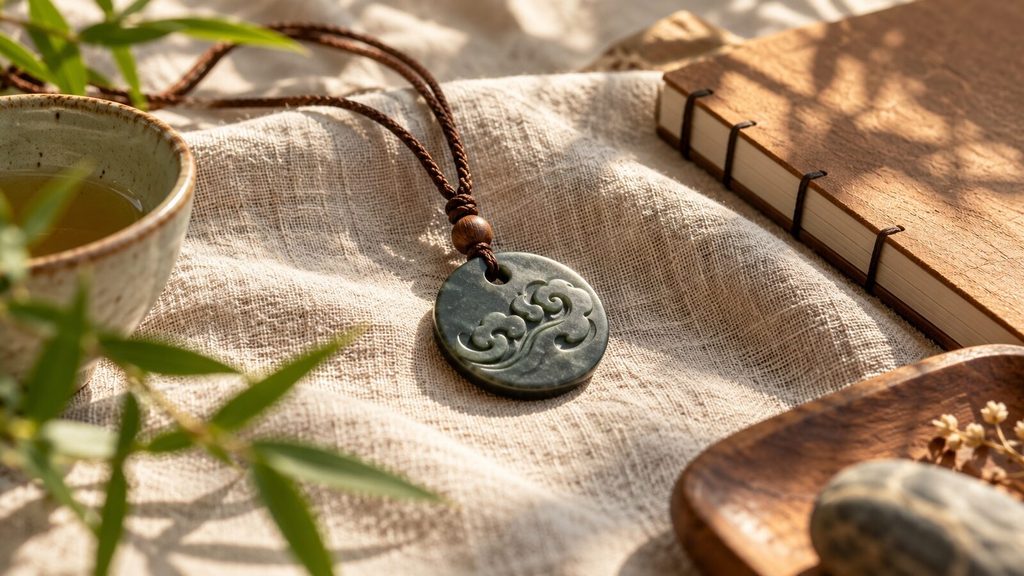
A symbolic pendant can be meaningful without becoming a promise. People wear one to remember a teaching, mark a personal transition, keep a family connection close, or simply choose an image that feels composed and familiar. The practical challenge is deciding how to let that meaning sit alongside clothes, work, movement, and ordinary care.
Begin with the question the pendant should answer
Before comparing shapes or materials, ask what you want the object to do in your life. A reminder worn during a busy commute has a different role from a ceremonial piece kept for special occasions. You may want a quiet visual cue, a connection to a tradition, or an object that starts a conversation. Naming that purpose prevents the purchase from being driven by a vague promise that the pendant will change circumstances for you.
Separate design, tradition, and personal meaning
A pendant has at least three layers. Its design includes proportion, surface, color, and the way it sits on the body. Its tradition includes the history and communities connected with the image. Its personal meaning is what you decide to remember when you wear it. These layers can support one another, but they are not identical.
Buddha imagery, for example, can be connected with teachings, compassion, attention, and different devotional or artistic traditions. Interpretations vary by culture, school, region, and individual. A respectful description uses qualified language such as “often associated with” instead of presenting one universal definition. It also avoids turning a sacred figure into a decorative slogan or claiming that a pendant guarantees protection, luck, wealth, health, or a particular emotional result.
Choose scale and placement for real movement
The most meaningful pendant is still an object you have to wear. Consider the neckline of the clothes you use most, the amount of movement in your day, and whether the pendant will sit over fabric or against skin. A small, restrained form may work with a shirt collar or knit layer, while a larger form needs enough space around it to remain legible rather than crowded.
Try to picture the pendant while walking, sitting at a desk, reaching for a bag, or putting on a coat. Placement should feel deliberate but not fragile. If the chain or cord tends to catch on clothing, a different length or a simpler shape may make the object easier to keep in rotation. The aim is not to follow a fixed styling rule; it is to choose a proportion that remains comfortable and visually clear across the settings you actually use.
Let the surrounding clothes provide context
A symbolic pendant does not need a costume-like outfit. It can sit with plain knitwear, a simple shirt, or a restrained layered look. Neutral clothing can let the form become a quiet focal point, while a patterned or richly textured outfit may call for a smaller pendant. Think about contrast and repetition: a warm metal tone may echo a belt or button, while a darker surface may create a calm break in a light outfit.
Context also includes where you are going. In a workplace, a modest scale and clear spacing may communicate respect more effectively than a highly elaborate display. At a cultural event or personal ceremony, you may choose something more visible because the setting gives the symbol room to be understood. Neither choice is automatically more authentic; the right one depends on intention and context.
Check care and information before you commit
Daily wear means contact with skin, fabric, moisture, and storage surfaces. Ask what the supplied care guidance says about cleaning, exposure, and keeping the pendant separate from harder objects. If the piece has a surface that matters to its appearance, a soft storage pouch and a simple routine can prevent avoidable marks. Care is part of the meaning: it treats the object as something to live with rather than a prop to display once.
It is also reasonable to ask what is known about the material, finish, chain, and construction. Clear answers are more useful than a dramatic origin story or a claim that the object guarantees a result. A brand earns confidence by explaining what it can verify and leaving personal interpretation in the hands of the wearer.
If you want to explore a brand that approaches symbolic jewelry through design, context, and everyday reflection, Buddha Auras offers a useful starting point. The point is to browse with questions in mind, not to accept a promise attached to a product category.
Keep the meaning open and honest
A symbolic pendant can hold a tradition, a memory, or a private intention without needing to prove anything. Choose an image you can describe responsibly, a proportion that works with your routine, and a care method you will actually follow. When design, context, and personal meaning agree, the pendant has a better chance of becoming part of ordinary life—and ordinary life is where personal objects earn their value.

